Lesson 02 — Rational and Irrational Numbers
Learners distinguish **rational numbers** — numbers that can be written as a fraction a/b — from **irrational numbers** — numbers whose decimal never terminates or repeats, like √2 and π. They sort a mixed set, apply the a/b test, and meet the idea that the number line is fuller than the fractions alone.
Objectives
Objectives
- D05.S1.08.01 Distinguish rational and irrational numbers and approximate square roots by locating them on the number line.
Essential question
How do I tell a rational number from an irrational one?
Key vocabulary
Materials
Standard materials
- Number-sort cards · 1 set per pair Cards showing numbers (1/2, 0.75, 0.333…, 3, −4, √2, π, √9, 2.5, 0.121212…) to sort into rational and irrational
- Decimal-deciding page · 1 per learner A page with the test — "does it terminate or repeat? can I write it as a/b?" — for deciding each number
Low-tech / no-cost
- Voice and a shared board Call out numbers and have learners hold up "rational" or "irrational" with hands; no cards needed
- Found objects A string and a square (a folded paper square) to see that a square's diagonal cannot be measured as a clean fraction of its side
Enriched / lab & device
- A calculator or number tool · 1 per group To compute decimal expansions of √2, π, and 22/7 and watch which terminate or repeat
- A number-line display · 1 per group A shared display where learners place rational and irrational numbers together on one line
Works in different contexts
- large-group Sort numbers together on the board, then have pairs sort cards and check each other's reasons
- multi-age Younger learners sort whole numbers and simple fractions; older learners decide the irrationals and justify with the a/b test
- self-directed A learner works the sort alone, applying the a/b test to each number and checking against the worked examples
- level-grouped Learners ready to extend prove that 0.121212… is rational by writing it as a fraction, and explain why √2 cannot be
- outdoor-only Fold a paper square and compare its side to its diagonal with a string to feel that the diagonal is not a clean fraction of the side
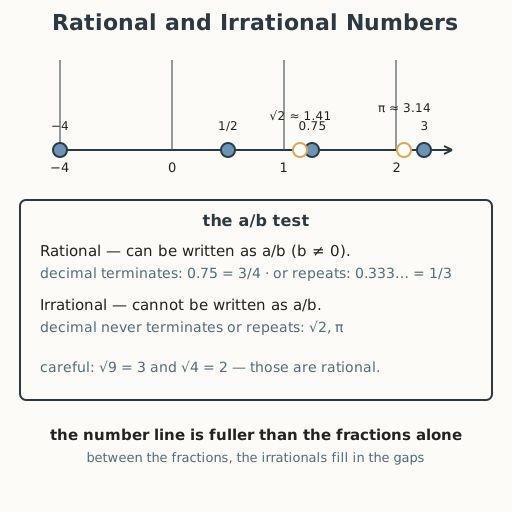
Lesson 2 — Rational and Irrational Numbers
Summary
Learners learn to distinguish rational from irrational numbers. A rational number can be written as a fraction a/b (b ≠ 0); its decimal either terminates or repeats. An irrational number cannot — its decimal goes on forever without repeating. Learners sort a mixed set and apply the a/b test.
Objectives
- Distinguish rational from irrational numbers and explain the test: rational numbers can be written as a/b and have terminating or repeating decimals, while irrational numbers cannot. (D05.S1.08.01)
Connection
Split three equal flatbreads among five people: each gets 3/5, and 3/5 = 0.6 — a clean, terminating decimal. Split one flatbread among three: each gets 1/3 = 0.333…, repeating forever but still a fraction. Now measure a square’s diagonal with its side as the ruler — the diagonal is about 1.414… times the side, and it never settles into a repeating pattern. That is the difference: some numbers are fractions, and some are not.
Materials
- Number-sort cards
- Decimal-deciding page
Preparation
- Copy the number-sort cards and decimal-deciding page.
- Have worked examples ready: 0.75 = 3/4 (terminating → rational); 0.333… = 1/3 (repeating → rational); √2 ≈ 1.41421… (neither → irrational); π ≈ 3.14159… (neither → irrational).
- Recall from Lesson 1: the four strands and the number strand’s Grade 8 extension.
Facilitator note
This lesson is written to the learner (“you”). The ideas to land: (1) a rational number can be written as a/b where a and b are integers and b ≠ 0; its decimal terminates or repeats; (2) an irrational number cannot be written as a/b; its decimal never terminates or repeats; (3) √2 and π are irrational. Because the a/b test is a foundational skill, use explicit instruction, worked examples, and guided practice before independent work (Kirschner, Sweller & Clark, 2006). Watch for the slips of calling every long decimal “irrational” (0.333… is rational — it repeats) and of thinking √9 is irrational (√9 = 3, rational). The critical-thinking lens: “irrational” is a mathematical fact about the number, not a slur — many learners first meet the word in everyday English, so name that clearly. The global lens: the realization that the diagonal is incommensurable with the side was made, as legend tells it, in the ancient Greek circle (Hippasus, 5th century BCE — S-353), but the number line is a shared human discovery, held side by side with other traditions (philosophy §11). The egalitarian lens: deciding “fraction or not” is a skill anyone can do with one clean test — mathematics as sense-making open to all.
Procedure
- Gather (5 min). Last time you mapped the year. Today you meet a question: is every number a fraction?
- Meet the test (10 min). A rational number can be written as a/b (a and b integers, b ≠ 0). Its decimal terminates (0.75) or repeats (0.333…). An irrational number cannot be written as a/b; its decimal never terminates or repeats.
- Worked examples (10 min). Decide together: 0.75 = 3/4 → rational. 0.333… = 1/3 → rational. √2 ≈ 1.41421356… → goes on, no repeating block → irrational. π ≈ 3.14159… → irrational. √9 = 3 → rational (be careful!).
- Sort the cards (15 min). With a partner, sort each number into rational or irrational, and say why using the a/b test. Trade with another pair and check each other’s reasons.
- Close (10 min). Share the hardest number to decide and how you settled it. Remember: the number line is fuller than the fractions alone — between the fractions, the irrationals fill in the gaps.
Differentiation
- Support: Use a smaller card set (clear terminating and repeating decimals first); say each decimal aloud and ask “does it stop, or does it repeat?” so learners with low vision can follow.
- Accessibility: Offer a raised-line or string number line with large, raised numerals so learners who are blind or have low vision can feel where each number sits; for learners with dyscalculia, provide the decimal expansions pre-printed and keep the focus on the terminates-or-repeats decision rather than on arithmetic.
- Extension: Write 0.121212… as a fraction to prove it is rational, and explain in words why √2 cannot be written as a/b.
Assessment
- Formative (observation/self): Can the learner sort numbers and justify each with the a/b test (terminates/repeats → rational; never → irrational)?
- Self-check: The learner asks, “Did I check whether the decimal terminates or repeats? Did I try to write it as a/b? Am I sure √9 and √4 are rational?”
Home connection
At home, find three numbers — a price, a measurement, a ratio — and decide whether each is rational or irrational, then explain your reasoning to someone.
Resources
- Rational and irrational numbers are standard in middle-grades mathematics; see John A. Van de
Walle, Elementary and Middle School Mathematics (10th ed., 2019) (S-026). The story that the
irrationality of √2 was noticed in the ancient Greek circle is a hedged legend (MacTutor,
Hippasus, S-353); that √2 and π are irrational is a proved mathematical fact. Treating all
mathematical traditions as worthy is a value (
docs/philosophy.md§4).