Lesson 03 — Approximating Square Roots on the Number Line
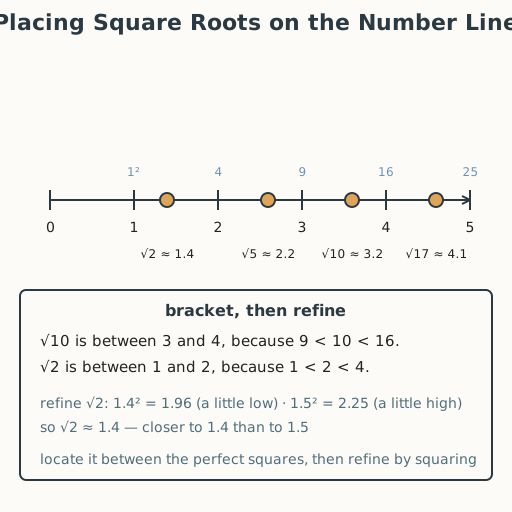
Learners approximate square roots by **locating them on the number line**. They bracket a square root between two consecutive integers using perfect squares (√10 is between 3 and 4 because 9 < 10 < 16), then refine the estimate to one decimal place by squaring nearby values.
Objectives
Objectives
- D05.S1.08.01 Distinguish rational and irrational numbers and approximate square roots by locating them on the number line.
Essential question
How do I locate a square root like √2 or √10 on the number line without a calculator?
Key vocabulary
Materials
Standard materials
- Number-line worksheet · 1 per learner A number line from 0 to 5 with perfect squares marked, for locating square roots between whole numbers
- Perfect-square cards · 1 set per pair Cards for 1, 4, 9, 16, 25, 36, 49, 64, 81, 100 and their square roots, to bracket a given square root
Low-tech / no-cost
- Voice and a shared board Bracket square roots aloud ("√10 is between 3 and 4 because 9 < 10 < 16") and mark them on a shared line; no cards needed
- A folding paper square Fold paper to feel that a square of area 2 has a side longer than 1 but shorter than 2
Enriched / lab & device
- A calculator · 1 per group To check decimal approximations (√2 ≈ 1.41, √10 ≈ 3.16) after learners bracket them by hand
- A number-line tool · 1 per group A digital number line where learners drag a marker to place a square root, where devices allow
Works in different contexts
- large-group Bracket several square roots together, then have pairs bracket and check each other before confirming with a calculator
- multi-age Younger learners place whole square roots (√4 = 2, √9 = 3); older learners bracket and refine √2 and √10 to one decimal
- self-directed A learner brackets each square root between consecutive integers, refines to one decimal, and checks with the worked examples
- level-grouped Learners ready to extend refine √2 by squaring 1.4 and 1.5, then 1.41 and 1.42, to see the decimal build up
- outdoor-only Draw a long number line in the dust and pace out the perfect squares, then stand where √2, √5, and √10 fall
Lesson 3 — Approximating Square Roots on the Number Line
Summary
Learners approximate square roots by locating them on the number line. Because √n sits between the two integers whose squares bracket n, a square root can be placed between whole numbers without a calculator, then refined to one decimal place by squaring nearby values.
Objectives
- Approximate square roots by locating them on the number line, using perfect squares to bracket a root between consecutive integers and refining the estimate. (D05.S1.08.01)
Connection
A square garden has an area of 2 square metres. How long is one side? Not 1 metre (1² = 1, too small) and not 2 metres (2² = 4, too big) — somewhere in between, about 1.41 metres. You can measure that length with a stick, but you cannot write it as a clean fraction. Today you learn to place such lengths — √2, √5, √10 — exactly where they belong on the number line, no calculator needed.
Materials
- Number-line worksheet
- Perfect-square cards
Preparation
- Copy the number-line worksheet and perfect-square cards.
- Have worked examples ready: √10 is between 3 and 4 (9 < 10 < 16); √2 is between 1 and 2 (1 < 2 < 4); refine √2: 1.4² = 1.96 and 1.5² = 2.25, so √2 ≈ 1.4 (closer to 1.4).
- Recall from Lesson 2: rational vs. irrational, and that √2 and √9 differ (√9 = 3 is rational).
Facilitator note
This lesson is written to the learner (“you”). The ideas to land: (1) every square root can be located on the number line by bracketing it with perfect squares — √n is between the two integers whose squares sit just below and just above n; (2) you can refine the estimate by squaring nearby decimal values (1.4² = 1.96, 1.5² = 2.25 → √2 ≈ 1.4); (3) locating a square root is the same approximation skill as reading a map or a scale. Because bracketing is a foundational skill, use explicit instruction, worked examples, and guided practice before independent work (Kirschner, Sweller & Clark, 2006). Watch for the slips of placing √10 between 4 and 5 (forgetting that 4² = 16 already exceeds 10) and of thinking √2 ≈ 2. The critical-thinking lens: approximation is honest — we say about, never a false exactness. The egalitarian lens: anyone with a list of perfect squares can locate a square root — no special tool is required. The global lens: estimating and bracketing quantities between known values is a sense-making habit found across measurement traditions, not one culture’s invention (philosophy §4). Retrieval: ask learners to recall the a/b test (Lesson 2) — √10 is irrational, yet we can still place it precisely on the line.
Procedure
- Gather (5 min). Last time you split numbers into rational and irrational. Today you learn to place an irrational number like √10 on the number line.
- Bracket with perfect squares (10 min). The perfect squares are 1, 4, 9, 16, 25, … For any n, √n sits between the two integers whose squares bracket n. Since 9 < 10 < 16, √10 is between 3 and 4. Since 1 < 2 < 4, √2 is between 1 and 2.
- Worked example — refine √2 (10 min). Square nearby decimals: 1.4² = 1.96 (a little low), 1.5² = 2.25 (a little high). So √2 ≈ 1.4, closer to 1.4 than to 1.5. Write it on the line.
- Practice with a partner (15 min). Take turns: one names a number (2, 5, 10, 17), the other brackets it with perfect squares, marks it on the line, and refines it to one decimal by squaring. Check each other’s work.
- Close (10 min). Share one placement and how you checked it. Remember: locate it between the perfect squares, then refine — the number line holds every number, rational or not.
Differentiation
- Support: Provide a completed perfect-square list and pre-drawn brackets; describe each step aloud for learners with low vision; use whole-number roots (√4, √9) first.
- Accessibility: Make the number line tactile (a raised or string line with beads for the perfect squares) and say each bracket aloud; for learners with dyscalculia, keep a perfect-square list visible and let a partner do the squaring so the focus stays on locating, not computing.
- Extension: Refine √2 to two decimals (1.41² = 1.9881, 1.42² = 2.0164) and explain the direction of each correction.
Assessment
- Formative (observation/performance): Can the learner bracket a square root between consecutive integers, place it on the number line, and refine it to one decimal place by squaring?
- Self-check: The learner asks, “Did I find the two perfect squares that bracket n? Is my estimate between them? Did I square nearby decimals to refine, and is my ‘about’ honest?”
Home connection
At home, find something with a square or a length you can measure, and estimate its square root on a number line — then check your bracket with someone.
Resources
- Approximating square roots by bracketing with perfect squares is standard in middle-grades
mathematics; see John A. Van de Walle, Elementary and Middle School Mathematics (10th ed., 2019)
(S-026). The claim that a square root is irrational (√2, √10) is a proved mathematical fact; that
mathematics is sense-making open to all is a value (
docs/philosophy.md§4).