Lesson 04 — Scientific Notation: Holding the Very Large and Very Small
Learners use **integer exponents** and **scientific notation** to represent very large and very small quantities. They write numbers as N × 10ᵏ (1 ≤ N < 10), convert between standard and scientific form, and order quantities by their exponent — from a cell's width to a galaxy's span.
Objectives
Objectives
- D05.S1.08.02 Use integer exponents and scientific notation to represent and compare very large and very small quantities, such as distances in space or the size of cells.
Essential question
How do I use integer exponents and scientific notation to represent and compare the very large and the very small?
Key vocabulary
Materials
Standard materials
- Powers-of-ten scale sheet · 1 per learner A vertical scale from 10⁻⁷ (a virus, about 100 nanometres) up to 10²¹ (a galaxy) with blank labels to fill
- Scientific-notation cards · 1 set per pair Cards pairing a quantity (distance to the Sun, a cell's width) with its scientific notation, to match and order
Low-tech / no-cost
- Voice and a shared board Write powers of ten as repeated multiplication and division together; order quantities aloud by their exponent; no cards needed
- Found objects A grain of rice (small) and a long stride (large) to feel how many powers of ten separate them
Enriched / lab & device
- A calculator · 1 per group To enter scientific notation and check conversions (1.5 × 10⁸, 2 × 10⁻⁵)
- An interactive powers-of-ten tool · 1 per group A zoomable scale of the universe, where devices allow, to feel the jump between powers of ten
Works in different contexts
- large-group Build the powers-of-ten scale together on the board, then have pairs match and order cards and check each other
- multi-age Younger learners count the zeros in powers of ten; older learners write full scientific notation and compare exponents
- self-directed A learner works the scale and cards alone, writing each quantity in scientific notation and ordering them by exponent
- level-grouped Learners ready to extend compute with scientific notation (multiply 1.5 × 10⁸ by 2 × 10¹) and explain the exponent arithmetic
- outdoor-only Measure a very short distance (a finger's width) and a very long one (a far landmark) and express both as powers of ten metres
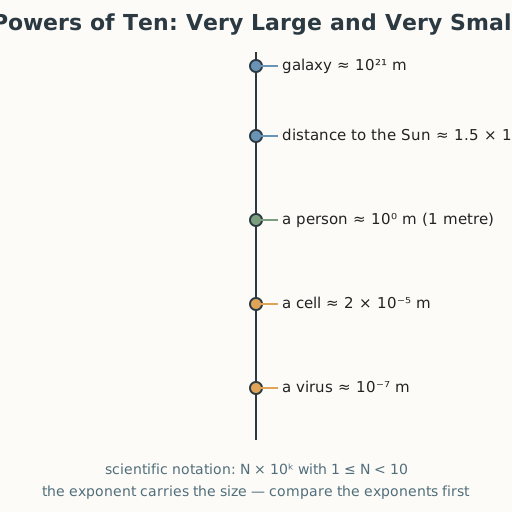
Lesson 4 — Scientific Notation: Holding the Very Large and Very Small
Summary
Learners use integer exponents and scientific notation to represent and compare quantities that would drown in zeros. They write numbers as N × 10ᵏ (where 1 ≤ N < 10), convert in both directions, and see how the exponent alone lets them order the very large and the very small.
Objectives
- Use integer exponents and scientific notation to represent very large and very small quantities, such as distances in space or the size of cells, and compare them. (D05.S1.08.02)
Connection
The distance from Earth to the Sun is about 150 000 000 kilometres — nine digits that are easy to miscount. A typical cell is about 0.00002 metres across — five places past the decimal, even easier to lose. Scientific notation tucks the size into one small exponent: 1.5 × 10⁸ km for the Sun, and 2 × 10⁻⁵ m for the cell. One short form holds both the unimaginably far and the invisibly small, so a navigator, a biologist, or a climate scientist can compare them at a glance.
Materials
- Powers-of-ten scale sheet
- Scientific-notation cards
Preparation
- Copy the scale sheet and cards.
- Have worked examples ready: 10³ = 1000 and 10⁻² = 1/100 = 0.01; 150 000 000 = 1.5 × 10⁸; and 0.00002 = 2 × 10⁻⁵.
- Recall from Lesson 3: locating numbers precisely; here we compress them instead.
Facilitator note
This lesson is written to the learner (“you”). The ideas to land: (1) a positive exponent counts how many times 10 multiplies (10³ = 1000); a negative exponent counts how many places past the decimal (10⁻² = 0.01); (2) scientific notation writes a number as N × 10ᵏ with 1 ≤ N < 10, so the exponent carries the size; (3) to compare, look at the exponent first — a larger exponent means a larger number. Because scientific notation is a foundational skill, use explicit instruction, worked examples, and guided practice before independent work (Kirschner, Sweller & Clark, 2006). Watch for the slips of writing 150 000 000 as 150 × 10⁶ (the coefficient must be between 1 and 10) and of treating a negative exponent as a negative number (10⁻⁵ is positive, just small). The environment lens: scientific notation is how we honestly hold Earth-scale numbers — a molecule, a cell, a forest, a planet’s carbon — without drowning in zeros. The technology lens: calculators and computers use scientific notation to store huge and tiny numbers; the notation is a tool. The egalitarian lens: anyone can compress a giant number with one clean rule — the power is in the method, not in any person. The global lens: writing very large and very small quantities is a shared human need, from astronomy in many cultures to modern microscopy (S-047, S-356).
Procedure
- Gather (5 min). You can already place √2 on the number line. Today you hold numbers so big or so small they would break the line — with exponents.
- Meet powers of ten (10 min). 10³ = 10 × 10 × 10 = 1000. A negative exponent means divide: 10⁻² = 1/10² = 0.01. The exponent counts places, not just zeros.
- Meet scientific notation (10 min). Write a number as N × 10ᵏ with 1 ≤ N < 10. 150 000 000 = 1.5 × 10⁸ (move the decimal 8 places). 0.00002 = 2 × 10⁻⁵ (move 5 places the other way).
- Match and order (15 min). With a partner, match each quantity card to its scientific notation, then order the whole set from smallest to largest using the exponents. Check each other’s order.
- Close (10 min). Share the most surprising size on your scale. Remember: the exponent holds the size — to compare, compare the exponents first.
Differentiation
- Support: Use only positive exponents at first, count the zeros aloud, and provide a filled powers-of-ten table; describe each step for learners with low vision.
- Accessibility: Build the powers-of-ten scale as a tactile ladder (string rungs or folded paper steps) and read each label aloud; for learners with dyscalculia, provide a printed place-value/zeros chart and keep the focus on the exponent, not on counting zeros.
- Extension: Compute with scientific notation (multiply 1.5 × 10⁸ by 2 × 10¹, add the exponents) and explain why the exponent does the work.
Assessment
- Formative (observation/performance): Can the learner write a large or small quantity in scientific notation (correct coefficient and exponent) and order several quantities by exponent?
- Self-check: The learner asks, “Is my coefficient between 1 and 10? Does my exponent match the number of places I moved the decimal? Did I compare exponents first, and is a negative exponent still a positive (just small) number?”
Home connection
At home, find one very large number (a distance, a price in some currency, a count of grains) and one very small one (a thickness, a drop), and write both in scientific notation — then compare their sizes with someone.
Resources
- Integer exponents and scientific notation are standard in middle-grades mathematics; see John A.
Van de Walle, Elementary and Middle School Mathematics (10th ed., 2019) (S-026). The Sun is
about 150 million km (≈1.5 × 10⁸ km) from Earth (NASA Space Place, S-047); a typical cell is on
the order of 10–30 micrometres across (Britannica, S-356). The claim that scientific notation
lets anyone hold and compare such sizes is a value, not a measurement (
docs/philosophy.md§4).