Lesson 05 — Functions: How One Quantity Depends on Another
Learners define a **function** as a rule that gives each input exactly one output, evaluate functions using **function notation f(x)**, and compare two functions. They move between a rule, a table, a graph, and a story, and see that the input is the independent variable and the output the dependent one.
Objectives
Objectives
- D05.S2.08.01 Define, evaluate, and compare functions and use function notation to describe how one quantity depends on another.
Essential question
How do I define, evaluate, and compare functions using function notation?
Key vocabulary
Materials
Standard materials
- Function machine sheet · 1 per learner A diagram of a machine taking an input x through a rule to an output f(x), with a table and blank slots
- Function cards · 1 set per pair Cards pairing a rule (f(x) = 2x + 1), a table, a graph, and a story, to match
Low-tech / no-cost
- Voice and body Act out a function — "clap twice for every one" — and chant the rule; no cards needed
- Found objects Use stones or counters to build the input-output pairs for a simple rule before writing it
Enriched / lab & device
- A graphing tool · 1 per group To type a rule and watch its table and graph appear together, where devices allow
- A function-match game · 1 per group Cards pairing equations, tables, graphs, and stories for repeated play
Works in different contexts
- large-group Model one function together, then have pairs match cards and report how they know the graph belongs to the rule
- multi-age Younger learners fill the table by counting; older learners write and evaluate f(x) and compare two functions
- self-directed A learner works the machine sheet alone, filling tables and evaluating f(x), checking against the worked examples
- level-grouped Learners ready to extend compare two functions (f(x) = 2x and g(x) = 2x + 1) and explain which grows faster and why the graphs differ
- outdoor-only Use a real relationship — steps and distance, or leaves per branch — build its table, and name the function aloud
Lesson 5 — Functions: How One Quantity Depends on Another
Summary
Learners define a function as a rule that assigns each input exactly one output, and learn to read and evaluate function notation f(x). They move between a rule, a table, a graph, and a story, and name the independent and dependent variables.
Objectives
- Define, evaluate, and compare functions, and use function notation to describe how one quantity depends on another. (D05.S2.08.01)
Connection
How far you travel depends on how long you move; what a basket of rice costs depends on how much you buy; how tall a seedling stands depends on the days of sun and water it has had. Each is a rule: put in one quantity, get out exactly one other. Mathematicians name that rule a function and write it compactly — “f of x” — so anyone can predict the output before it happens. A market price, a crop’s growth, a medicine’s dose: functions are how dependence becomes a language.
Materials
- Function machine sheet
- Function cards
Preparation
- Copy the function machine sheet and function cards.
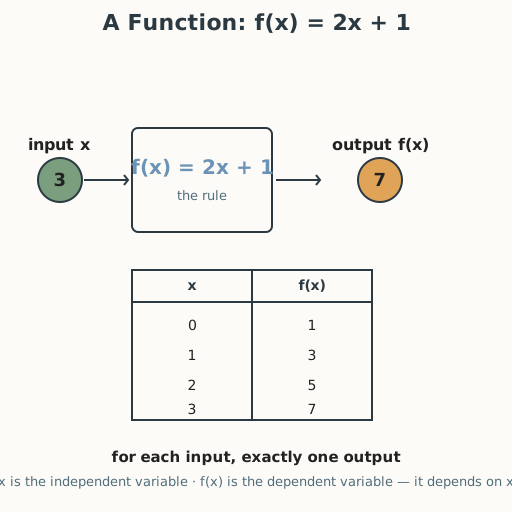
- Have worked examples ready: f(x) = 2x + 1; evaluate f(3) = 7; a table (0,1), (1,3), (2,5), (3,7); a story “a flat fee of 1 plus 2 per item.”
- Recall from Lesson 1 and Grade 7: y = kx is a special function (k times x).
Facilitator note
This lesson is written to the learner (“you”). The ideas to land: (1) a function is a rule that gives each input exactly one output; (2) function notation f(x) reads “f of x” and means the output when the input is x — f(3) = 7 says “input 3 → output 7”; (3) the input is the independent variable and the output the dependent variable, because the output depends on the input. Because reading and evaluating f(x) is a foundational skill, use explicit instruction, worked examples, and guided practice before independent work (Kirschner, Sweller & Clark, 2006). Watch for the slips of reading f(x) as “f times x” and of thinking a function can give two outputs for one input (it cannot, by definition). The technology lens: a graphing tool makes the rule-table-graph connection visible in one move — but the understanding is in the learner, not the tool. The egalitarian lens: a function is a compact, portable truth — once you can read f(x), you can check any claim that says “this depends on that,” whoever makes it (philosophy §4). The global lens: describing how one quantity depends on another appears across traditions (e.g., the proportional “per one” reasoning of the Rhind Papyrus, S-288) and grows into the modern universal form. Retrieval: y = kx (Grade 7) is the special function where the output is a constant multiple of the input.
Procedure
- Gather (5 min). Last time you held the very large and very small. Today you describe how one thing depends on another.
- Meet the function (10 min). A function is a rule that gives each input exactly one output. The input is the independent variable (x); the output is the dependent variable (f(x)) — it depends on x.
- Read the notation (10 min). f(x) = 2x + 1 reads “f of x equals 2x + 1.” Evaluate: f(3) = 2(3) + 1 = 7. Build the table: (0,1), (1,3), (2,5), (3,7).
- Match rule, table, graph, story (15 min). With a partner, match each function card’s rule to its table, graph, and story. Say why they belong together, then check with another pair.
- Close (10 min). Share one function you can now read and evaluate. Remember: a function says how one quantity depends on another — one input in, exactly one output out.
Differentiation
- Support: Use a single rule with whole-number inputs and a pre-built table; describe each step aloud for learners with low vision; read f(x) as “f of x” every time.
- Accessibility: Offer the function machine as a tactile model (counters in and out through a cup or box) and describe each step aloud; for learners with dyscalculia, pre-fill the table and use counters for the arithmetic so the focus stays on input → output.
- Extension: Compare f(x) = 2x and g(x) = 2x + 1 — which output is larger for each x, and how do their graphs differ (parallel lines)?
Assessment
- Formative (observation/self): Can the learner define a function, evaluate f(x) for given inputs, and match a rule to its table, graph, and story?
- Self-check: The learner asks, “Did I read f(x) as ‘f of x’? Does each input have exactly one output? Did I substitute the input correctly and name which variable depends on which?”
Home connection
At home, find a rule where one quantity depends on another (cost and amount, distance and time, water and plant growth), write it as a function f(x), and evaluate it for one real input.
Resources
- Functions and function notation are standard in middle-grades mathematics; see John A. Van de
Walle, Elementary and Middle School Mathematics (10th ed., 2019) (S-026). The note that “per
one” proportional reasoning appears in the Rhind Papyrus (Egypt, c. 1650 BCE) is documented history
(MacTutor, S-288); treating all traditions as worthy is a value (
docs/philosophy.md§4). On explicit instruction for novice skills: Kirschner, Sweller & Clark (2006), S-011.