Lesson 04 — Genes, DNA, and the Environment: Inheritance and Expression
Learners explain how organisms **inherit and express traits through genes (DNA)** and how the **environment interacts with genes**. They sort traits into "genes," "environment," and "both," and see that most traits are a product of both.
Objectives
Objectives
- D06.S2.08.01 Explain how organisms inherit and express traits through genes (DNA) and how the environment interacts with genes.
Essential question
How do organisms inherit and express traits through genes (DNA), and how does the environment interact with genes?
Key vocabulary
Materials
Standard materials
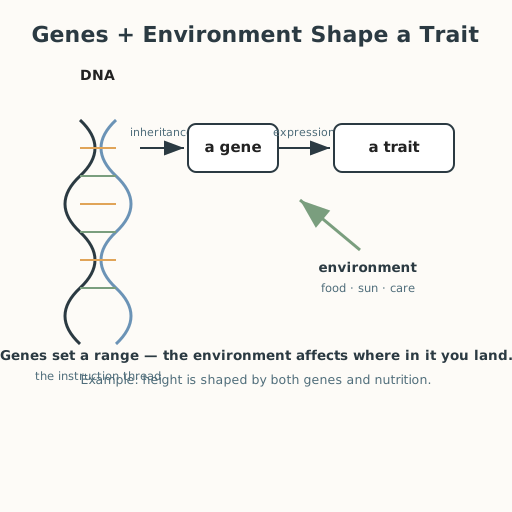
- Gene-and-environment sheet · 1 per learner A diagram of DNA → gene → trait, with a second arrow from the environment, to label and annotate
- Trait cards · 1 set per group Cards for several traits (height, skin tone, plant height, coat color in animals) to sort into genes-only, environment-only, and both
Low-tech / no-cost
- A shared board or large paper Draw the DNA → gene → trait → environment diagram together
- Voice and a partner Sort the traits aloud by discussion, with no cards needed
Enriched / lab & device
- A simple model of DNA (paper or pipe-cleaner double helix) · 1 per group A twistable model to see DNA as a long instruction thread made of a four-letter code
- Photos of identical twins raised in different settings · 1 set To discuss how the same genes can look different when environments differ
Works in different contexts
- large-group Model the DNA → gene → trait → environment chain once to the whole group, then small groups sort trait cards and report
- multi-age Younger learners match each trait to one picture; older learners explain the genes-plus-environment interaction in a sentence
- self-directed A learner labels the sheet, sorts the traits, and writes one example of genes and environment working together
- level-grouped Learners ready to extend explain why "nature or nurture" is a false choice for most traits, using one example
- outdoor-only Find two plants of the same kind in different sun or water, and discuss how the same genes look different in different settings
Lesson 4 — Genes, DNA, and the Environment: Inheritance and Expression
Summary
Learners explain how organisms inherit and express traits through genes (DNA) and how the environment interacts with genes. They sort traits into “genes,” “environment,” and “both,” and see that most traits are a product of both.
Objectives
- Explain how organisms inherit and express traits through genes (DNA) and how the environment interacts with genes. (D06.S2.08.01)
Connection
Why do you look a little like the people who raised you and a little like yourself, all at once? The answer lives in a molecule inside nearly every cell of your body: DNA. It is a long, twisted instruction thread that you inherited from your parents, and it helps shape your height, your hair, and the color of your eyes. But it is not a script you are forced to follow — the world you live in nudges how those instructions play out. Today you learn how genes and the environment work together to make you, you.
Materials
- Gene-and-environment sheet
- Trait cards
Preparation
- Copy the sheet and trait cards.
- Retrieval: from Grade 5, recall that traits pass from parents to offspring and vary within a family; from Grade 7, recall variation and natural selection.
Facilitator note
This lesson is written to the learner (“you”). The ideas to land: (1) DNA is a long molecule in nearly every cell, organized into units called genes; you inherit your DNA from your parents — half from each; (2) a gene carries instructions for a trait; “expression” means the instructions are carried out — and not every gene is expressed in every cell; (3) the environment interacts with genes, so most traits are the product of both. Use the trait sort as a worked example first (height: genes set a range, nutrition and health affect where a person lands in it — S-177). The egalitarian lens is central and non-negotiable: genetic determinism is false. Genes shape, they do not decree; no trait makes one person “better” than another, and skin tone is a continuous trait shaped by many genes and by sun exposure — the idea that it sorts people into fixed “races” is a social story, not a genetic one (S-177). The ethics lens: because environment matters, a fair world is one where every child gets the nutrition, safety, and care that let their genes do their best. The global lens: the same DNA molecule and the same rules of inheritance operate in every living thing on Earth, from a rice plant in Asia to a whale in the ocean. The critical-thinking lens: “nature versus nurture” is a false choice — for most traits, it is nature and nurture. Keep claims precise and cite the heredity source (S-177); hold origins open — this is evidence, not creed (philosophy §11).
Procedure
- Recall (5 min). From Grade 5 and 7: how do traits pass from parents to offspring? Today we look inside the mechanism.
- Meet DNA and genes (10 min). DNA is a long, twisted instruction thread inside nearly every cell. Genes are the sections of DNA that carry instructions for a trait — like height or eye color. You inherit your DNA from your parents, half from each.
- Meet expression (8 min). A gene is expressed when its instructions are carried out. Not every gene is expressed in every cell — that is why a liver cell and a skin cell, with the same DNA, do different jobs.
- Meet the environment (12 min). Most traits are shaped by both genes and the environment. Worked example: height — your genes set a possible range, and nutrition, health, and care affect where in that range you grow. Sort the trait cards into three piles: mostly genes, mostly environment, or both.
- Say it together (10 min). Write one sentence for one trait using this frame: “My ___ is shaped by both my genes (which give a range) and my environment (which affects where in that range I land).”
- Close (5 min). Genes shape; they do not decree. You are a meeting of inheritance and the world you live in — and both deserve to be honored.
Differentiation
- Support: Provide the trait sort pre-sorted and ask learners to explain one “both” example in their own words.
- Extension: Explain why “nature or nurture” is a false choice for most traits, using height or skin tone as your example.
Assessment
- Formative (observation): Can the learner explain inheritance through DNA, expression of a gene, and one gene-plus-environment example?
- Portfolio artifact: The labeled gene-and-environment sheet, kept in the portfolio.
Home connection
Notice a trait in your own family — height, hair, a skill — and ask: which part seems inherited, which part seems shaped by how people live? Talk it through.
Resources
- On heredity, genes, and the heredity–environment relationship: Encyclopaedia Britannica, “Heredity,” https://www.britannica.com/science/heredity-genetics (S-177).
- On explicit instruction and worked examples: Kirschner, Sweller & Clark (2006), https://doi.org/10.1207/s15326985ep4102_1 (S-011).