Lesson 05 — One Population Ripples Through an Ecosystem
Learners analyze how a change in **one population ripples through an ecosystem** and can **reduce or restore balance**, using the return of wolves to Yellowstone and the sea-otter–urchin–kelp chain. They trace cause-and-effect through a food web.
Objectives
Objectives
- D06.S2.08.02 Analyze how changes in one population ripple through an ecosystem and can reduce or restore balance.
Essential question
How do changes in one population ripple through an ecosystem, and how can they reduce or restore balance?
Key vocabulary
Materials
Standard materials
- Ripple-chain sheet · 1 per learner A chain diagram — top predator, prey, plants, habitat — with arrows to trace a change through the web
- Ripple cards · 1 set per group Cards for two ecosystems (Yellowstone wolves; sea otters and kelp) to arrange into cause-and-effect chains
Low-tech / no-cost
- A shared board or large paper Draw the ripple chains together with arrows, one species at a time
- Voice and bodies Act out the chain — learners each play a species and pass the change along the web
Enriched / lab & device
- A short video of a real ecosystem · 1 An age-appropriate clip of wolves or sea otters in their habitat to watch and then trace
- A food-web poster · 1 per group A printed web to mark where the change enters and follow the arrows outward
Works in different contexts
- large-group Build the ripple chain once as a whole class, then groups each trace one link and report how it connects
- multi-age Younger learners match a species to its food; older learners trace the full ripple and say whether balance was reduced or restored
- self-directed A learner arranges the ripple cards into a chain, writes one "because" for each arrow, and self-checks the chain is complete
- level-grouped Learners ready to extend predict what happens when a *different* population changes, and test their prediction against the card set
- outdoor-only In a real green space, find a plant, an eater of plants, and an eater of eaters, and trace what a change to one would do
Lesson 5 — One Population Ripples Through an Ecosystem
Summary
Learners analyze how a change in one population ripples through an ecosystem and can reduce or restore balance, using the return of wolves to Yellowstone and the sea-otter–urchin–kelp chain. They trace cause and effect through a food web.
Objectives
- Analyze how changes in one population ripple through an ecosystem and can reduce or restore balance. (D06.S2.08.02)
Connection
Nothing in a living place stands alone. If the fish in a lake suddenly become few, the birds that eat them go hungry; if a forest’s big trees are cut, the animals that lived in their shade move on. Living things are linked like a web — pull one thread, and the pull travels outward. Today you trace that ripple, and see how it can make a place poorer or richer, out of balance or back into it.
Materials
- Ripple-chain sheet
- Ripple cards
Preparation
- Copy the ripple sheet and cards.
- Retrieval: from Grade 5 and 7, recall food webs, and that matter and energy move through them; from Grade 7, recall predator and prey relationships.
Facilitator note
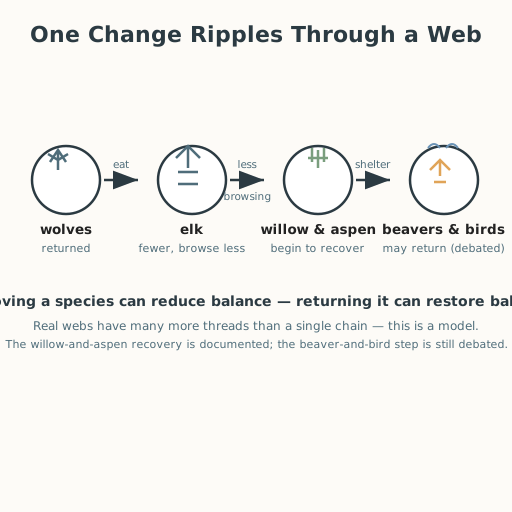
This lesson is written to the learner (“you”). The idea to land: ecosystems are webs, so a change in one population ripples outward — and that ripple can reduce balance (a species removed, its prey multiply, the plants suffer) or restore it (a species returned, the web reweaves). Worked example: Yellowstone wolves — wolves were removed by the early 1900s; elk grew numerous and browsed heavily; when wolves were reintroduced in 1995–1996, elk numbers and browsing fell, and some willow and aspen recovery followed (S-310). Be accurate and hedged: the real ecosystem response is complex and still debated — do not teach the oversimplified “wolves changed the rivers” story; state the documented elk-browsing reduction and partial plant recovery instead (S-310). Second example: sea otters, sea urchins, kelp — where otters were hunted away, urchins multiplied and ate the kelp forests; where otters returned, kelp recovered (S-176). The environment lens: the health of the whole place depends on its parts. The ethics lens: when people remove a species — for fur, for fear, for profit — the harm spreads; when people choose to restore it, the web can heal, and that healing is often slow and imperfect. The egalitarian lens: who benefits and who is harmed when an ecosystem changes is not distributed equally — fishing communities, herders, and farmers feel the ripple first. The global lens: this is the same process in a kelp forest off the Pacific coast, a savanna in Africa, or a reef in the tropics — for example, when rinderpest was driven out of the Serengeti in the mid-1900s, wildebeest numbers recovered and reshaped the savanna’s grass and fire. The critical-thinking lens: cause-and-effect in a web is rarely a single clean line — the lesson’s “because” chains are a model, and real webs have many threads (S-310).
Procedure
- Recall (5 min). From Grade 5 and 7: what is a food web, and what happens when one part changes? Today we trace the ripple precisely.
- Meet the ripple (10 min). A change in one population — a group of one kind of living thing — ripples through the ecosystem. Trace the worked example: wolves → elk → willow and aspen. When wolves returned, elk browsing fell, and some plants recovered. The steps that follow in the full story — beavers and birds — are real but more debated, so we hold them lightly (S-310).
- Read the cards (15 min). With a group, arrange the Yellowstone cards into a cause-and-effect chain, writing one “because” for each arrow. Then do the same for the sea-otter chain: otters → urchins → kelp → fish and shelter.
- Reduce or restore? (10 min). For each chain, ask: did the change reduce balance or restore it? Removing wolves reduced it; reintroducing them began to restore it. Removing otters reduced it; their return restored the kelp.
- Be honest about the model (5 min). Real webs are messier than a single chain. The chain is a model — useful and partly true, but the real ecosystem has many more threads (S-310).
- Close (5 min). Share one ripple you can now trace. A living place is a web, and every thread matters.
Differentiation
- Support: Provide the chains pre-ordered and ask learners to write the “because” for each arrow.
- Extension: Predict what happens if a different population changes in one of the two ecosystems, and trace your predicted ripple, naming the limits of your prediction.
Assessment
- Formative (observation): Can the learner trace a ripple through a food web and say whether it reduced or restored balance?
- Portfolio artifact: The completed ripple-chain sheet, kept in the portfolio.
Home connection
Think of a change near home — a pond cleaned, a field planted, a species that disappeared or returned — and trace what else might have changed because of it.
Resources
- On the Yellowstone wolf cascade, accurately hedged: Ripple & Beschta (2012), Biological Conservation (S-310).
- On keystone species and the sea-otter–urchin–kelp chain: National Geographic Education, “Role of Keystone Species in an Ecosystem,” https://education.nationalgeographic.org/resource/role-keystone-species-ecosystem/ (S-176).
- On explicit instruction and worked examples: Kirschner, Sweller & Clark (2006), https://doi.org/10.1207/s15326985ep4102_1 (S-011).