Lesson 02 — A Series on One Theme: The Idea That Changes
Learners choose one theme and make a **series** of three or four artworks exploring it, deliberately letting the work change across the series, then reflect in writing on what changed and why. They meet the example of artists who work in series — Jacob Lawrence's _Migration Series_ and Hokusai's _Thirty-six Views of Mount Fuji_.
Objectives
Objectives
- D07.S1.08.01 Create a series of artworks exploring one theme or idea, reflecting on how the work changes across the series.
Essential question
How do I create a series of artworks exploring one theme, and reflect on how the work changes across the series?
Key vocabulary
Materials
Standard materials
- Theme brainstorm sheet · 1 per learner A page to list three possible themes and circle the one to explore
- Series planner · 1 per learner A grid of three or four frames to plan each work in the series and note what will change
Low-tech / no-cost
- Scrap paper or a found surface Draw each work on paper, cloth, or bark; no special art supplies needed
- Found or natural media Charcoal from a fire, plant stains, mud, chalk, or torn paper as the medium
- A tactile series Build the series from materials a hand can read — clay, string, sand, torn or folded paper, leaf or bark rubbings — so the change across works can be felt, not only seen
Enriched / lab & device
- A set of drawing or painting media · 1 set per learner Pencils, pens, pastels, paint, or a simple digital drawing app to vary the medium across the series
- A camera or phone · 1 per group Photograph each work to compare them side by side digitally
Works in different contexts
- large-group Brainstorm themes together on the board, then each learner works their series independently and shares one work in a gallery walk
- multi-age Younger learners make a series of two or three; older learners make four and write the reflection in full
- self-directed A learner chooses a theme, plans three or four works, makes them over several sittings, and writes the reflection alone
- level-grouped Learners ready to extend deliberately change one element (line, color, scale) across the series and explain why
- outdoor-only Choose a theme from the outdoors — the same tree, sky, or water at different times or in different weather
Lesson 2 — A Series on One Theme: The Idea That Changes
Summary
Learners choose one theme and make a series of three or four artworks exploring it, deliberately letting the work change across the series, then reflect in writing on what changed and why. They meet the example of artists who work in series — Jacob Lawrence’s Migration Series and Hokusai’s Thirty-six Views of Mount Fuji.
Objectives
- Create a series of artworks exploring one theme or idea. (D07.S1.08.01)
- Reflect on how the work changes across the series. (D07.S1.08.01)
Connection
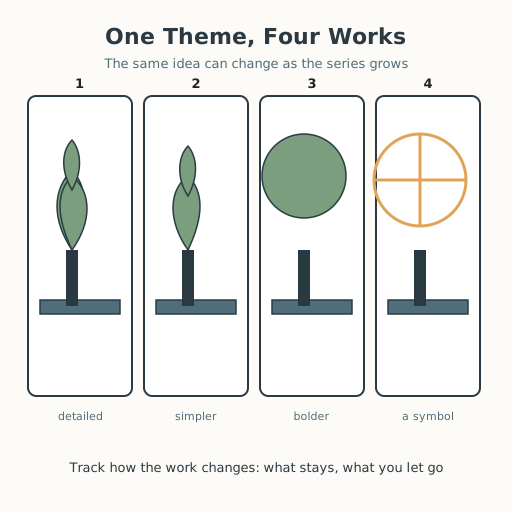
Have you ever drawn the same thing twice and noticed the second one came out differently — bolder, simpler, or more sure? That is not a mistake; that is a series trying to happen. An artist who returns to one theme — the same mountain, the same face, the same feeling — is not repeating; they are digging deeper. Each new work changes the idea a little, and the change is the meaning. Today you do this on purpose.
Materials
- Theme brainstorm sheet
- Series planner
Preparation
- Copy the theme brainstorm sheet and series planner.
- Retrieval: from Grade 7, recall creating an artwork that communicates a message and revising it after feedback — today we stretch that one work into a series.
- Optional: print or project the unit map graphic as a reminder of where this lesson sits.
Facilitator note
This lesson is written to the learner (“you”). The skill to land: a series is several works on one theme in which the change is the point — the learner plans three or four works, makes them, and then reflects in writing on what changed (line? color? scale? feeling?) and why. This is a making skill, so model the pattern first, then let learners work independently (explicit instruction carries novice skills — S-011): show a quick three-frame example of one simple subject (a tree, a cup, a face) getting bolder across three tries, then invite learners to choose their own theme. The global lens: series are a worldwide practice — Jacob Lawrence’s 60-panel Migration Series (1940–41) told the story of the Great Migration of African Americans from the rural South to the urban North (S-363), and the Japanese printmaker Katsushika Hokusai made Thirty-six Views of Mount Fuji (c. 1830–32), a series on one mountain seen many ways (S-364). Name these as examples to honor with questions, not specimens. The egalitarian lens: a series needs only paper and a mark-making tool; no expensive supplies are required. The intellectual lens: reflection — noticing what changed and why — is where the learning lives. The ethics lens: there is no single “right” way for the series to change; each learner’s change is their own, and all are valid. Keep assessment mastery-based: a series that is not finished is “not yet,” never a failure.
Procedure
- Recall (5 min). From Grade 7: what did you make to carry a message, and how did you change it after feedback? Today we stretch one work into a series.
- Meet the idea (8 min). A theme is one big idea; a series is several works on that theme in which the work changes. Look at two examples: Jacob Lawrence painted 60 panels about one story — migration (S-363); Hokusai made 36 views of one mountain (S-364). What changed across each artist’s series?
- Choose a theme (7 min). On the brainstorm sheet, list three themes that matter to you — a place, a feeling, a person, a season, a question. Circle the one you want to explore.
- Plan the series (10 min). On the series planner, sketch a plan for three or four works. Decide one thing you will change across the series: line, color, scale, viewpoint, or feeling.
- Make the series (20 min). Make each work in turn. Let the change happen; don’t force it to stay the same. If a work surprises you, follow it.
- Reflect (5 min). Write two or three sentences: what changed across your series, and why do you think it changed? Which work do you understand best now?
- Close (5 min). Share one work with a partner and say what changed. The change is the meaning.
Differentiation
- Support: Make a series of two works and use a sentence starter (“From the first to the second, my ___ got ___ because…”).
- Extension: Deliberately change one element (line, shape, color) across all four works and write why each choice carries the theme further.
- Access (non-visual): Make the series as textures and shapes instead of images — clay, string, or folded paper — so each change can be felt by hand as well as seen; reflect on how the feel changed, not only the look.
Assessment
- Formative (observation): Does the learner make three or four works on one theme and name what changed?
- Portfolio artifact: The completed series (or photographs of it) plus the written reflection, kept in the portfolio.
Home connection
At home, find one subject you see every day — a door, a plant, a window — and sketch it twice, a day apart. Notice what changed between the two. Bring your two sketches to the next lesson.
Resources
- Jacob Lawrence, The Migration Series (1940–41): The Phillips Collection, https://www.phillipscollection.org/collection/migration-series (S-363).
- Katsushika Hokusai, Thirty-six Views of Mount Fuji (c. 1830–32): The Metropolitan Museum of Art, https://www.metmuseum.org/art/collection/search/36490 (S-364).
- On explicit instruction and worked examples: Kirschner, Sweller & Clark (2006), https://doi.org/10.1207/s15326985ep4102_1 (S-011).