Lesson 03 — Critiquing an Artwork: Evidence, Not Mere Taste
Learners learn to critique an artwork with **evidence**, not mere taste, by working a four-step frame — **describe, analyze, interpret, evaluate** — that separates **observation** (what is there) from **judgment** (what it means and whether it works). They practice on artworks from different cultures.
Objectives
Objectives
- D07.S1.08.02 Critique an artwork using evidence about its elements, context, and purpose, distinguishing observation from judgment.
Essential question
How do I critique an artwork using evidence about its elements, context, and purpose — separating observation from judgment?
Key vocabulary
Materials
Standard materials
- Critique frame sheet · 1 per learner A four-part frame — describe, analyze, interpret, evaluate — with space to write evidence under each
- Two artworks to critique · 2 per pair Printed or projected artworks from different cultures, chosen to be rich in elements and context
Low-tech / no-cost
- A shared board or large paper Write the critique frame on the board; learners copy and fill it by hand
- The learners' own series from Lesson 2 Critique a peer's artwork from the previous lesson as the subject
- A tactile or described artwork For learners who do not see, use a sculpture, relief, or textured work explored by hand — or have a partner describe the artwork aloud — so observation can be by touch or listening, not only sight
Enriched / lab & device
- A digital image collection or museum site · 1 Browse high-resolution artworks from several traditions to choose a critique subject
- A shared document or slide · 1 per group Write the critique collaboratively and compare evidence
Works in different contexts
- large-group Model one critique aloud on a projected artwork, then pairs critique a second artwork and share one evidence-based sentence each
- multi-age Younger learners complete the first two steps (describe, analyze); older learners complete all four and write a full evidence-based judgment
- self-directed A learner works the four steps alone on one artwork, self-checking that every judgment cites at least one observation
- level-grouped Learners ready to extend critique the same artwork twice — once with evidence and once with only taste — and compare which is more useful
- outdoor-only Critique something visual outdoors — a mural, a woven pattern, a building's front, a natural scene — using the same four steps
Lesson 3 — Critiquing an Artwork: Evidence, Not Mere Taste
Summary
Learners learn to critique an artwork with evidence, not mere taste, by working a four-step frame — describe, analyze, interpret, evaluate — that separates observation (what is actually there) from judgment (what it means and whether it works). They practice on artworks from different cultures, treating each as a living tradition to honor with questions.
Objectives
- Critique an artwork using evidence about its elements, context, and purpose. (D07.S1.08.02)
- Distinguish observation from judgment. (D07.S1.08.02)
Connection
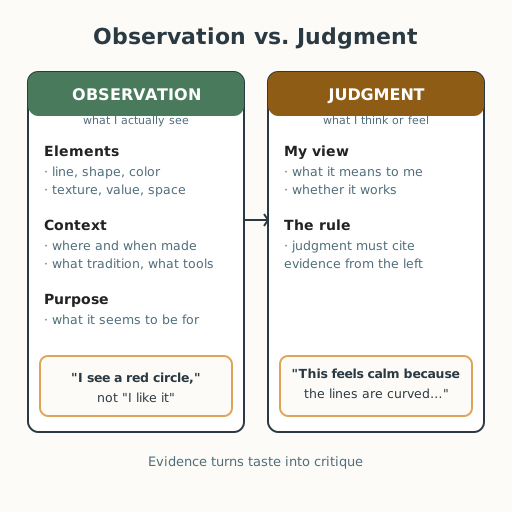
Two people can look at the same picture and disagree — one says “I love it,” the other says “I don’t get it.” Neither has said much yet. A critique goes further: it names what is actually there (the shapes, the colors, the way the space is arranged) and why it produces the effect it does. The difference between “I like it” and “this feels calm because the lines are long and horizontal” is the difference between mere taste and evidence. That skill serves you everywhere — in choosing what to trust, what to buy, and what to make.
Materials
- Critique frame sheet
- Two artworks to critique
Preparation
- Copy the critique frame sheet; choose and print or project two artworks from different cultures.
- Retrieval: from Grade 7, recall how perspective, framing, and emphasis shape what a viewer notices — today we turn that noticing into a full, evidence-based critique.
Facilitator note
This lesson is written to the learner (“you”). The skill to land: a critique separates observation from judgment and requires judgment to cite evidence. Use the four-step frame — describe (name the elements you actually see: line, shape, color, value, texture, space), analyze (say how those elements are arranged and relate), interpret (say what the work seems to mean or be for — its context and purpose), evaluate (say whether and why it works, citing the evidence you gathered). The elements of art and principles of design are one tradition’s vocabulary for the first two steps (S-365) — other traditions describe their arts in their own words — but naming what is there before judging is a move shared across cultures. This is a skill, so model the frame once on a projected artwork, then let learners practice in pairs (explicit instruction carries novice skills — S-011). The critical-thinking lens: “cite the evidence” is the whole point — a judgment without evidence is just a preference. The ethics lens: critique is honest and kind; it describes the work, never the maker, and it can disagree respectfully — and when a classmate’s work is the subject, it is critiqued only with their consent, saying what is true and kind. The egalitarian lens: every learner’s judgment is valid if it is supported; no learner’s taste is “better.” The global lens: critique works the same way across cultures — name what is there, honor its context, then judge. When critiquing the art of another culture, ask respectful questions about its purpose rather than ranking it by one tradition’s rules (S-056). Keep the tone generative: critique builds, it does not tear down.
Procedure
- Recall (5 min). From Grade 7: how does framing or emphasis change what a viewer notices? Today we turn noticing into critique.
- Meet the four steps (10 min). A critique has four moves: describe (what do I see?), analyze (how are the elements arranged?), interpret (what does it mean or what is it for?), evaluate (does it work, and why?). The first two are observation; the last two are judgment — and judgment must cite evidence from the first two. Trace the frame on the sheet.
- Modeled critique (10 min). Together, critique one artwork aloud: describe its line, shape, color, and space; analyze how they are arranged; interpret its context and purpose; then evaluate it with a reason drawn from what you saw.
- Practice in pairs (20 min). With a partner, critique a second artwork from a different culture. Fill in each of the four steps. Rule: every judgment sentence must name at least one observation.
- Peer-check (5 min). Swap sheets. Check: is each judgment backed by evidence? Is observation kept separate from judgment? Fix what is missing.
- Close (5 min). Share one evidence-based sentence. “I see…, so I think…” is a critique; “I just like it” is a start.
Differentiation
- Support: Complete only describe and analyze, with a sentence starter for judgment (“Because I see ___, I think the work feels ___”).
- Extension: Critique the same artwork twice — once with evidence, once with only taste — and write two sentences on which critique is more useful and why.
- Access (non-visual): The subject can be a tactile work explored by hand, or an artwork described aloud by a partner (“top left, a large red circle; below it, three long curved lines…”). Because “describe” is already spoken and written, a learner who does not see works the same four steps through touch or listening.
Assessment
- Formative (observation): Can the learner name an element and connect a judgment to that observation?
- Peer/portfolio artifact: The completed critique frame sheet, kept in the portfolio.
Home connection
At home, choose any image — a label, a poster, a photo, a painted wall — and write one evidence-based sentence about it: “I see ___, so I think ___.” Bring it to the next lesson.
Resources
- On the elements of art and principles of design (the vocabulary of observation and analysis): The J. Paul Getty Museum, “Understanding Formal Analysis,” https://www.getty.edu/education/teachers/building_lessons/formal_analysis.html (S-365).
- On honoring the arts of other cultures as living traditions: UNESCO, Intangible Cultural Heritage, https://ich.unesco.org/ (S-056).
- On explicit instruction and worked examples: Kirschner, Sweller & Clark (2006), https://doi.org/10.1207/s15326985ep4102_1 (S-011).