Lesson 07 — Critiquing a Performance: Movement, Expression, Context, Purpose
Learners critique a performance with **evidence**, using four lenses — **movement, expression, context, and purpose** — and separating observation from judgment. They watch performances from different traditions, treating each as a living practice to honor with questions.
Objectives
Objectives
- D07.S3.08.02 Critique a performance using evidence about its movement, expression, context, and purpose, separating observation from judgment.
Essential question
How do I critique a performance using evidence about its movement, expression, context, and purpose — separating observation from judgment?
Key vocabulary
Materials
Standard materials
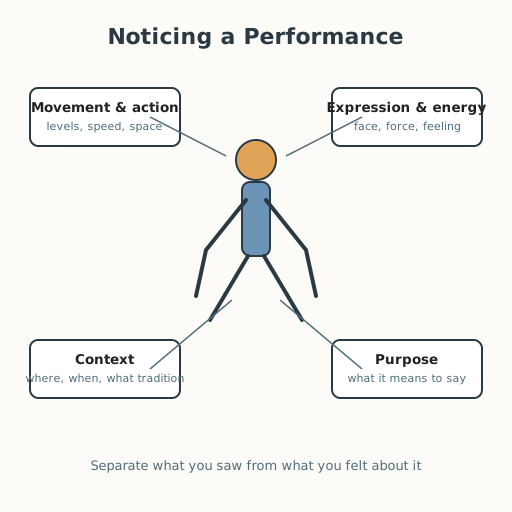
- Performance notice sheet · 1 per learner A frame with four lenses — movement, expression, context, purpose — each with space for evidence
- Two performances to critique · 2 per pair Short live or recorded performances from different traditions, chosen to be rich in movement and expression
Low-tech / no-cost
- A peer's devised piece from Lesson 6 Critique a classmate's performance as the subject, with no recording needed
- A described or sounded performance For learners who do not see, experience the performance through its sound — footfalls, breath, music, spoken word — or a partner's live description of what moves, so observation can be by listening, not only watching
- A shared board or large paper Write the four lenses on the board; learners fill the frame by hand
Enriched / lab & device
- A video of a performance · 1 per group Watch a short recorded dance or drama performance from a tradition to critique
- A shared document or slide · 1 per group Write the critique collaboratively and compare evidence
Works in different contexts
- large-group Watch one performance and model the critique, then pairs critique a second and share one evidence-based sentence each
- multi-age Younger learners name what they saw move and one feeling; older learners complete all four lenses with evidence
- self-directed A learner watches twice, fills the frame alone, and self-checks that every judgment cites something observed
- level-grouped Learners ready to extend compare how two traditions use movement or drama to express one shared theme
- outdoor-only Critique movement outdoors — a game, a dance, a ritual, or everyday gesture — using the four lenses where they apply
Lesson 7 — Critiquing a Performance: Movement, Expression, Context, Purpose
Summary
Learners critique a performance with evidence, using four lenses — movement, expression, context, and purpose — and separating observation from judgment. They watch performances from different traditions, treating each as a living practice to honor with questions.
Objectives
- Critique a performance using evidence about its movement, expression, context, and purpose. (D07.S3.08.02)
- Separate observation from judgment. (D07.S3.08.02)
Connection
You already “read” performances every day: you can tell a lot from how someone stands, how fast they move, what their face and hands are saying — before anyone speaks a word. Gesture, posture, and spacing carry meaning without words (a skill you met in Grade 7). A critique just makes that reading deliberate: what did the body do? what did it express? where and why was it performed? When you can name those things, you stop being carried along by a performance and start understanding how it carried you.
Materials
- Performance notice sheet
- Two performances to critique
Preparation
- Copy the performance notice sheet; choose and prepare two short performances (live or recorded) from different traditions.
- Retrieval: from Grade 7, recall how gesture, posture, and spacing communicate meaning without words — today we turn that into a full, evidence-based critique.
Facilitator note
This lesson is written to the learner (“you”). The skill to land: a performance critique names what the body did — movement (levels, speed, space, timing), expression (face, force, feeling), context (where, when, what tradition), and purpose (what it means to say) — and separates observation from judgment, with judgment citing evidence. This is a skill, so model the critique once on a first performance, then let learners practice in pairs (explicit instruction carries novice skills — S-011). The critical-thinking lens: “separate what you saw from what you felt about it” is the evidence habit applied to the moving body. The ethics lens: critique describes the work, never the performer — and never a performer’s body, identity, or ability — and it can disagree without disrespect. The egalitarian lens: every body and every ability is honored — a performance can be large or small, seated or standing, and stillness is movement too; no learner’s evidence-based judgment is “better.” The global lens: the same four lenses help you watch across traditions, but context matters — a gesture or a dance means something inside its own tradition, so honor that context rather than ranking it by one tradition’s rules (S-056). Keep the tone generative: critique deepens watching, it does not shut it down.
Procedure
- Recall (5 min). From Grade 7: how do gesture, posture, and spacing carry meaning without words? Today we turn that into critique.
- Meet the four lenses (10 min). Look at the performance notice sheet. Four lenses: movement (levels, speed, space, timing), expression (face, force, feeling), context (where, when, what tradition), purpose (what it means to say). These are the words that make a critique precise.
- Modeled critique (10 min). Watch the first performance twice. Together, name what you saw (its movement and expression), state its context, and describe its purpose — with a reason drawn from what you observed.
- Practice in pairs (20 min). Watch a second performance from a different tradition. Fill in the four lenses. Rule: every judgment sentence must name something you saw.
- Peer-check (5 min). Swap sheets. Check: is each judgment backed by evidence? Is observation separate from judgment? Fix what is missing.
- Close (5 min). Share one evidence-based sentence: “I saw ___, so I think it means ___.” That is a critique.
Differentiation
- Support: Name one thing you saw move and one feeling it gave you, with a sentence starter (“The ___ moved ___, so I felt ___”).
- Extension: Compare how two traditions use movement or drama to express one shared theme, and write one reason for the difference.
- Access (non-visual): A performance can be observed by listening — footfalls, breath, voice, music — and rhythm, spacing, and energy can be felt or heard, not only seen. A partner’s spoken description (“she rises from a chair, then moves quickly left…”) is a full path into all four lenses.
- Access (performance anxiety): When a classmate’s devised piece is the subject, performing it for critique is voluntary and needs the performer’s consent. A learner may decline and instead have their rehearsal reflection critiqued, or critique only the outside performances.
Assessment
- Formative (observation): Can the learner name a movement or expression observed and connect a judgment to it?
- Peer/portfolio artifact: The completed performance notice sheet, kept in the portfolio.
Home connection
At home, watch a short performance (a dance, a game, a scene) and write one evidence-based sentence: “I saw ___, so I think it means ___.” Bring it to the next lesson.
Resources
- On dance, drama, and ritual as living practices: UNESCO, Intangible Cultural Heritage, https://ich.unesco.org/ (S-056).
- On explicit instruction and worked examples: Kirschner, Sweller & Clark (2006), https://doi.org/10.1207/s15326985ep4102_1 (S-011).