Lesson 06 — Devising a Piece: One Theme, Made Through Rehearsal
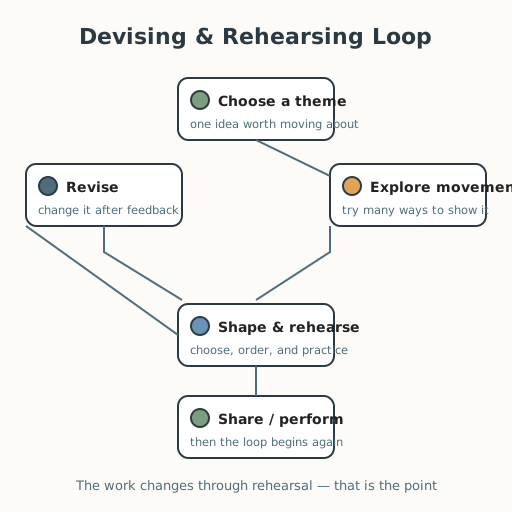
Learners devise (choreograph) a short piece exploring one theme through a loop — **choose a theme, explore movement, shape and rehearse, revise, share** — and reflect in writing on how the work changed through rehearsal. They meet the idea that devised and improvised traditions, such as capoeira, are living forms made and remade in the doing.
Objectives
Objectives
- D07.S3.08.01 Choreograph or devise a piece exploring one theme, and reflect on how the work changed through rehearsal.
Essential question
How do I choreograph or devise a piece exploring one theme, and reflect on how the work changed through rehearsal?
Key vocabulary
Materials
Standard materials
- Devising loop sheet · 1 per learner A one-page cycle — choose a theme, explore movement, shape and rehearse, revise, share — with space to note changes at each loop
- Rehearsal reflection sheet · 1 per learner A page to record what changed in the piece at each rehearsal and why
Low-tech / no-cost
- Voice and body Devise using movement, gesture, and voice; no props or music needed
- Found objects as simple props A stick, cloth, or stone to focus the movement if useful
Enriched / lab & device
- Music or sound · 1 per group A short piece of music or a simple soundscape to shape and support the movement
- A recording device · 1 per group Record each rehearsal to watch back and revise
Works in different contexts
- large-group Devise in small groups, then each group performs and the class notes one thing that changed through rehearsal
- multi-age Younger learners devise a short movement phrase on one theme; older learners devise a full piece and write the rehearsal reflection in full
- self-directed A learner devises a short solo piece, rehearses it alone over two or three passes, and writes what changed each time
- level-grouped Learners ready to extend add a second element — music, a prop, or a partner — and explain how it changed the piece
- outdoor-only Devise a piece that uses the outdoor space — its levels, distances, and surfaces — as part of the movement
Lesson 6 — Devising a Piece: One Theme, Made Through Rehearsal
Summary
Learners devise (choreograph) a short piece exploring one theme through a loop — choose a theme, explore movement, shape and rehearse, revise, share — and reflect in writing on how the work changed through rehearsal. They meet the idea that devised and improvised traditions, such as capoeira, are living forms made and remade in the doing.
Objectives
- Choreograph or devise a piece exploring one theme. (D07.S3.08.01)
- Reflect on how the work changed through rehearsal. (D07.S3.08.01)
Connection
You already “devise” movement every time you mime a story, dance to a song, or show a feeling with your whole body instead of words. Devising is just doing that on purpose: taking one theme — an idea worth moving about — and building a piece by trying many ways to show it, then choosing, ordering, and practicing the ones that work. The piece will not be the same at the end as it was at the start, and that is the point: rehearsal is where the piece becomes itself.
Materials
- Devising loop sheet
- Rehearsal reflection sheet
Preparation
- Copy the devising loop sheet and rehearsal reflection sheet; clear a safe space to move.
- Retrieval: from Grade 7, recall performing a scene or dance with attention to timing, expression, and ensemble — today we move from performing to devising.
Facilitator note
This lesson is written to the learner (“you”). The skill to land: devising is a loop — (1) choose a theme, (2) explore movement (try many ways to show it), (3) shape and rehearse (choose, order, practice), (4) revise (change it after feedback), (5) share — and the change across rehearsals is the point. This is a making skill, so model the loop once with a tiny example (show three movement ideas for one theme, then choose, order, and revise), then let learners devise in small groups or alone (explicit instruction carries novice skills — S-011). The physical lens: this is body learning — honor every body and ability; movement can be large or small, seated or standing, and stillness is movement too. The global lens: devising and improvisation are living traditions worldwide — capoeira, for example, is a Brazilian art that weaves movement, music, and play together, improvised within a shared circle (S-056). Teach such traditions as living forms to honor with respectful questions, never as specimens to copy carelessly. The egalitarian lens: devising needs only a body and a space — no equipment, no particular ability. The ethics lens: when devising in a group, every voice shapes the piece; no one’s idea is “better,” and consent matters — no one is touched or lifted without asking, and performing in front of the group is a choice, never a requirement. Keep assessment mastery-based: a piece that is still changing is “not yet,” never a failure — change is the work.
Procedure
- Recall (5 min). From Grade 7: what did you attend to in performance — timing, expression, ensemble? Today we move from performing to devising.
- Meet the loop (10 min). Look at the devising loop sheet. Five moves: choose a theme, explore movement, shape & rehearse, revise, share. The loop repeats — each pass changes the piece. Capoeira is one example of a living art made in the doing (S-056).
- Modeled loop (10 min). Together, take one theme (for example, waiting). Try three movement ideas for it. Choose two, order them, practice once, then change one thing after a partner’s suggestion. Notice the change.
- Devise your own (20 min). Choose your theme. Explore at least three movement ideas. Shape them into a short piece (about 30–60 seconds), rehearse it two or three times, and after each rehearsal note on the reflection sheet what changed and why.
- Reflect (5 min). Write two or three sentences: how did your piece change from the first rehearsal to the last, and why? What did feedback teach you?
- Close (5 min). Share your piece with a partner and say one thing that changed through rehearsal. Rehearsal is where the piece becomes itself.
Differentiation
- Support: Devise a single movement phrase on one theme and record one change and its reason.
- Extension: Add a second element — music, a prop, or a partner — and explain how it changed the piece.
- Access (performance anxiety): Performing for others is a choice, never a requirement. A learner who does not want to perform in front of the group may instead share the rehearsal reflection, a short recording, a drawn or spoken description of the movement plan, or the piece with a single trusted partner. The goal is the devising and the reflection on change — not performing in front of everyone.
Assessment
- Formative (observation): Can the learner devise a piece on one theme and name what changed through rehearsal?
- Performance/portfolio artifact: The performed piece plus the rehearsal reflection, kept in the portfolio.
Home connection
At home, choose a feeling and show it three different ways with your body. Which way works best, and why? Bring your answer to the next lesson.
Resources
- On capoeira and other devised, improvised arts as living heritage: UNESCO, Intangible Cultural Heritage, https://ich.unesco.org/ (S-056).
- On explicit instruction and worked examples: Kirschner, Sweller & Clark (2006), https://doi.org/10.1207/s15326985ep4102_1 (S-011).