Lesson 04 — Preparing a Simple Meal Safely
Learners **prepare a simple, balanced meal** using safe food-handling practices from start to finish, following a recipe and a safety checklist. They link each step to the four keys — clean, separate, cook, chill — and honor allergies and each person's needs.
Objectives
Objectives
- D03.S3.08.01 Plan and prepare a simple balanced meal using safe food-handling practices.
Essential question
How do I prepare a simple, balanced meal with safe food-handling practices from start to finish?
Key vocabulary
Materials
Standard materials
- Simple recipe card · 1 per learner A no-cook or low-cook recipe (a grain-and-vegetable bowl, a fruit-and-vegetable salad, or a simple sandwich) with a safety checklist on the back
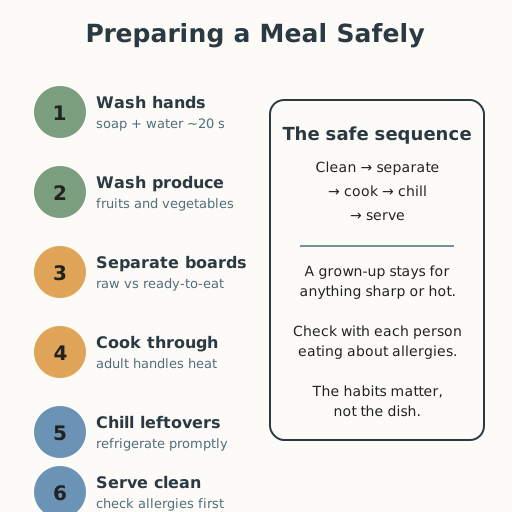
- Safety checklist · 1 per learner A step-by-step list — wash hands, wash produce, separate boards, cook or chill, serve — to tick as the learner goes
Low-tech / no-cost
- Whatever foods are at hand Any simple foods available — fruit, vegetables, cooked grains, beans, bread — to assemble a meal with no special equipment
- Clean water and soap The single most important safety tool; if clean water is scarce, use boiled or treated water
Enriched / lab & device
- A supervised kitchen space · 1 A safe place with a heat source, a refrigerator, and an adult to supervise any cooking
- Measuring cups, spoons, and a clean cutting board · 1 set per group Tools to measure ingredients and keep raw and ready-to-eat food separate
Works in different contexts
- large-group Prepare one meal as a whole class at stations, with each group responsible for one step of the safety checklist
- multi-age Younger learners handle safe, no-knife tasks (washing, tearing leaves, measuring); older learners handle cutting and any cooking with supervision
- self-directed A learner prepares a simple no-cook meal alone, following the checklist, and photographs or draws each safe step
- level-grouped Learners ready to extend write their own recipe with a safety note for each step, then make it
- outdoor-only Prepare a cold meal outdoors (fruit and vegetable salad) using clean water, a clean surface, and covered bowls
Lesson 4 — Preparing a Simple Meal Safely
Summary
Learners prepare a simple, balanced meal using safe food-handling practices from start to finish, following a recipe and a safety checklist. They link each step to the four keys — clean, separate, cook, chill — and honor allergies and each person’s needs.
Objectives
- Prepare a simple, balanced meal using safe food-handling practices. (D03.S3.08.01)
- Connect each step of preparation to a safety key and to the needs of the people eating. (D03.S3.08.01)
Connection
Planning a meal is a map; preparing it is the walk. The safest cooks are not the most skilled — they are the most careful: they wash, they separate, they heat, they cool, and they think about who is eating (including anyone with a food allergy). Today you take the meal you planned and make it real, one safe step at a time. This is a skill you will use for the rest of your life.
Materials
- Simple recipe card
- Safety checklist
Preparation
- Copy the recipe card and safety checklist; arrange a safe workspace and clean water.
- Retrieval: from Lesson 2, recall the four keys — clean, separate, cook, chill.
Facilitator note
This lesson is written to the learner (“you”). It is the performance lesson for D03.S3.08.01: the learner actually prepares a meal. The skill to land: safe preparation is a sequence — wash hands; wash produce; keep raw and ready-to-eat food separate (different boards/plates); cook food thoroughly if heat is used; chill leftovers promptly; serve clean. Emphasize knife safety and adult supervision for anything sharp or hot — a young teen must never cook with heat or sharp tools unattended, and allergies are non-negotiable: check with the person eating, and never share a dish with a known allergen (S-372, S-373). This is a skill, so model one full sequence once (for example, assemble a fruit-and-vegetable salad: wash hands → wash produce → clean board → cut → serve), then let learners do theirs (explicit instruction + worked example carry novice skills — S-011). Choose a no-cook or low-cook recipe so the lesson works with limited resources; the low-tech path uses whatever foods are at hand. The egalitarian lens: not every learner has a kitchen, so frame this as a skill that belongs to everyone, adaptable to any table — and never let it become a display of who has more. The community lens: cooking for others is care, and sharing the food is the point. The ethics lens: safe handling is how we protect the people we feed. The environment lens: wash with just the water you need, use what is fresh and local, and avoid waste. The global lens: every cuisine on Earth has its own safe ways of preparing food — fermenting, steaming, pounding, raw preparations — and no single kitchen style owns safety; the four keys work in any kitchen, with any tradition. Assess by observing the habits (washing, separating, checking), not the tastiness of the food. If a learner cannot prepare food in this setting, they can still demonstrate the sequence with props or describe it step by step — the learning is the habits, not the dish. For learners with limited hand or arm movement, adapt the workspace and tools — a seated workspace, a non-slip mat or bowl stabilizer, and one-handed or no-knife tasks (tearing leaves, mixing, assembling) — or let the learner direct each step while a partner performs it.
Procedure
- Recall (5 min). From Lesson 2: name the four keys — clean, separate, cook, chill. Today we put them to work.
- Read the recipe and checklist (5 min). Look at your recipe card and the safety checklist on the back. Notice where each of the four keys appears.
- Model the sequence (8 min). Watch one worked example: wash hands, wash produce, use a clean separate board, cut or assemble, serve. Notice each safe step.
- Prepare your meal (25 min). Follow your checklist step by step. Wash your hands first. Wash produce. Keep raw and ready-to-eat food separate. If anything is cooked, cook it through and let an adult handle heat. Chill any leftovers. Serve.
- Check your work (7 min). Tick each step on your checklist. Ask: did I wash? separate? cook or chill? Does this meal include several food groups? Is it safe for everyone eating (allergies)?
- Close (5 min). Share the meal if you can. You just did something real: you made food that feeds a body, safely. Next: we look at how we eat, not only what.
Differentiation
- Support: Handle a single safe task (washing, tearing, measuring) and narrate the sequence a partner carries out. Where hand or arm movement is limited, use a non-slip mat, a seated workspace, and no-knife tasks, or direct a partner through each step while you name it.
- Extension: Write your own recipe with a safety note for each step, then make it and explain the notes to someone.
Assessment
- Performance (observation): Does the learner wash hands, keep raw and ready-to-eat food separate, and handle food safely from start to finish?
- Portfolio artifact: The completed safety checklist (and a drawing or photo of the meal), kept in the portfolio.
Home connection
Prepare the same meal (or one like it) for your family at home, with a grown-up present for anything sharp or hot. Ask them to watch your safe habits.
Resources
- On safe food handling in preparation: World Health Organization, “Food safety,” https://www.who.int/news-room/fact-sheets/detail/food-safety (S-372); WHO, “Five keys to safer food,” https://www.who.int/publications/i/item/9789241594639 (S-373).
- On explicit instruction and worked examples: Kirschner, Sweller & Clark (2006), https://doi.org/10.1207/s15326985ep4102_1 (S-011).