Lesson 07 — Alcohol: Effects on a Growing Body and Brain
Learners explain **how alcohol affects a growing body and brain** — it depresses the central nervous system, slowing judgment and coordination, and the adolescent brain is especially vulnerable — and weigh scenarios to make **safe, informed choices**, including the protective power of delaying drinking.
Objectives
Objectives
- D03.S4.08.01 Explain how substances such as tobacco, alcohol, and drugs affect the body and brain and how to make safe, informed choices.
Essential question
How does alcohol affect a growing body and brain, and how do I make a safe, informed choice about it?
Key vocabulary
Materials
Standard materials
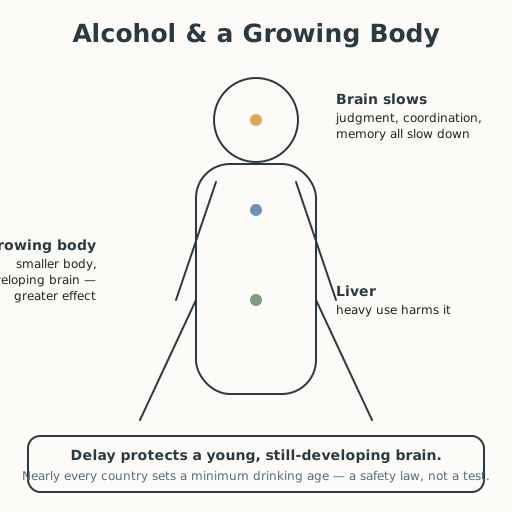
- Alcohol-effects sheet · 1 per learner A body outline with labeled spots for the brain (judgment, coordination, memory) and body (liver, growth) to annotate
- Scenario-and-decision cards · 1 set per group Scenes where alcohol is present (a party, a family gathering, a dare) with questions to weigh — what could go wrong, what would a safe choice look like, who could you ask
Low-tech / no-cost
- A shared board or large paper Draw the body outline and label the effects together
- Voice and role-play Practice a safe response to an offer of alcohol, with no cards needed
Enriched / lab & device
- A short, age-appropriate video on alcohol and the adolescent brain · 1 A brief clip on how alcohol depresses the central nervous system and why the teen brain is vulnerable, previewed by the facilitator
- A chart of legal drinking ages around the world · 1 To discuss that nearly every country restricts alcohol for young people — the age is a safety law, not a test of maturity
Works in different contexts
- large-group Label the body outline once as a whole group, then small groups weigh one scenario and share a safe choice
- multi-age Younger learners match each effect to a body part; older learners explain how alcohol slows the brain and practice a refusal
- self-directed A learner labels the sheet, writes one fact about each effect, and writes a plan for what to do if offered alcohol
- level-grouped Learners ready to extend explain why delaying drinking protects a developing brain, and name the legal age in their country
- outdoor-only Discuss alcohol at community events and how a young person can choose a non-alcoholic drink and step away safely
Lesson 7 — Alcohol: Effects on a Growing Body and Brain
Summary
Learners explain how alcohol affects a growing body and brain — it depresses the central nervous system, slowing judgment and coordination, and the adolescent brain is especially vulnerable — and weigh scenarios to make safe, informed choices, including the protective power of delaying drinking.
Objectives
- Explain how alcohol affects the body and brain, especially a still-developing one. (D03.S4.08.01)
- Make a safe, informed choice about alcohol in a realistic scenario. (D03.S4.08.01)
Connection
Alcohol has been part of human life for thousands of years — in food, medicine, and celebration — but the science is equally old in one clear finding: it changes how the brain works, and it affects a young, still-growing body differently than an adult’s. Alcohol is not a food and not a toy; it is a depressant — a substance that slows the brain down. Today you learn exactly how, and how to choose safely.
Materials
- Alcohol-effects sheet
- Scenario-and-decision cards
Preparation
- Copy the effects sheet and scenario cards; preview any video before showing it.
- Retrieval: from Lesson 6, recall how nicotine reaches the brain; from Grade 7, recall first aid and when to get adult help.
Facilitator note
This lesson is written to the learner (“you”). The tone must stay factual, calm, and non-shaming — never moralizing, never fear, and never judgment of families or cultures where alcohol is present. The facts to land: (1) alcohol is a psychoactive substance that depresses the central nervous system — it slows brain activity, which is why it affects judgment, coordination, reaction time, and memory (S-375); (2) because a young person’s body is smaller and their brain still developing, alcohol affects them more, and early drinking is linked to greater later harm — so delay is protective (S-375); (3) alcohol harms the liver and other organs with heavy, repeated use, and impairs the ability to judge danger (S-375). Do not present a single drink as inevitably harmful or a sip as a catastrophe — that would be inaccurate and would cost the lesson its credibility with teens. Instead: the developing brain and the legal age are the anchors. Nearly every country sets a minimum age for buying and drinking alcohol (safety law, not a test of maturity), and the standard’s own language is “safe, informed choices.” The critical-thinking lens: connect to Grade 7’s marketing literacy — alcohol advertising associates drinking with glamour and belonging, which is a claim to read, not to swallow. The egalitarian lens: alcohol’s harms fall unequally — on poorer communities and on those marketed to most — a justice matter. The global lens: cultures hold alcohol very differently, from total avoidance to everyday moderation; this lesson honors all of them and ranks none. The technology & environment lens: alcohol also travels through tools and landscapes — it is promoted through the same screens and media the learner reads critically, and producing it uses land and water — so the choice touches more than the drinker alone. The ethics lens: a safe choice protects our own body and the people around us (drinking and driving or other risk puts others in danger). Teach decision-making as a skill (worked example: notice the situation → name the risk → choose a safe response → know who to call). Always include the harm-reduction safety floor without endorsing use: if someone has drunk too much and becomes unresponsive, this is an emergency — call for adult or medical help immediately; never leave an impaired person alone. That is knowledge that saves a life, and it is not the same as approving. A learner who has already tried alcohol is met with facts and care, never shame.
Procedure
- Recall (5 min). From Lesson 6: how did nicotine reach the brain? Today we meet a different substance that works another way.
- Meet alcohol (10 min). Alcohol is a depressant — it slows the central nervous system. That is why it changes judgment, coordination, reaction time, and memory (S-375).
- Map the effects (10 min). On the alcohol-effects sheet, label the body: brain (slower judgment, coordination, memory), liver (harm from heavy use), a growing body (smaller body, developing brain = greater effect). Mark why delay protects a young brain (S-375).
- The legal age (5 min). Nearly every country sets a minimum age for alcohol. It is a safety law, not a test of maturity — and it exists because a young body is more vulnerable.
- Weigh a scenario (15 min). With your cards, work one scene: alcohol is offered or present. Answer three questions — what could go wrong? What would a safe choice look like? Who could you ask or call? Practice saying your choice out loud.
- Close (5 min). You now know the facts and the safety floor: if someone ever drinks too much and won’t wake up, that is an emergency — get adult or medical help, and never leave them alone. Next: we meet medicines and other drugs.
Differentiation
- Support: Match each effect to a body part with a partner; write one sentence of a safe choice.
- Extension: Explain, in your own words, why delaying drinking protects a developing brain — and name the legal drinking age in your country.
Assessment
- Formative (observation): Can the learner name at least two effects of alcohol and describe one safe, informed choice in a scenario?
Home connection
Talk with a trusted adult at home about how your family or community views alcohol. You do not need to agree; the goal is to understand the range of views — and to know one adult you could call if you ever needed help.
Resources
- On the effects of alcohol, including on young people: World Health Organization, “Alcohol,” https://www.who.int/news-room/fact-sheets/detail/alcohol (S-375).
- On the adolescent brain and health as context: World Health Organization, “Adolescent health,” https://www.who.int/health-topics/adolescent-health (S-261).