Lesson 06 — Tobacco & Nicotine: What They Do to the Body and Brain
Learners explain **how tobacco affects the body and brain** — nicotine reaches the brain quickly and is highly addictive, and tobacco smoke harms the lungs, heart, and blood vessels — and practice making a **safe, informed choice**, including clear refusal skills and the truth that most teens do not smoke.
Objectives
Objectives
- D03.S4.08.01 Explain how substances such as tobacco, alcohol, and drugs affect the body and brain and how to make safe, informed choices.
Essential question
How does tobacco affect the body and brain, and how do I make a safe, informed choice about it?
Key vocabulary
Materials
Standard materials
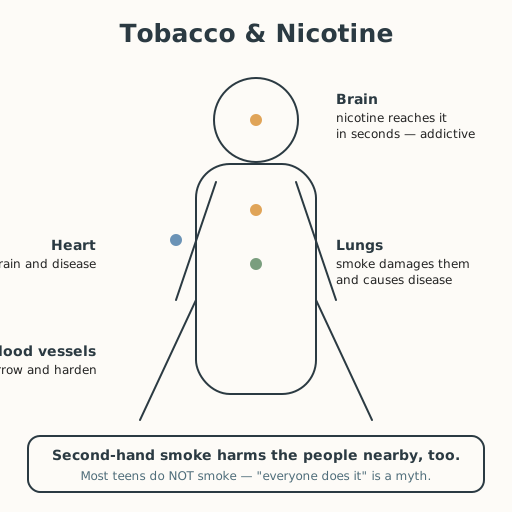
- Tobacco-effects sheet · 1 per learner A body outline with labeled spots for the brain (addiction), lungs, heart, and blood vessels, to annotate
- Choice-and-refusal cards · 1 set per group Short scenes (an offer to try a cigarette or vape, a friend saying "everyone does it") with possible responses to discuss and practice
Low-tech / no-cost
- A shared board or large paper Draw the body outline and label the effects together
- Voice and role-play Practice saying "no, thanks" clearly and kindly, with no cards needed
Enriched / lab & device
- A short, age-appropriate video on how nicotine reaches the brain · 1 A brief clip explaining nicotine's effect on the brain's reward system, previewed by the facilitator
- Current data on teen tobacco and vaping rates · 1 set To show that, in most places, the majority of teens do *not* smoke or vape
Works in different contexts
- large-group Label the body outline once as a whole group, then pairs practice one refusal scene and share
- multi-age Younger learners match each effect to a body part; older learners explain the brain-and-addiction link and practice a refusal
- self-directed A learner labels the sheet, writes one fact about each effect, and writes two refusal responses they would use
- level-grouped Learners ready to extend explain why nicotine's effect on the developing adolescent brain makes delaying use protective
- outdoor-only Discuss second-hand smoke in shared outdoor spaces and how to step away politely from smoke
Lesson 6 — Tobacco & Nicotine: What They Do to the Body and Brain
Summary
Learners explain how tobacco affects the body and brain — nicotine reaches the brain quickly and is highly addictive, and tobacco smoke harms the lungs, heart, and blood vessels — and practice making a safe, informed choice, including clear refusal skills and the truth that most teens do not smoke.
Objectives
- Explain how tobacco and nicotine affect the body and brain. (D03.S4.08.01)
- Practice making a safe, informed choice about tobacco, including how to refuse without shame. (D03.S4.08.01)
Connection
Tobacco has been grown and used by humans for thousands of years — chewed, smoked, and offered in ceremony — but its health effects are now among the best-understood facts in medicine. When tobacco burns or is vaped, it delivers a chemical called nicotine to the brain within seconds. That speed is why nicotine is so habit-forming. Today you learn what tobacco does to a body, and how to choose for yourself with clear eyes.
Materials
- Tobacco-effects sheet
- Choice-and-refusal cards
Preparation
- Copy the effects sheet and refusal cards; preview any video before showing it.
- Retrieval: from Grade 7, recall evaluating health claims and telling marketing from evidence; from Grade 6, recall assessing everyday risks.
Facilitator note
This lesson is written to the learner (“you”). It opens the unit’s substance strand, and the tone is everything: factual, calm, and non-shaming — never moralizing, never fear, and never insulting people who use tobacco. The facts to land: (1) nicotine reaches the brain in seconds and is highly addictive (S-374); (2) tobacco smoke harms the lungs, heart, and blood vessels, and is a leading preventable cause of death worldwide (S-374); (3) second-hand smoke harms the people around the smoker, too (S-374); (4) the developing adolescent brain is especially sensitive to nicotine, so delaying use is protective. The critical-thinking lens is central: connect to Grade 7’s marketing literacy — the tobacco and vaping industries have a long history of designing products and ads to make use look glamorous and universal; learners already know how to tell claims from evidence. The WHO tobacco page documents this directly (tobacco advertising, promotion and sponsorship “increases and sustains tobacco use by effectively recruiting new tobacco users” — S-374); S-312 is the Grade-7 food-marketing-literacy frame that taught the tell-claims-from-evidence skill itself. Deliver the norms correction that prevention science supports: in most places, the large majority of teenagers do not smoke or vape — “everyone does it” is a myth, and saying so is itself protective (S-374; frame as a general, hedged truth). The egalitarian lens: tobacco companies have historically marketed hardest to particular groups and to lower-income countries; the burden of tobacco falls unequally, which is a justice matter. The global lens: tobacco’s harms are global, and many countries now restrict tobacco advertising and raise the age of sale — and this lesson honors Indigenous and ceremonial uses of tobacco as distinct from commercial smoking, without ranking them. The technology & environment lens: tobacco is also a story of tools and land — new devices such as vapes are a technology engineered to deliver nicotine quickly, and growing tobacco and discarding its waste leave a footprint on the environment — so the choice is never only personal. The ethics lens: a safe, informed choice protects our own body and the people who breathe the air around us. Teach refusal as a skill (worked examples: “No thanks, I don’t smoke”; “I’m good — my lungs are for running”; walk away; suggest something else), and always point to a trusted adult for help. A learner who has already tried tobacco is never shamed — they are met with facts and support.
Procedure
- Recall (5 min). From Grade 7: how do you tell a health claim from a marketing claim? Today we use that skill on tobacco.
- Meet nicotine (10 min). Tobacco contains nicotine, a chemical that reaches the brain in seconds and is highly addictive — the body comes to want it more and more (S-374).
- Map the effects (10 min). On the tobacco-effects sheet, label the body: brain (addiction), lungs (damage and disease), heart and blood vessels (strain). Note that second-hand smoke harms people nearby too (S-374).
- The real norm (5 min). Here is a truth worth holding: in most places, the large majority of teenagers do not smoke or vape. “Everyone does it” is a myth — and knowing that makes it easier to choose for yourself (S-374).
- Practice refusal (15 min). With your cards, role-play an offer and a refusal. Try: a clear “no thanks,” a reason that is true for you, walking away, and suggesting something else to do. Switch roles.
- Close (5 min). You have facts and words, not fear. Next: we meet alcohol.
Differentiation
- Support: Match each effect to a body part with a partner, and practice one simple refusal line.
- Extension: Explain why nicotine’s effect on a still-developing adolescent brain makes delaying use protective, in your own words.
Assessment
- Formative (observation): Can the learner name at least two body effects of tobacco and give one clear refusal response?
Home connection
Ask a trusted adult at home what they wish they had known about tobacco when they were your age. Listen; you do not need to share your own thoughts unless you want to.
Resources
- On the health effects of tobacco and nicotine, including how tobacco advertising recruits new users: World Health Organization, “Tobacco,” https://www.who.int/news-room/fact-sheets/detail/tobacco (S-374).
- On reading marketing claims against evidence (the Grade-7 media-literacy frame): World Health Organization, “Set of recommendations on the marketing of foods and non-alcoholic beverages to children,” https://www.who.int/publications/i/item/9789241500210 (S-312).