Lesson 01 — Trade, Knowledge & the Human Story: Where We've Been, Where We're Going
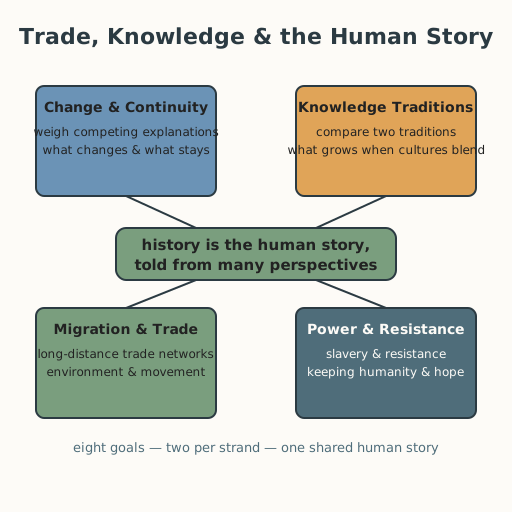
Learners recall Grade-7 history ideas — multiple causes, knowledge-system comparison, sources, migration, colonization, and resistance — and preview this unit's four strands and eight goals. They meet the unit's organizing idea: history is the human story, told from many perspectives.
Objectives
Objectives
- D08.S1.08.01 Evaluate competing explanations for one major historical change and support a reasoned judgment with evidence.
- D08.S1.08.02 Analyze how a long-running human practice, such as trade, farming, or writing, changed over centuries and what stayed the same.
- D08.S2.08.01 Compare two knowledge traditions in depth and explain what each offers and where they agree and differ.
- D08.S2.08.02 Analyze a case of cultural exchange and blending, such as foods, languages, or beliefs meeting, and what new things grew from it.
- D08.S3.08.01 Analyze how long-distance trade networks, such as the Silk Roads or Indian Ocean routes, connected peoples and moved goods, ideas, and beliefs.
- D08.S3.08.02 Analyze how environmental change, such as drought, flood, or a shift in climate, has driven people to move and adapt, in the past and today.
- D08.S4.08.01 Analyze slavery and the transatlantic slave trade as systems built on the denial of human dignity, and describe how enslaved people resisted.
- D08.S4.08.02 Explain how enslaved and colonized peoples kept their humanity, culture, and hope alive under oppression, with specific examples.
Essential question
How do we tell the human story — and where are we going in this unit?
Key vocabulary
Materials
Standard materials
- Unit map sheet · 1 per learner A one-page map of the unit's four strands and eight goals, to mark and return to across the unit
- Recall cards · 1 set per group Cards recalling Grade-7 ideas — multiple causes, knowledge-system comparison, primary vs. secondary sources, voluntary vs. forced migration, colonization, forms of resistance, rivers and trade
Low-tech / no-cost
- A shared board or large paper Draw the four strands and eight goals together; no printed map needed
- Voice and memory Recall the Grade-7 ideas aloud as a group instead of using cards
Enriched / lab & device
- A digital slideshow of the four strands · 1 One image or diagram per strand (change and continuity, knowledge traditions, migration and trade, power and resistance) to preview each
- A wonder box (physical or shared document) · 1 A place to collect every learner's questions about the unit to revisit at the close
Works in different contexts
- large-group Do the recall round as a whole group with ideas recorded on the board, then small groups sort the recall cards
- multi-age Younger learners match each recall idea to a picture; older learners state the idea in one sentence and connect it to the new unit
- self-directed A learner reads the unit map, writes a few sentences recalling the Grade-7 ideas, and lists one question per strand
- level-grouped Learners ready to extend add a Grade-7 idea not on the cards and explain why it matters here
- outdoor-only Point to something real outdoors — a road, a field, the sky — and ask how it connects to the unit's four strands
Lesson 1 — Trade, Knowledge & the Human Story: Where We’ve Been, Where We’re Going
Summary
Learners recall Grade-7 history ideas — multiple causes, comparing knowledge systems, primary and secondary sources, voluntary and forced migration, colonization, and forms of resistance — and preview this unit’s four strands and eight goals. They meet the unit’s organizing idea: history is the human story, told from many perspectives, never one people’s triumph.
Objectives
- Preview the unit’s eight goals: evaluating competing explanations, change and continuity, comparing knowledge traditions, cultural blending, trade networks, environmental migration, and slavery, resistance, and the keeping of hope. (D08.S1.08.01, D08.S1.08.02, D08.S2.08.01, D08.S2.08.02, D08.S3.08.01, D08.S3.08.02, D08.S4.08.01, D08.S4.08.02)
Connection
Think of a story your family tells — how someone arrived somewhere, what they brought, what they kept. Every family story is a piece of a much bigger story: the story of how humans have moved, traded, learned, and held on to hope across thousands of years. History is not a list of dates to memorize; it is that big story, told from many sides. Today we remember what we already know how to do, and see where the story is taking us.
Materials
- Unit map sheet
- Recall cards
Preparation
- Copy the unit map sheet and recall cards.
- Retrieval: from Grade 7, recall (a) that a major change has multiple causes and consequences, (b) that knowledge systems — such as indigenous ecological knowledge and formal science — can be compared with respect, (c) the difference between a primary and a secondary source, (d) that migration can be voluntary or forced, (e) that colonization brought loss of land, culture, and self-rule, and (f) that people resist through protest, refusal, art, and storytelling. Today we link those to the new unit.
Facilitator note
This lesson is written to the learner (“you”). It is the unit’s opening and retrieval pass, so the goals are modest: (1) recall the Grade-7 ideas that this unit builds on; (2) preview the unit’s four strands — change and continuity, knowledge traditions, migration and trade, power and resistance — and its eight goals; (3) plant the organizing idea: history is a global story told from many perspectives. Do not try to teach the eight goals today; just name and locate them. The critical-thinking lens: weighing competing explanations and checking sources is the habit we carry forward (S-011). The global lens: this unit moves across many regions — Mesoamerica, the Pacific, the Indian Ocean, East and West Africa, the Andes, the Americas — because the human story is one story in many places. The ethics lens: we hold hard topics (slavery, colonization) with honesty and care, never as spectacle, and we name the dignity of the people in the story (philosophy §5, facilitation “Holding difficult topics safely”). The egalitarian lens: we ask, at every turn, who benefits, who is left out, and whose voice is heard. Keep big questions open: origins and meaning are held as questions, never answered as creed (philosophy §11). Spacing note (S-039): this recall pass is what makes the unit’s ideas stick later.
Procedure
- Recall (10 min). In a small group, look at the recall cards: multiple causes, knowledge-system comparison, primary vs. secondary sources, voluntary vs. forced migration, colonization, forms of resistance. For each, say in one sentence what you remember from Grade 7.
- Connect the six (5 min). What do all six have in common? (Each is about how we know and tell the human story — with evidence, from more than one side.)
- Meet the map (10 min). Look at the unit map. Four strands: change and continuity, knowledge traditions, migration and trade, power and resistance. Eight goals — two per strand. Read each goal aloud once; don’t worry about understanding them yet. (A partner or facilitator can read the strands and goals aloud, and the four strands can be named while tapping four fingers, so the map can be heard and counted, not only seen.)
- Plant the big idea (10 min). The unit’s idea in one breath: history is the human story, told from many perspectives — and it is still being written, by every one of us. Say it back in your own words.
- Wonder (10 min). Write one question about each strand in the wonder box. Which question do you most want answered by the end of the unit?
- Close (5 min). Today we remembered what we know and saw the road ahead. Next: we weigh competing explanations for one great change.
Differentiation
- Support: Give sentence starters for the recall round (“A major change has many causes because…”; “A primary source is…”).
- Extension: Add a Grade-7 idea of your own and say why it will matter in this unit.
Assessment
- Formative (observation): Can the learner recall each Grade-7 idea in one sentence and name the unit’s four strands?
- Artifact: The completed unit map (or the learner’s written recall), kept in the portfolio.
Home connection
Ask someone at home: what is one story your family tells about moving, trading, or holding on to a tradition? Bring the story (no names needed) to the next lesson.
Resources
- On the payoff of spaced retrieval: Dunlosky et al. (2013), https://doi.org/10.1177/1529100612453266 (S-039).
- On explicit instruction and worked examples: Kirschner, Sweller & Clark (2006), https://doi.org/10.1207/s15326985ep4102_1 (S-011).