Lesson 02 — Weighing Competing Explanations: The Classic Maya Collapse
Learners evaluate **competing explanations** for one major change — the Classic Maya collapse (about 800–950 CE) — weighing three explanations (drought, warfare, environmental stress) and the evidence for each, then supporting a reasoned judgment. They learn that historians weigh evidence, and that several causes often work together.
Objectives
Objectives
- D08.S1.08.01 Evaluate competing explanations for one major historical change and support a reasoned judgment with evidence.
Essential question
How do I evaluate competing explanations for one major historical change and support a reasoned judgment with evidence?
Key vocabulary
Materials
Standard materials
- Evidence-and-explanation sheet · 1 per learner A sheet with three candidate explanations (drought, warfare, environmental stress) and rows to record the evidence for and against each, plus a space for a reasoned judgment
- Evidence cards · 1 set per group Cards carrying one piece of evidence each (lake-sediment drought record, warfare imagery on monuments, population and land-use stress) to sort under the three explanations
Low-tech / no-cost
- A shared board or large paper Draw the three explanations as three columns and sort the evidence together
- Voice and retelling Tell the three explanations aloud and have learners restate the evidence in their own words
Enriched / lab & device
- Images of Maya sites and monuments · 1 set Photographs of Maya cities (Tikal, Copán, Palenque) and stelae, to look at and wonder over
- A short video or article on the Classic Maya collapse · 1 An age-appropriate account of the collapse debate to watch or read and then retell
Works in different contexts
- large-group Present the three explanations once to the whole group, then small groups sort the evidence cards and fill the sheet
- multi-age Younger learners match each piece of evidence to an explanation; older learners weigh the evidence and write a reasoned judgment
- self-directed A learner reads the three explanations, sorts the evidence, and writes a short reasoned judgment citing the strongest evidence
- level-grouped Learners ready to extend apply the same weighing skill to a second change (for example, the fall of the Western Roman Empire) and name two competing explanations
- outdoor-only Use a local example of environmental stress (a dried stream, worn soil) and ask how environment, conflict, and population might each explain a change
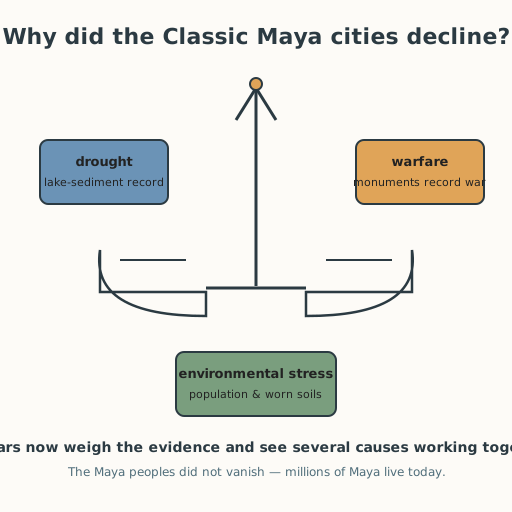
Lesson 2 — Weighing Competing Explanations: The Classic Maya Collapse
Summary
Learners evaluate competing explanations for one major historical change — the Classic Maya collapse (roughly 800–950 CE) — weighing three explanations (drought, warfare, environmental stress) and the evidence for each, then supporting a reasoned judgment. They learn that historians weigh evidence, and that several causes often work together.
Objectives
- Evaluate competing explanations for one major historical change and support a reasoned judgment with evidence. (D08.S1.08.01)
Connection
When something big goes wrong at school or at home — a garden fails, a team loses, a friendship breaks — people often give different reasons: “it was the weather,” “it was a bad decision,” “it was too much at once.” Usually it is not one thing; it is several, working together. Historians face the same puzzle about the past. Today you act as a historian and weigh the rival explanations for one great change, deciding what the evidence best supports.
Materials
- Evidence-and-explanation sheet
- Evidence cards
Preparation
- Copy the evidence-and-explanation sheet and the evidence cards.
- Retrieval: from Grade 7, recall that a major change has multiple causes and consequences (D08.S1.07.02) and that a claim needs evidence.
Facilitator note
This lesson is written to the learner (“you”). The idea to land: historians evaluate competing explanations by weighing evidence, and a reasoned judgment says which explanation the evidence best supports — often several causes working together. The worked historical example: the Classic Maya civilization flourished from about 250 to 900 CE across Mesoamerica (present-day southern Mexico, Guatemala, Belize, Honduras, and El Salvador), building great cities (Tikal, Calakmul, Copán, Palenque) with writing, astronomy, and a precise calendar (S-378, S-204). Then, beginning around 800–950 CE, many southern-lowland cities were abandoned — the “Classic Maya collapse.” Three competing explanations: (1) drought — evidence from lake-sediment cores (for example, gypsum and oxygen-isotope records at Lake Chichancanab) points to severe, repeated droughts around 800–1000 CE; (2) warfare and political instability — monuments and inscriptions record mounting war between rival city-states; (3) environmental stress and overpopulation — intensive farming and growing populations may have worn down fragile tropical soils (S-378). Most scholars today hold that these worked together, with drought as a trigger that magnified the others (S-378). The ethics lens: it is honest and respectful to say “we are not certain; the evidence supports several causes” rather than pretending to one clean answer. The egalitarian lens: the Maya did not “vanish” — Maya peoples live today in the millions across the region, speaking Maya languages and carrying their traditions; the “collapse” was the decline of certain lowland cities, not of a people. The global lens: the Classic Maya are one of many brilliant civilizations (Mesoamerica, the Andes, West Africa, the Indian Ocean world) in this unit — the human story is many stories. The environment lens: a changing climate (drought) is a reminder that environmental change has shaped human history for thousands of years — a thread we will pick up later in the unit. Keep it honest: this is documented scholarship, and where scholars disagree, we hold the disagreement as a question, not a verdict (philosophy §11).
Procedure
- Recall (5 min). From Grade 7: why does a major change usually have more than one cause? Today you weigh rival explanations for one change.
- Meet the change (8 min). The Classic Maya built great cities in Mesoamerica with writing, astronomy, and a precise calendar (about 250–900 CE). Then, around 800–950 CE, many southern lowland cities were abandoned. Historians do not all agree on why — and that is our job today.
- Meet the three explanations (10 min). Read the three candidate explanations: (1) drought — the rains failed; (2) warfare — rival cities fought until the system broke; (3) environmental stress — too many people and too much farming wore out the land. A good historian does not pick a favorite; a good historian asks: what is the evidence?
- Sort the evidence (12 min). In a group, sort the evidence cards under the three explanations. Notice: some evidence fits more than one explanation. Note the strongest piece of evidence for each.
- Make a reasoned judgment (12 min). Write your judgment: which explanation does the evidence best support — and is it just one, or several working together? Back it with at least two pieces of evidence. You may say “the evidence supports several causes.”
- Close (8 min). Share judgments. Notice that many scholars now hold the same view most learners reach: drought, warfare, and environmental stress worked together, with drought as a trigger. And remember: the Maya peoples did not vanish — millions of Maya live today.
Differentiation
- Support: Provide the three explanations pre-written and ask learners to match each piece of evidence to an explanation, then choose one piece of evidence to support a simple judgment.
- Extension: Apply the same weighing skill to a second change — the fall of the Western Roman Empire — and name two competing explanations with one piece of evidence each.
Assessment
- Formative (observation): Can the learner weigh at least two explanations against evidence and state a judgment with a reason?
- Portfolio artifact: The completed evidence-and-explanation sheet with a reasoned judgment, kept in the portfolio.
Home connection
Ask at home: when something changed in your family’s life, did one cause explain it, or several? Compare with the Maya collapse.
Resources
- On the Classic Maya, the collapse, and the competing explanations (drought, warfare, environmental stress): Encyclopaedia Britannica, “Maya” (Dates, Collapse, Civilization), https://www.britannica.com/topic/Maya-people (S-378).
- On Maya astronomy, writing, and the calendar (context for the civilization): Smithsonian Institution, writing systems, the wheel, and Maya astronomy (S-204).
- On explicit instruction and worked examples: Kirschner, Sweller & Clark (2006), https://doi.org/10.1207/s15326985ep4102_1 (S-011).