Lesson 03 — Change & Continuity in a Long-Running Practice: Trade
Learners analyze how one long-running practice — **trade** — changed over centuries (scale, speed, money, technology) and what stayed the same (exchanging what is scarce, carrying goods and ideas, trust and credit). They build a change-and-continuity analysis as a portfolio artifact.
Objectives
Objectives
- D08.S1.08.02 Analyze how a long-running human practice, such as trade, farming, or writing, changed over centuries and what stayed the same.
Essential question
How has one long-running human practice — trade — changed over centuries, and what has stayed the same?
Key vocabulary
Materials
Standard materials
- Change-and-continuity sheet · 1 per learner A two-column sheet — "what changed" on the left, "what stayed the same" on the right — for the practice of trade
- Trade-stage cards · 1 set per group Cards for stages of trade over time (early exchange of obsidian and salt, Silk Road caravans, Indian Ocean dhows, transatlantic sail, container ships today) to arrange and analyze
Low-tech / no-cost
- A shared board or large paper Draw the two columns together and fill them from memory and discussion
- Voice and retelling Tell the story of trade aloud and have learners retell what changed and what stayed
Enriched / lab & device
- A short video or image set of trade through time · 1 Images of caravans, dhows, sailing ships, and container ports to compare
- A modern object to trace · 1 per group A common object (a piece of clothing, a spice, a tool) whose materials came from far away, to trace back through trade
Works in different contexts
- large-group Build the change/continuity columns once as a whole class, then small groups arrange the stage cards
- multi-age Younger learners match each stage to a picture; older learners state what changed and what stayed and why the staying matters
- self-directed A learner arranges the stages, fills the two columns, and writes one sentence on what continuity means for a practice
- level-grouped Learners ready to extend do the same for a second practice (writing or farming) and compare
- outdoor-only Trace a real traded item (salt, a spice, cloth) and ask how it reached here and what about that journey has changed and stayed the same
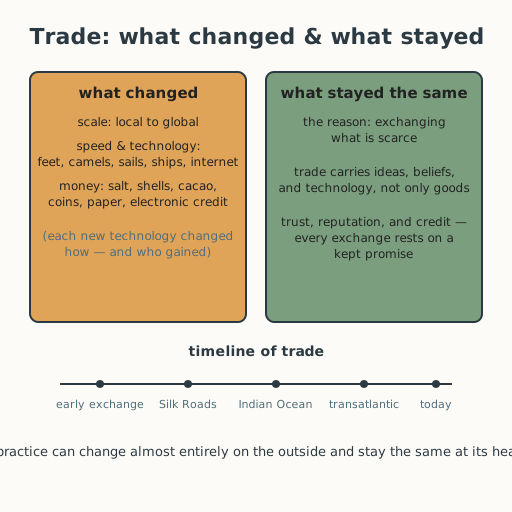
Lesson 3 — Change & Continuity in a Long-Running Practice: Trade
Summary
Learners analyze how one long-running practice — trade — changed over centuries (scale, speed, money, and technology) and what stayed the same (exchanging what is scarce, carrying goods and ideas, and the trust and credit that make exchange possible). They build a change-and-continuity analysis as a portfolio artifact.
Objectives
- Analyze how a long-running human practice, such as trade, changed over centuries and what stayed the same. (D08.S1.08.02)
Connection
Look at the label on your shirt, the spice in your kitchen, the cup you drink from. Almost certainly, parts of them came from far away — sewn in one place, woven in another, grown or mined in a third. That everyday fact is the tip of a practice thousands of years old: trade. Some things about trade have changed beyond recognition; other things — the reason we trade at all — have not changed one bit. Today you tell the difference.
Materials
- Change-and-continuity sheet
- Trade-stage cards
Preparation
- Copy the change-and-continuity sheet and the trade-stage cards.
- Retrieval: from Grade 7, recall that rivers, oceans, deserts, and mountains connected or separated peoples (D08.S3.07.02), and from Grade 5, that trade and travel moved goods, ideas, plants, and animals (D08.S3.05.02).
Facilitator note
This lesson is written to the learner (“you”). The idea to land: a long-running practice shows both change and continuity — historians ask what changed and what stayed the same. The worked example is trade. What changed: (1) scale — from local and regional exchange to networks spanning continents (the Silk Roads overland and the Indian Ocean by sea, S-323, S-207); (2) speed and technology — from foot, camel caravan, and monsoon dhow to sail, steam, and today’s container ships; (3) money — from barter and commodity money (cacao, salt, cowrie shells, beads) to coin, paper money, and electronic credit. What stayed the same: (1) the reason — people exchange what is scarce or absent in one place for what another place has; (2) trade carries ideas, beliefs, and technology, not only goods (paper and numerals traveled the Silk Roads, S-317, S-318); (3) trust, reputation, and credit — every exchange, ancient or modern, rests on people trusting that a promise will be kept. The global lens: trade is a human universal — every region has its own networks and traditions of exchange. The technology lens: each new technology (the wheel, the sail, the container ship, the internet) changed how we trade — often for good and for strain, and never equally for everyone. The ethics and egalitarian lenses: not all trade has been free — some trade was built on theft and slavery (we face that squarely later in this unit), and the gains of trade have never been shared equally; ask who benefits and who is left out. Keep it honest: this is documented history, told as a pattern, not a single story of progress (philosophy §11).
Procedure
- Recall (5 min). From Grade 7: how did rivers, oceans, and mountains connect or separate peoples? From Grade 5: what moved along with goods when peoples traded? Today we watch one practice — trade — change and stay the same across centuries.
- Meet the stages (10 min). Arrange the trade-stage cards in order: early exchange of obsidian and salt, Silk Road caravans, Indian Ocean dhows riding the monsoon, transatlantic sail, container ships today. What do you notice changes as you move through the stages?
- Find what changed (10 min). Fill the left column: scale (local to global), speed and technology (feet and camels and sails to engines and ships and the internet), money (salt and shells and cacao to coins, paper money, and electronic credit).
- Find what stayed (10 min). Fill the right column: the reason (exchange what is scarce), trade carries ideas (paper and numerals traveled with goods), and trust and credit (every exchange rests on a kept promise).
- Apply it (10 min). Pick one modern object in the room. Trace its materials back through today’s trade. Which of your “changed” and “stayed” ideas can you see in that one object?
- Close (5 min). A practice can change almost entirely on the outside and stay the same at its heart. That is what “change and continuity” means.
Differentiation
- Support: Provide the “changed” and “stayed” ideas pre-written and ask learners to sort them into the two columns.
- Extension: Repeat the analysis for a second practice — writing or farming — and name one change and one continuity for it.
Assessment
- Formative (observation): Can the learner name at least one change and one continuity in trade and say why the continuity matters?
- Portfolio artifact: The completed change-and-continuity sheet, kept in the portfolio.
Home connection
Trace one thing at home — a food, a tool, a piece of clothing — and ask: how far did its pieces travel, and what about that journey is new and what is ancient?
Resources
- On the Silk Roads and Indian Ocean trade as long-distance networks: Encyclopaedia Britannica, “Silk Road” / Indian Ocean trade, https://www.britannica.com/topic/Silk-Road-trade-route (S-323).
- On the Indian Ocean as a shared maritime space of exchange: UNESCO, “The Indian Ocean, a shared heritage,” https://www.unesco.org/en/silk-roads (S-207).
- On paper and the decimal numerals traveling with trade: Britannica “Paper / Papermaking” (S-317) and “Zero / Hindu-Arabic numerals” (S-318).
- On explicit instruction and worked examples: Kirschner, Sweller & Clark (2006), https://doi.org/10.1207/s15326985ep4102_1 (S-011).