Lesson 04 — Comparing Two Knowledge Traditions: Polynesian Wayfinding & Indian Ocean Navigation
Learners compare two knowledge traditions in depth — **Polynesian wayfinding** (reading stars, swells, clouds, and birds, passed on orally) and **Indian Ocean astronomical navigation** (the astrolabe, the kamal, and written sailing guides). They explain what each offers and where the two agree and differ.
Objectives
Objectives
- D08.S2.08.01 Compare two knowledge traditions in depth and explain what each offers and where they agree and differ.
Essential question
How do two knowledge traditions compare — what does each offer, and where do they agree and differ?
Key vocabulary
Materials
Standard materials
- Two-traditions comparison sheet · 1 per learner A sheet with columns for "what each offers," "where they agree," and "where they differ," and two labeled panels — Polynesian wayfinding and Indian Ocean astronomical navigation
- Knowledge cards · 1 set per group Cards describing how each tradition reads stars, sea, and sky, and how each is taught and passed on
Low-tech / no-cost
- A shared board or large paper Draw the two traditions side by side and fill the agree/differ/offers columns together
- Voice and retelling Tell each tradition's way of knowing aloud and have learners retell it
Enriched / lab & device
- A short video on Hōkūleʻa and traditional wayfinding · 1 An age-appropriate account of the 1976 voyage and of Mau Piailug's navigation without instruments
- Images of an astrolabe and a kamal · 1 set Pictures of the instruments Indian Ocean navigators used, to examine and ask how they worked
Works in different contexts
- large-group Introduce both traditions once to the whole group, then small groups sort the knowledge cards and fill the comparison sheet
- multi-age Younger learners match each practice to a picture (stars, swells, instrument); older learners state where the traditions agree and differ and why both are valid
- self-directed A learner reads both traditions, fills the comparison sheet, and writes a short paragraph on what each offers
- level-grouped Learners ready to extend add a third knowledge tradition (for example, Aboriginal Australian star and seasonal knowledge) and compare
- outdoor-only Look at the sky and the wind outdoors and ask what could you read here to find your way, and how would an instrument help?
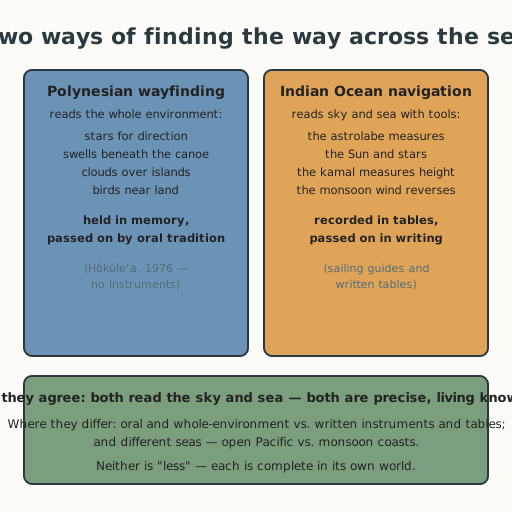
Lesson 4 — Comparing Two Knowledge Traditions: Polynesian Wayfinding & Indian Ocean Navigation
Summary
Learners compare two knowledge traditions in depth — Polynesian wayfinding (reading stars, swells, clouds, and birds, passed on orally) and Indian Ocean astronomical navigation (the astrolabe, the kamal, and written sailing guides). They explain what each offers and where the two agree and differ.
Objectives
- Compare two knowledge traditions in depth and explain what each offers and where they agree and differ. (D08.S2.08.01)
Connection
Think of two ways to find your way somewhere you have never been. One person memorizes the route from a friend, noticing landmarks — the hill, the bend in the river, the way the wind blows. Another person opens a map on a phone and follows it turn by turn. Both arrive. Both are real knowledge. Neither is “wrong.” Today you compare two great traditions of finding a way across the open sea — and see that knowledge itself comes in more than one form.
Materials
- Two-traditions comparison sheet
- Knowledge cards
Preparation
- Copy the comparison sheet and the knowledge cards.
- Retrieval: from Grade 7, recall comparing two knowledge systems (indigenous ecological knowledge and formal science) and what each offered (D08.S2.07.02); from Grade 6, recall that knowledge is passed on through oral tradition, written records, or apprenticeship (D08.S2.06.01).
Facilitator note
This lesson is written to the learner (“you”). The idea to land: two knowledge traditions can be compared with respect — each offers something real, and they may agree on some things and differ on others, without one being “better.” The two traditions: (1) Polynesian wayfinding — navigating the vast Pacific without instruments by reading the stars, the ocean swells, clouds, and birds, and holding routes in memory, passed master-to-apprentice through oral tradition. The 1976 voyage of Hōkūleʻa from Hawaiʻi to Tahiti, navigated without instruments by the master navigator Mau Piailug, showed this living knowledge to the wider world (S-055). (2) Indian Ocean astronomical navigation — sailors from Arabia, Persia, India, and the Swahili coast sailed the monsoon seas using instruments such as the astrolabe and the kamal, along with astronomical tables and written sailing guides (S-379, S-207). Where they agree: both read the sky and the sea as reliable sources of information, and both are precise, living knowledge systems — not guesses. Where they differ: how knowledge is held and passed (oral, embodied, integrated reading of the whole environment, versus written instruments and tables), and the environment each was built for (the open Pacific, where a single voyage might cross thousands of kilometres of ocean, versus a monsoon basin with coasts, ports, and a reversing seasonal wind). What each offers: wayfinding offers a deep, whole-body reading of the environment and a living oral tradition of memory and trust; astronomical navigation offers portable instruments and records that can be copied, taught, and shared across a network of ports. The ethics lens: comparing traditions honestly means not ranking them — each is a complete, sophisticated system in its own context. The egalitarian lens: Western textbooks once called wayfinding “primitive” and instrument navigation “advanced” — a false hierarchy; both are sophisticated knowledge, and the people who held each deserve credit (S-055, S-379). The global lens: these are two of the world’s great traditions of knowing — and many more exist, from Aboriginal Australian star-and-season knowledge to Andean and Arctic traditions. The critical-thinking lens: notice that “how do you know?” is a question every tradition answers in its own way. Keep it honest: hold both as living traditions to honor with respectful questions, never as specimens (philosophy §11).
Procedure
- Recall (5 min). From Grade 7: how did you compare two knowledge systems, and what did each offer? Today we compare two traditions of navigation.
- Meet wayfinding (10 min). Polynesian wayfinding reads the whole environment to cross the open Pacific: the stars for direction, the swells for how the ocean moves beneath the canoe, clouds for islands over the horizon, birds for land nearby — all held in memory, passed master-to-apprentice by oral tradition. In 1976, the canoe Hōkūleʻa sailed from Hawaiʻi to Tahiti with no instruments, navigated by Mau Piailug (S-055).
- Meet astronomical navigation (10 min). Across the Indian Ocean, sailors rode the monsoon — a wind that reverses with the seasons — using the astrolabe and the kamal to measure the height of the Sun and stars, plus written tables and sailing guides passed on in writing (S-379, S-207).
- Compare (15 min). Fill the comparison sheet. Where they agree: both read sky and sea, and both are precise, living systems. Where they differ: oral, embodied, whole-environment reading versus written instruments and tables — and different seas (open Pacific versus monsoon coasts). What each offers: wayfinding — deep environmental reading and a living oral tradition; astronomical navigation — portable instruments and records that travel.
- Share (10 min). In a group, say in your own words what each tradition offers and why neither is “less.” Listen for how others phrase it.
- Close (5 min). Knowledge is not one thing. Different peoples have built different — and equally real — ways of knowing. Honoring many ways of knowing is part of telling the human story fairly.
Differentiation
- Support: Provide the “agree / differ / offers” ideas pre-written and ask learners to sort them into the three columns.
- Extension: Add a third knowledge tradition (for example, Aboriginal Australian star and seasonal knowledge) and name one thing it offers and one way it differs from the two above.
Assessment
- Formative (observation): Can the learner name one thing each tradition offers, one point of agreement, and one difference — without ranking one as “better”?
- Portfolio artifact: The completed comparison sheet, kept in the portfolio.
Home connection
Ask at home: are there two different ways your family or community knows something — one passed on by word and memory, one written down or on a device? Compare how each is held and shared.
Resources
- On Polynesian wayfinding and the 1976 Hōkūleʻa voyage: Polynesian Voyaging Society (Hōkūleʻa) (S-055).
- On the astrolabe as an instrument of navigation: Encyclopaedia Britannica, “Astrolabe,” https://www.britannica.com/science/astrolabe-instrument (S-379).
- On the Indian Ocean monsoon network: UNESCO, “The Indian Ocean, a shared heritage,” https://www.unesco.org/en/silk-roads (S-207).
- On explicit instruction and worked examples: Kirschner, Sweller & Clark (2006), https://doi.org/10.1207/s15326985ep4102_1 (S-011).