Lesson 05 — Cultural Exchange & Blending: The Swahili Coast
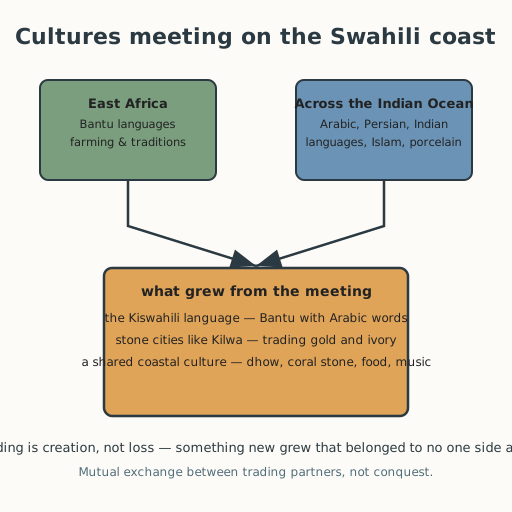
Learners analyze a case of **cultural exchange and blending** — the **Swahili coast**, where East African peoples met Arab, Persian, Indian, and Chinese traders across the Indian Ocean. From the meeting grew new things: the **Kiswahili language**, stone cities such as **Kilwa**, and a shared coastal culture.
Objectives
Objectives
- D08.S2.08.02 Analyze a case of cultural exchange and blending, such as foods, languages, or beliefs meeting, and what new things grew from it.
Essential question
What happens when cultures meet and blend — and what new things grow from it?
Key vocabulary
Materials
Standard materials
- Blending case sheet · 1 per learner A sheet showing what came from Africa, what came from across the Indian Ocean, and the new things that grew where they met (language, cities, trade, food)
- Blending cards · 1 set per group Cards naming elements that met on the Swahili coast (Bantu languages, Arabic loanwords, Chinese porcelain, Indian cloth, dhow sailing) and the new things that grew (Kiswahili, stone cities, a shared coastal culture)
Low-tech / no-cost
- A shared board or large paper Draw the "what met / what grew" diagram together
- Voice and retelling Tell the story of the Swahili coast aloud and have learners retell the blending in their own words
Enriched / lab & device
- Images of Swahili architecture and Kilwa · 1 set Photographs of the Great Mosque and Husuni Kubwa at Kilwa Kisiwani, to look at and wonder over
- A map of the Indian Ocean coast · 1 A map showing the Swahili coast and the ports it traded with, to trace the connections
Works in different contexts
- large-group Tell the story once to the whole group, then small groups sort the blending cards and fill the sheet
- multi-age Younger learners match each element to where it came from; older learners name the new things that grew and explain how blending works
- self-directed A learner reads the case, sorts the cards, and writes a short paragraph on what new things grew from the blending
- level-grouped Learners ready to extend analyze a second case of blending (for example, food crops moving across oceans) and name what new thing grew
- outdoor-only Look at the local language, food, or music and ask what came from more than one place, and what grew where they met
Lesson 5 — Cultural Exchange & Blending: The Swahili Coast
Summary
Learners analyze a case of cultural exchange and blending — the Swahili coast, where East African peoples met Arab, Persian, Indian, and Chinese traders across the Indian Ocean. From the meeting grew new things: the Kiswahili language, stone cities such as Kilwa, and a shared coastal culture.
Objectives
- Analyze a case of cultural exchange and blending — foods, languages, or beliefs meeting — and what new things grew from it. (D08.S2.08.02)
Connection
Think of a meal you love that mixes things from more than one place — rice from one region, a spice from another, a way of cooking from a third. Or a word you use that actually came from another language long ago. Cultures are not boxes kept apart; when people meet and trade, their languages, foods, and beliefs meet too — and something new grows, something that did not exist before. Today you study one of the world’s great stories of that blending.
Materials
- Blending case sheet
- Blending cards
Preparation
- Copy the blending case sheet and the blending cards.
- Retrieval: from Grade 6, recall how a technology or idea spread between cultures and changed as it moved (D08.S2.06.02); from Grade 7, recall the Indian Ocean as a route that connected peoples (D08.S3.07.02).
Facilitator note
This lesson is written to the learner (“you”). The idea to land: cultural exchange is not one culture replacing another; it is peoples meeting and something new growing from the meeting. The worked case: the Swahili coast — the East African coast (present-day Somalia to Mozambique), where Bantu-speaking African peoples met traders from Arabia, Persia, India, and China across the Indian Ocean monsoon network (S-207, S-380). What met: African languages, farming, and traditions; Arabic and Persian languages, writing, and Islam; Indian cloth; Chinese porcelain. What grew: (1) the Kiswahili language — a Bantu language in grammar and core, with many Arabic loanwords (and later Persian, Portuguese, and English ones), long written in Arabic script, and today spoken by tens of millions (S-381); (2) stone cities such as Kilwa Kisiwani, which from the 13th to 16th centuries traded African gold and ivory for Chinese porcelain, Persian ceramics, and Indian cloth, and minted its own coins; the traveler Ibn Battuta stopped there in 1331–32 and called Kilwa “one of the most beautiful cities in the world” (S-380); (3) a shared coastal culture — dhow sailing, Swahili architecture built of coral stone, and a cuisine and music that blend inland African and Indian Ocean traditions. This is a story of mutual exchange between trading partners, not conquest — an important contrast with the colonialism we study later. The ethics lens: honoring a blended culture means crediting everyone who contributed, not one side only. The egalitarian lens: the Swahili coast is a reminder that African peoples were not isolated or “discovered” by outsiders — they were central, creative partners in a vast Indian Ocean world. The global lens: the same pattern of meeting-and-growing happened everywhere — food crops moving across oceans, music mixing, languages borrowing. The community lens: blended cultures are living proof that people can build together. Keep it honest: this is documented history, told as mutual exchange (S-380, S-381, S-207).
Procedure
- Recall (5 min). From Grade 6: how did an idea or technology change as it moved between cultures? Today we watch cultures themselves meet and blend.
- Meet the meeting (8 min). On the Swahili coast of East Africa, Bantu-speaking African peoples met traders from Arabia, Persia, India, and China who sailed the monsoon seas. What happens when such different worlds meet as partners?
- Meet what grew (15 min). Sort the blending cards and discover three new things: the Kiswahili language (Bantu at its core, with many Arabic words, written for centuries in Arabic script); stone cities like Kilwa, whose merchants traded gold and ivory for Chinese porcelain, Persian ceramics, and Indian cloth, and minted their own coins; and a shared coastal culture of dhow sailing, coral-stone architecture, food, and music (S-380, S-381).
- Analyze the blending (10 min). On the case sheet, record: what came from Africa, what came from across the ocean, and what new thing grew from the meeting. Notice: the new thing — Kiswahili, the Swahili cities — belonged to no one side alone.
- Share (7 min). In a group, name one example of blending you have seen in your own life — a food, a word, a song that mixes two sources — and what new thing grew.
- Close (5 min). Blending is creation, not loss. When cultures meet as partners, the human story grows richer.
Differentiation
- Support: Provide the “what met / what grew” ideas pre-written and ask learners to match each to its source.
- Extension: Analyze a second case of blending — for example, food crops moving across oceans after 1492 — and name one new thing that grew.
Assessment
- Formative (observation): Can the learner name what met on the Swahili coast and one new thing that grew from the meeting?
- Portfolio artifact: The completed blending case sheet, kept in the portfolio.
Home connection
Find one word in your home language that came from another language, or one dish that mixes two traditions. Bring it to share.
Resources
- On Kilwa and the Swahili coast as a center of Indian Ocean trade: UNESCO World Heritage Centre, “Ruins of Kilwa Kisiwani and Ruins of Songo Mnara,” https://whc.unesco.org/en/list/144/ (S-380).
- On the Kiswahili language and its blending: Encyclopaedia Britannica, “Swahili language,” https://www.britannica.com/topic/Swahili-language (S-381).
- On the Indian Ocean as a shared space of exchange: UNESCO, “The Indian Ocean, a shared heritage,” https://www.unesco.org/en/silk-roads (S-207).
- On explicit instruction and worked examples: Kirschner, Sweller & Clark (2006), https://doi.org/10.1207/s15326985ep4102_1 (S-011).