Lesson 07 — Environmental Change & Migration: Past and Today
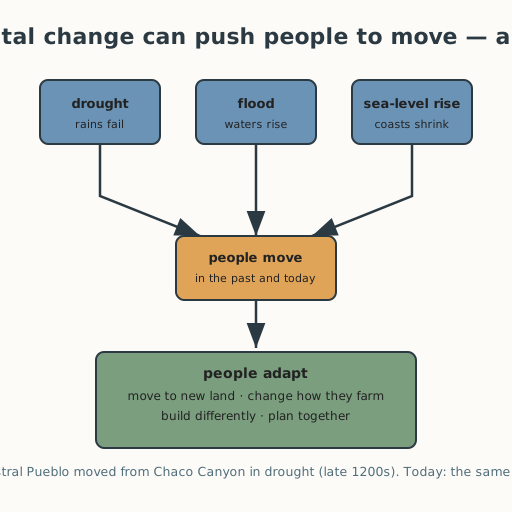
Learners analyze how **environmental change** — drought, flood, a shifting climate — has driven people to **move and adapt**, in the past (the Ancestral Pueblo of the North American Southwest) and today (sea-level rise, drought, and flood). They build an environmental-migration analysis as a portfolio artifact.
Objectives
Objectives
- D08.S3.08.02 Analyze how environmental change, such as drought, flood, or a shift in climate, has driven people to move and adapt, in the past and today.
Essential question
How has environmental change — drought, flood, a shifting climate — driven people to move and adapt, in the past and today?
Key vocabulary
Materials
Standard materials
- Environmental-migration sheet · 1 per learner A sheet with columns for the environmental change, the push to move, and how people adapted — one row for the past (Ancestral Pueblo) and one for today
- Case cards · 1 set per group Cards carrying the past case (drought and the Ancestral Pueblo) and the present case (sea-level rise, drought, and flood today) in short steps
Low-tech / no-cost
- A shared board or large paper Draw the two cases side by side and fill the columns together
- Voice and retelling Tell the two cases aloud and have learners retell them in their own words
Enriched / lab & device
- A short video or article on climate migration today · 1 An age-appropriate account of people moving because of sea-level rise, drought, or flood, to watch or read and retell
- Images of Chaco Canyon and of drought-affected landscapes · 1 set Photographs to compare the past and present cases
Works in different contexts
- large-group Present both cases once to the whole group, then small groups sort the case cards and fill the sheet
- multi-age Younger learners match each change to its consequence; older learners explain how environmental change can push people to move and how people adapt
- self-directed A learner reads both cases, fills the sheet, and writes a short paragraph on one push factor and one adaptation
- level-grouped Learners ready to extend connect this to the Maya drought from earlier in the unit and compare the two cases
- outdoor-only Look for signs of environmental stress nearby (dry ground, eroded soil, a flood mark) and ask how such change might push people to move or adapt
Lesson 7 — Environmental Change & Migration: Past and Today
Summary
Learners analyze how environmental change — drought, flood, a shifting climate — has driven people to move and adapt, in the past (the Ancestral Pueblo of the North American Southwest) and today (sea-level rise, drought, and flood). They build an environmental-migration analysis as a portfolio artifact.
Objectives
- Analyze how environmental change, such as drought, flood, or a shift in climate, has driven people to move and adapt, in the past and today. (D08.S3.08.02)
Connection
Have you ever seen a dry riverbed, a flooded street, or a shore the sea has crept over? When the land or water people depend on changes, their lives change with it — and sometimes they move. This is not new: for thousands of years, environmental change has been one of the reasons people move and adapt. Today you look at one story from the past and one from our own time, and see the same pattern at work.
Materials
- Environmental-migration sheet
- Case cards
Preparation
- Copy the environmental-migration sheet and the case cards.
- Retrieval: from Grade 7, recall that migration can be voluntary or forced and has causes and effects (D08.S3.07.01); from earlier this unit, recall the drought explanation for the Maya collapse (D08.S1.08.01).
Facilitator note
This lesson is written to the learner (“you”). The idea to land: environmental change (drought, flood, a shifting climate) can be a push factor — a reason people move — and people also adapt, changing how they live rather than only leaving. The two cases: (1) the past — the Ancestral Pueblo. Chaco Canyon, in present-day New Mexico, was a thriving regional center of the Ancestral Pueblo people from about 850 to 1250 CE (S-382). Sustained drought in the late 1200s — recorded in tree rings — contributed to people leaving Chaco and nearby centers, migrating to new pueblos along the Rio Grande and elsewhere, where their descendants live today (S-382). (2) today. Around the world, people are moving — within and across borders — because of sea-level rise (low-lying islands and coasts), drought, and flood, as the climate changes; the International Organization for Migration documents environment and climate as real drivers of migration (S-383, S-086). People adapt too: moving to higher ground, changing crops, building differently, and planning together. The environment lens: environmental change has shaped human history for millennia — it is not new, but today’s change is fast and, for many, made worse by human activity (S-005). The ethics lens: people who move because of environmental change are not “the problem” — they are people adapting with courage; how we welcome them is a moral question. The egalitarian lens: those who contributed least to climate change are often hit first and hardest — a matter of justice, not only of weather (S-005). The global lens: this happens everywhere — small island nations, dry Sahel lands, river deltas — and it always has. Keep it honest: migration is rarely caused by the environment alone; economy, safety, and family mix in, and we distinguish evidence from values (philosophy §5).
Procedure
- Recall (5 min). From Grade 7: what makes migration voluntary or forced? From earlier this unit: what environmental change may have helped end the Classic Maya cities? Today we watch environmental change drive movement — past and present.
- Meet the past (12 min). Chaco Canyon was a center of the Ancestral Pueblo people from about 850 to 1250 CE. Then a long drought, recorded in tree rings, set in through the late 1200s. People adapted and moved — to new pueblos along the Rio Grande and elsewhere, where their descendants live today (S-382).
- Meet today (12 min). Around the world, people now move — within and across borders — because of sea-level rise on low coasts and islands, and because of drought and flood as the climate changes (S-383, S-086). People also adapt: moving to higher ground, changing crops, building differently.
- Analyze (12 min). Fill the sheet: for each case, name the environmental change, the push to move, and how people adapted. Notice what is the same across a thousand years.
- Share (6 min). In a group, say one way the past case and today’s case are alike, and one way they differ.
- Close (3 min). Environmental change has always been part of the human story. What is new today is the speed — and the question of how we respond to the people who must move.
Differentiation
- Support: Provide the “change / push / adaptation” ideas pre-written and ask learners to sort them into the correct rows.
- Extension: Connect this lesson back to the Maya drought (Lesson 2) and write one sentence comparing the two cases of drought-driven change.
Assessment
- Formative (observation): Can the learner name an environmental push factor and one way people adapted, in both the past and the present?
- Portfolio artifact: The completed environmental-migration sheet, kept in the portfolio.
Home connection
Ask at home: has our family or anyone we know ever had to move or change how they live because of weather, drought, or flood? Compare with the two cases.
Resources
- On Chaco Canyon and the Ancestral Pueblo: U.S. National Park Service, “Chaco Culture National Historical Park,” https://www.nps.gov/chcu/index.htm (S-382).
- On environment and climate as drivers of migration today: IOM, “Migration, Environment and Climate Change,” https://www.iom.int/migration-environment-and-climate-change (S-383); IOM, “Who is a migrant?” (S-086).
- On climate change as a global, human-amplified process: Intergovernmental Panel on Climate Change (S-005).
- On explicit instruction and worked examples: Kirschner, Sweller & Clark (2006), https://doi.org/10.1207/s15326985ep4102_1 (S-011).