Lesson 01 — Ethics, Justice & Civic Power: Where We've Been, Where We're Going
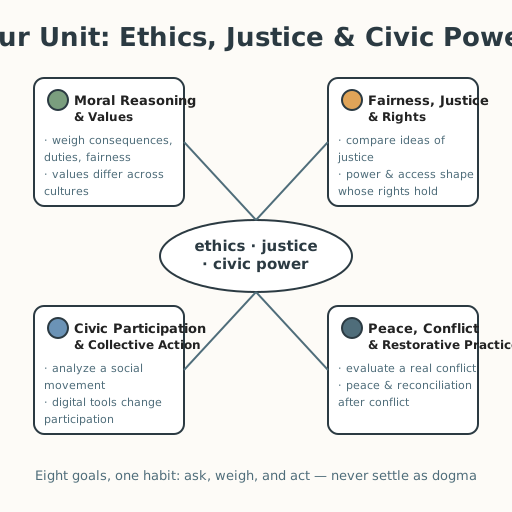
Learners recall four Grade-7 ideas — who is helped/harmed/what is fair, human rights, how people influence decisions, and restorative steps — and preview this unit's four strands and eight goals. They meet the unit's organizing idea: we weigh dilemmas, compare ideas of justice, study collective action, and pursue peace — and we hold every question as a question, never as dogma.
Objectives
Objectives
- D09.S1.08.01 Evaluate a real-world moral dilemma by weighing consequences, duties, and fairness, and defend a reasoned position.
- D09.S1.08.02 Explain how values and moral codes differ across cultures and argue for respectful engagement with those differences.
- D09.S2.08.01 Compare different ideas of justice (such as equal treatment, need, and restitution) and apply them to a real case.
- D09.S2.08.02 Analyze how power and access shape who gets their rights protected and who does not.
- D09.S3.08.01 Analyze a social movement (its goals, strategies, and effects) and evaluate what made it succeed or struggle.
- D09.S3.08.02 Explain how digital tools change civic participation, and weigh the risks and benefits of organizing online.
- D09.S4.08.01 Evaluate a real conflict and weigh peaceful, restorative, and other responses, defending a reasoned choice.
- D09.S4.08.02 Analyze how groups and societies have pursued peace and reconciliation after conflict, using a historical example.
Essential question
What does it mean to think about right and wrong, fairness, and power — and where is this unit going?
Key vocabulary
Materials
Standard materials
- Unit map sheet · 1 per learner A one-page map of the unit's four strands and eight goals, to mark and return to across the unit
- Recall cards · 1 set per group Cards recalling four Grade-7 ideas — helped/harmed/fair, human rights, influence, restorative steps
Low-tech / no-cost
- A shared board or large paper Draw the four strands and eight goals together; no printed map needed
- Voice and memory Recall the Grade-7 ideas aloud as a group instead of using cards
Enriched / lab & device
- A digital slideshow of the four strands · 1 One image or short video per strand to preview each
- A wonder box (physical or shared document) · 1 A place to collect every learner's questions about the unit to revisit at the close
Works in different contexts
- large-group Do the recall round as a whole group with hands raised and ideas recorded on the board, then small groups sort the recall cards
- multi-age Younger learners match each recall idea to a picture; older learners state the idea in one sentence and connect it to the new unit
- self-directed A learner reads the unit map, writes four sentences recalling the Grade-7 ideas, and lists one question per strand
- level-grouped Learners ready to extend write a fifth Grade-7 idea not on the cards and explain why it matters here
- outdoor-only Sit in a circle outdoors and talk through the four strands as four parts of one shared life, pointing to a real group decision nearby as an example
Lesson 1 — Ethics, Justice & Civic Power: Where We’ve Been, Where We’re Going
Summary
Learners recall four Grade-7 ideas — the who is helped, who is harmed, what is fair frame, human rights, how people influence decisions, and restorative steps — and preview this unit’s four strands and eight goals. They meet the unit’s organizing idea: we weigh dilemmas, compare ideas of justice, study collective action, and pursue peace — and we hold every question as a question, never as a settled answer.
Objectives
- Begin to name the unit’s eight goals and see how they trace to the four strands. (D09.S1.08.01–D09.S4.08.02)
- Recall from Grade 7 the tools we already carry — weighing who is helped and harmed, naming human rights, noticing how people influence decisions, and repairing harm through listening. (builds on D09.S1.07.01, D09.S2.07.02, D09.S3.07.01, D09.S4.07.01)
Connection
Think of the last time you saw something unfair — a line skipped, a voice talked over, a place closed to some people but not others. In that moment you were already doing ethics: you noticed something was wrong, you cared, and you wondered what to do. Ethics is not a subject that lives only in books; it is the everyday habit of asking is this right? who is helped? who is left out? and then deciding how to act. Today we gather the tools we already have and see where they are taking us.
Materials
- Unit map sheet
- Recall cards
Preparation
- Copy the unit map sheet and recall cards.
- Retrieval: from Grade 7, recall (a) the frame who is helped, who is harmed, what is fair, (b) human rights, (c) how people influence decisions, and (d) restorative steps. Today we link those to the new unit.
Facilitator note
This lesson is written to the learner (“you”). It is the unit’s opening and retrieval pass, so the goals are modest: (1) recall four Grade-7 ideas — the helped/harmed/fair frame (S-001), human rights (S-060, S-149), ways people influence decisions, and restorative steps (S-022, S-161); (2) preview the unit’s four strands — moral reasoning & values, fairness/justice/rights, civic participation & collective action, peace/conflict & restorative practice — and its eight goals; (3) plant the organizing idea: we ask, weigh, and act, and we hold questions open (philosophy §11). Do not try to teach the eight goals today; just name and locate them. The ethics lens: the whole unit is one long practice in weighing what is right. The egalitarianism lens: every question asks who benefits and who is left out. The global lens: the same questions are asked differently in every culture, and none of those ways is the “default” (philosophy §4). The critical-thinking lens: we distinguish evidence from values all year (philosophy §5). Spacing note (S-039): this recall pass is what makes the unit’s ideas stick later. Keep it warm and open — nothing here is a verdict, a ranking, or a creed.
Procedure
- Recall (10 min). In a small group, look at four recall cards: helped/harmed/fair, human rights, influence decisions, restorative steps. For each, say in one sentence what you remember from Grade 7.
- Connect the four (5 min). What do all four have in common? (Each is about how people decide what is right and act on it — alone and together.)
- Meet the map (10 min). Look at the unit map. Four strands: moral reasoning & values, fairness, justice & rights, civic participation & collective action, peace, conflict & restorative practice. Eight goals — two per strand. Read each goal aloud once; don’t worry about understanding them yet.
- Plant the big idea (10 min). The unit’s idea in one breath: we ask what is right, weigh it with care, and act with others — and we never pretend the answer is easy or already settled. Say it back in your own words.
- Wonder (10 min). Write one question about each strand in the wonder box. Which question do you most want answered by the end of the unit?
- Close (5 min). Today we remembered what we know and saw the road ahead. Next: we weigh a real dilemma — consequences, duties, and fairness.
Differentiation
- Support: Give sentence starters for the recall round (“A right is…”, “To repair harm means…”).
- Extension: Add a fifth Grade-7 idea of your own and say why it will matter in this unit.
Assessment
- Formative (observation): Can the learner recall each Grade-7 idea in one sentence and name the unit’s four strands?
- Artifact: The completed unit map (or the learner’s written recall), kept in the portfolio.
Home connection
Ask someone at home: what is one thing that felt unfair when they were your age, and what did they do about it? Bring the story (no names needed) to the next lesson.
Resources
- On the Grade-7 helped/harmed/fair frame and responsible decision-making: CASEL, https://casel.org/fundamentals-of-sel/ (S-001).
- On children’s rights: UNICEF Convention on the Rights of the Child, https://www.unicef.org/child-rights-convention (S-060); Universal Declaration of Human Rights, https://www.un.org/en/about-us/universal-declaration-of-human-rights (S-149).
- On restorative practice: International Institute for Restorative Practices, https://www.iirp.edu/ (S-022); Zehr, Changing Lenses (1990) (S-161).
- On the payoff of spaced retrieval: Dunlosky et al. (2013), https://doi.org/10.1177/1529100612453266 (S-039).