Lesson 02 — Weighing Consequences, Duties, and Fairness
Learners meet three lenses for weighing a moral dilemma — consequences, duties, and fairness — see a worked example, and then weigh two more dilemmas themselves, defending a reasoned position in writing and talk. The three lenses are tools for thinking, not a formula that yields one "correct" answer.
Objectives
Objectives
- D09.S1.08.01 Evaluate a real-world moral dilemma by weighing consequences, duties, and fairness, and defend a reasoned position.
Essential question
How do I evaluate a real moral dilemma by weighing consequences, duties, and fairness — and defend my position with reasons?
Key vocabulary
Materials
Standard materials
- Dilemma cards · 1 set per group Three short, age-appropriate dilemmas — a found item, a promised secret, a scarce resource
- Three-lens chart · 1 per learner A three-column chart (consequences, duties, fairness) to weigh each dilemma
Low-tech / no-cost
- Paper and pencil Draw the three columns by hand; speak the dilemmas aloud
- Voice and body Act out one dilemma and weigh it together in a circle
Enriched / lab & device
- A shared document or slideshow · 1 Collect and display the class's weighed positions side by side
Works in different contexts
- large-group Model one dilemma whole-group on the board, then small groups weigh two more and share back
- multi-age Younger learners weigh one lens at a time; older learners weigh all three and add a fourth lens of their own
- self-directed A learner reads the worked example, weighs two dilemmas alone on the chart, and writes a one-paragraph position
- level-grouped Learners ready to extend write the strongest counterargument to their own position and answer it
- outdoor-only Use a dilemma from the immediate setting — sharing scarce shade or water — and weigh it aloud together
Lesson 2 — Weighing Consequences, Duties, and Fairness
Summary
Learners meet three lenses for weighing a moral dilemma — consequences, duties, and fairness — study a worked example, and then weigh two more dilemmas themselves, defending a reasoned position in writing and talk. The three lenses are tools for thinking, not a machine that prints one “correct” answer.
Objectives
- Evaluate a real-world moral dilemma by weighing consequences, duties, and fairness, and defend a reasoned position. (D09.S1.08.01)
Connection
You find a wallet on the ground with money in it and a name inside. No one is watching. What do you do? Almost everyone feels the pull of several answers at once — keep it (no one would know), return it (it belongs to someone), give it to an adult (let someone else decide). That pull is the heart of ethics: a real dilemma is not a choice between good and evil but between two or more good-seeming things that cannot all be done. Today you learn three lenses for looking at such a moment clearly before you decide.
Materials
- Dilemma cards
- Three-lens chart
Preparation
- Copy the dilemma cards and three-lens charts.
- Prepare three short dilemmas (see the worked example and practice list below). Choose ones a learner can recognize from ordinary life — school, family, neighborhood, public space — so no learner needs special knowledge to enter the conversation.
Facilitator note
This lesson is written to the learner. It introduces the unit’s first skill — weighing a dilemma with three lenses — so it uses a worked example and guided practice before independent work (S-011; Kirschner, Sweller & Clark, 2006). The three lenses map onto long-standing ethical traditions: consequences (what happens to everyone affected — consequentialism, S-386), duties (what I owe — deontology, S-387), and fairness (who gets what and who is left out — distributive justice, S-388). Do not present these as rival “teams” to pick from; present them as three questions to ask together, because most careful judgments draw on all three. This honors philosophy §11 (inquiry, not creed) and philosophy §5 (distinguish evidence from values): the lenses describe ways of reasoning, not a ranking of what is right. The egalitarianism lens lives inside the fairness question: always ask who is left out. The ethics lens is the whole lesson. Keep the climate safe: no learner’s answer is judged; the standard is does your reason hold up and do you hear other reasons. A learner who weighs only one lens is not wrong — invite them to try a second lens, never shame them (mastery, not ranking).
Procedure
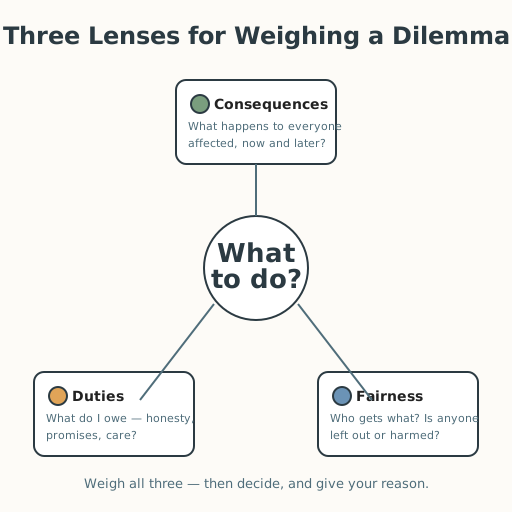
- Meet the three lenses (10 min). Look at the three-lens chart. Three questions to ask of
any dilemma:
- Consequences — what will happen to everyone affected, now and later?
- Duties — what do I owe others — honesty, keeping promises, care?
- Fairness — who gets what? is anyone left out or harmed?
- Worked example (12 min). Watch and listen as we weigh a first dilemma together. Dilemma:
a friend asks you to lie to a teacher about where they were, to keep them out of trouble.
- Consequences: the lie might save your friend trouble now, but it could harm trust later, and hurt the person lied about.
- Duties: you owe honesty to the teacher and care to your friend — two duties pull against each other.
- Fairness: is it fair to the teacher, or to others who follow the rules, to be deceived? Then hear the position: “I would not lie, because honesty matters and the lie would quietly hurt trust — but I would stand with my friend and help them face it.” Notice: a reasoned position gives reasons, and it can be challenged.
- Guided practice (13 min). In pairs, weigh a second dilemma aloud: you find money in the library with no name on it. Fill the three columns together, then each say one position and one reason.
- Independent weigh (12 min). Choose a third dilemma from the cards — a scarce resource must be divided among people with unequal need. Weigh all three lenses on your own chart, then write a four-sentence position: what you would do, and one reason from each lens.
- Feedback and revisit (5 min). Trade charts with a partner. Ask: does their position give a reason from each lens? If a lens is missing, say so kindly, and they try again.
- Close (3 min). The three lenses are not a tie-breaker that always agrees with itself — they are a way to see more clearly. Next: how values and moral codes differ across cultures.
Differentiation
- Support: Provide sentence starters (“The consequence of this is…”, “My duty here is…”, “It is fair/unfair because…”).
- Extension: Write the strongest counterargument to your own position, then answer it in one sentence.
Assessment
- Formative (self/peer): Does the learner’s written position give a reason from consequences, duties, and fairness, and can they defend it when a peer questions it?
- Artifact: The completed three-lens chart and the four-sentence position, kept in the portfolio.
Home connection
Tell someone at home about a small dilemma you faced this week and weigh it out loud with the three lenses. Ask them: which lens do they lean on first, and why?
Resources
- On reasoning from consequences: Stanford Encyclopedia of Philosophy, “Consequentialism,” https://plato.stanford.edu/entries/consequentialism/ (S-386).
- On reasoning from duties: Stanford Encyclopedia of Philosophy, “Deontological Ethics,” https://plato.stanford.edu/entries/ethics-deontological/ (S-387).
- On fairness as distribution: Stanford Encyclopedia of Philosophy, “Distributive Justice,” https://plato.stanford.edu/entries/justice-distributive/ (S-388).
- On explicit instruction and worked examples for new skills: Kirschner, Sweller & Clark (2006), https://doi.org/10.1207/s15326985ep4102_1 (S-011).
- On philosophy with young learners as a tradition: Lipman, Harry Stottlemeier’s Discovery (1974) (S-094).