Lesson 04 — Three Ideas of Justice: Equal Treatment, Need, and Restitution
Learners compare three ideas of justice — equal treatment, need, and restitution — and apply each to one real case of sharing a scarce resource. They see that justice is more than one thing, and that fair answers often blend the three.
Objectives
Objectives
- D09.S2.08.01 Compare different ideas of justice (such as equal treatment, need, and restitution) and apply them to a real case.
Essential question
How do I compare ideas of justice — equal treatment, need, and restitution — and apply them to a real case?
Key vocabulary
Materials
Standard materials
- Justice case sheet · 1 per learner One real, concrete case — a scarce resource divided after a disaster — to apply the three ideas of justice
- Three-ideas chart · 1 per learner A three-column chart (equal treatment, need, restitution) with room to apply each to the case
Low-tech / no-cost
- Paper and pencil Draw the three columns by hand; tell the case aloud
- Counters or found objects · 20 per group Physically divide the scarce resource three different ways to feel each idea of justice
Enriched / lab & device
- A short news story or video about a real resource-allocation decision · 1 To compare the three ideas against a documented real-world case
Works in different contexts
- large-group Apply the three ideas to the case whole-group on the board, then pairs defend which idea (or mix) is most just
- multi-age Younger learners physically divide counters; older learners write which idea each division uses and why
- self-directed A learner reads the case, fills the three-column chart alone, and writes which idea — or blend — they would choose
- level-grouped Learners ready to extend design a hybrid that uses all three ideas and justify the proportions
- outdoor-only Use water, shade, or food as the scarce resource and divide it three ways in the open air
Lesson 4 — Three Ideas of Justice: Equal Treatment, Need, and Restitution
Summary
Learners compare three ideas of justice — equal treatment, need, and restitution — and apply each to one real case of sharing a scarce resource. They discover that justice is more than one thing, and that careful answers often blend the three.
Objectives
- Compare different ideas of justice (such as equal treatment, need, and restitution) and apply them to a real case. (D09.S2.08.01)
Connection
A drought leaves a village with less water than everyone needs. Who should get it — everyone the same share, those who are thirstiest or most at risk, or those whose crops were destroyed and must be made whole again? Each answer feels fair in a different way. That is the discovery behind today’s lesson: justice is not one rule but several ideas, and they sometimes point in different directions. You will learn to tell them apart and to use them on a real case.
Materials
- Justice case sheet
- Three-ideas chart
- Counters (low-tech)
Preparation
- Copy the case sheet and three-ideas charts.
- Choose one concrete, age-appropriate case a learner can reason about without specialized knowledge — for example, dividing scarce water, food, or medicine after a disaster, or repairing a harm done within a school. Prepare the facts plainly (who is affected, what is scarce, what was lost).
Facilitator note
This lesson is written to the learner. It opens strand 2. The three ideas are distinct and real, so teach them explicitly with a worked example before independent application (S-011): equal treatment (everyone the same — a core of formal equality), need (those in greater need get more — the distributive idea), and restitution (those who were harmed are made whole again — the repair idea; S-161, S-022) — an idea with deep roots in Indigenous peacemaking circles and Ubuntu, not only in Western theory. These map onto long-standing debates in the theory of justice (S-388). Hold them as ideas to compare, not a menu where one is “correct” (philosophy §11). The egalitarianism lens is central: ask who is left out by each idea — equal treatment can ignore unequal need; need can ignore past harm; restitution alone may not feed anyone tomorrow. The ethics lens: choosing is itself a moral act, and the standard is a reasoned choice, not a “right” answer. The critical-thinking lens: the same word “fair” hides three different ideas — learning to name them is the skill. When learners disagree, that is the point: have them name which idea of justice they are using, and the disagreement often becomes clearer. Distinguish description from value: the three ideas describe ways of being just; the learner’s choice among them is a value judgment to be defended, not graded (philosophy §5).
Procedure
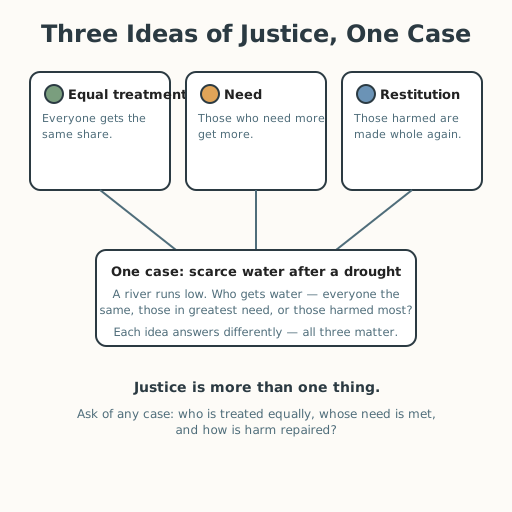
- Meet the three ideas (10 min). Read the three-ideas chart. Three ways to answer “what is
just?” —
- Equal treatment: everyone gets the same share.
- Need: those who need more get more.
- Restitution: those who were harmed are made whole again.
- Worked example (12 min). Listen as we apply all three to one case: a drought leaves a
village with less water than everyone needs.
- Equal treatment: every household gets the same amount.
- Need: the sick, the young, and those with the least get more.
- Restitution: farmers whose crops died first get water to replant. Notice each is fair in a different way — and each leaves someone out.
- Apply to a new case (15 min). Read the case sheet. On your chart, write what each idea of justice would do, and who benefits and who is left out under each.
- Defend a choice (12 min). In pairs, tell each other which idea — or which blend of the three — you would choose, and why. A blend is allowed and often best: “equal shares as a floor, extra for the most vulnerable, and some set aside to repair the damage.”
- Feedback (4 min). Ask your partner: did I name the idea I was using? did I notice who is left out? If not, say so kindly and try again.
- Close (2 min). Justice is more than one thing. Next: how power and access shape whose rights are actually protected.
Differentiation
- Support: Physically divide 20 counters three ways to feel equal treatment, need, and restitution before writing.
- Extension: Design a hybrid plan that uses all three ideas and justify the proportions you give to each.
Assessment
- Formative (peer): Can the learner name which idea (or blend) their plan uses, and can they say who benefits and who is left out?
- Artifact: The completed three-ideas chart and the defended choice, kept in the portfolio.
Home connection
Ask someone at home how they would divide a scarce thing fairly — and which they would weigh more, equal shares or greatest need. Do they also think about repairing past harm? Compare answers.
Resources
- On the theory of justice and its competing ideas: Stanford Encyclopedia of Philosophy, “Distributive Justice,” https://plato.stanford.edu/entries/justice-distributive/ (S-388).
- On restitution and repair as justice: Zehr, Changing Lenses (1990) (S-161); International Institute for Restorative Practices, https://www.iirp.edu/ (S-022).
- On explicit instruction and worked examples for new skills: Kirschner, Sweller & Clark (2006), https://doi.org/10.1207/s15326985ep4102_1 (S-011).