Lesson 05 — Power and Access: Whose Rights Are Protected?
Learners analyze how power and access shape whose rights are protected and whose are not, using a real case of a right declared on paper but unevenly reached in practice. They trace barriers and levers, and see that a right is only real when a person can reach it.
Objectives
Objectives
- D09.S2.08.02 Analyze how power and access shape who gets their rights protected and who does not.
Essential question
How do power and access shape who gets their rights protected — and who does not?
Key vocabulary
Materials
Standard materials
- Rights-and-access case sheet · 1 per learner One concrete case — a right on paper that some people can reach and others cannot — to analyze
- Power-and-access chart · 1 per learner A chart to trace who reaches a right, who does not, and what stands in the way
Low-tech / no-cost
- Paper and pencil Draw the chart by hand; discuss the case aloud
- A role-play Act out the case with learners taking the roles of those with and without access
Enriched / lab & device
- A documented rights case (news or human-rights report) · 1 To trace a real right — voting, water, education, a fair trial — and its barriers in the world today
Works in different contexts
- large-group Trace one case whole-group on the board, then small groups trace a second and share one barrier and one lever
- multi-age Younger learners sort cards of "barriers" and "levers"; older learners write who reaches the right and who is blocked
- self-directed A learner reads the case, fills the chart alone, and writes one sentence on who is left out and why
- level-grouped Learners ready to extend connect a local barrier to a global one, or design one lever that would widen access
- outdoor-only Use a nearby right — safe water, shade, a path to school — and walk through who can reach it and who cannot
Lesson 5 — Power and Access: Whose Rights Are Protected?
Summary
Learners analyze how power and access shape whose rights are protected and whose are not, using a real case of a right declared on paper but unevenly reached in practice. They trace barriers and levers, and see that a right is only real when a person can reach it.
Objectives
- Analyze how power and access shape who gets their rights protected and who does not. (D09.S2.08.02)
Connection
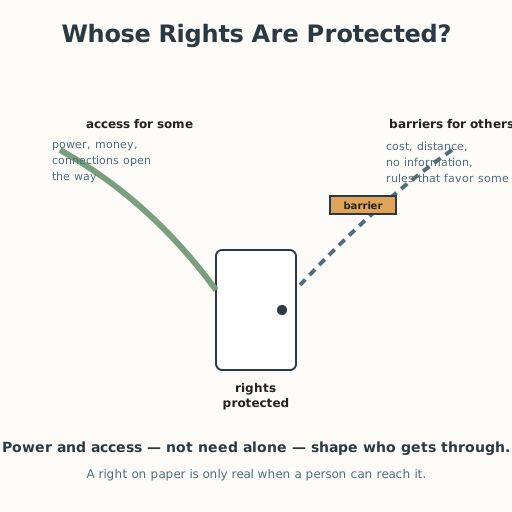
A law says every child has the right to go to school. But one child lives a two-hour walk from the nearest school, another cannot afford the fees, another is told the school is not for children like them. The right is the same for all three — but it is not reached by all three. That gap between a right on paper and a right in a person’s life is what power and access shape. Today you learn to trace that gap, and to name what opens it and what closes it.
Materials
- Rights-and-access case sheet
- Power-and-access chart
Preparation
- Copy the case sheet and charts.
- Choose one concrete case a learner can reason about: a declared right (education, safe water, voting, health care, a fair hearing) that some people in a community can reach and others cannot. Keep it faithful and non-sensational; the point is analysis, not shock.
Facilitator note
This lesson is written to the learner. It delivers the second strand-2 goal. Two working definitions anchor it: power is the ability to influence or decide — for oneself and for others (S-275, Lukes); access is whether a person can actually reach a right, through cost, distance, information, or rules. Hold these as descriptions, not verdicts (philosophy §5). The egalitarianism lens is the spine: the lesson exists to notice who is left out and why, not to blame individuals — barriers are often built into rules and structures, not into any one person’s intentions (this echoes the Grade-6 idea that systems can treat groups unfairly even when no one intends harm). The ethics lens: naming an unfair gap is the first step toward closing it, and the lesson ends with a lever — something that widens access — so learners leave with agency, not despair (facilitation.md “holding difficult topics safely”). The global lens: the same right is reached unevenly in every country; use examples from more than one region (the right to vote granted at very different times — S-327; the right to safe water unevenly met — S-065; the right to be heard — S-060, S-149). The community lens: access is built or blocked in the places learners actually live. Keep the tone honest and calm: these are real and serious facts, and the learner’s job is to see clearly and name one lever, which is both true to the world and age-appropriate.
Procedure
- Meet the two ideas (8 min). Two words today: power (the ability to influence or decide) and access (whether you can actually reach a right). Say each in your own words, then give one everyday example of each.
- Read the case (8 min). Read the rights-and-access case: a right declared for everyone — education, water, voting, health care, or a fair hearing — that some people reach and others do not.
- Trace it (15 min). On your chart, answer three questions: Who reaches this right? Who does not? What stands in the way — cost, distance, information, or a rule? Name the barriers one by one.
- Find the power (8 min). For each barrier, ask: who or what keeps this barrier in place, and who has the power to remove it? Write one sentence naming the power behind the barrier.
- Name a lever (10 min). A lever is something that widens access — a rule changed, a path built, information shared, a group organized. Write one lever for this case and say how it would help.
- Feedback and close (6 min). Share your lever with a partner. Ask: does it remove a real barrier, or only wish it away? A right on paper is only real when a person can reach it — and access can be widened. Next: how social movements widen access together.
Differentiation
- Support: Sort pre-made “barrier” and “lever” cards before writing your own.
- Extension: Connect the case’s barrier to a similar barrier in another country, or design a second lever that reaches the most-left-out person.
Assessment
- Formative (observation): Can the learner name at least one barrier and one lever, and link the barrier to a form of power rather than to an individual’s fault?
- Artifact: The completed power-and-access chart and the lever, kept in the portfolio.
Home connection
Ask someone at home about a right people around you take for granted that is hard to reach for someone else — and what would widen access. Bring one idea back.
Resources
- On power as the ability to influence or decide: Lukes, Power: A Radical View (1974/2005) (S-275).
- On rights and their uneven reach: Universal Declaration of Human Rights, https://www.un.org/en/about-us/universal-declaration-of-human-rights (S-149); UNICEF Convention on the Rights of the Child, https://www.unicef.org/child-rights-convention (S-060).
- On the right to vote granted at very different times: Encyclopaedia Britannica, “Woman suffrage,” https://www.britannica.com/topic/woman-suffrage (S-327).
- On uneven access to safe water: WHO/UNICEF Joint Monitoring Programme, https://washdata.org/ (S-065).