Lesson 03 — Values and Moral Codes Across Cultures
Learners compare how values and moral codes differ across cultures — using hospitality, respect for elders, honesty, care for the group, and care for the land as living examples — and practice respectful engagement: understanding is not agreement, and difference is not defect.
Objectives
Objectives
- D09.S1.08.02 Explain how values and moral codes differ across cultures and argue for respectful engagement with those differences.
Essential question
How do values and moral codes differ across cultures, and how do I engage those differences with respect?
Key vocabulary
Materials
Standard materials
- Value cards · 1 set per group Cards naming values held dear in different communities — hospitality, respect for elders, honesty, care for the group, care for the land
- Values comparison chart · 1 per learner A two-column chart for comparing two communities' values and where they agree and differ
Low-tech / no-cost
- Paper and pencil Draw the comparison chart by hand; name values aloud from memory
- A shared board Collect the whole group's values and sort them together
Enriched / lab & device
- Short video or photo set of daily life in two communities · 1 To ground the comparison in real, respectful images rather than stereotypes
- A world map · 1 Mark where each community lives and note that values travel and change
Works in different contexts
- large-group Compare two communities whole-group, then pairs compare a second pairing and share one finding
- multi-age Younger learners match a value to a picture of daily life; older learners name where two communities agree and differ and why
- self-directed A learner chooses two communities, fills the chart from a provided short text, and writes a reflection on respectful engagement
- level-grouped Learners ready to extend examine a case where two values conflict within one community
- outdoor-only Discuss how the place people live shapes what they value — sea people, mountain people, desert people — without ranking any way of life
Lesson 3 — Values and Moral Codes Across Cultures
Summary
Learners compare how values and moral codes differ across cultures, using living examples — hospitality, respect for elders, honesty, care for the group, and care for the land — and practice respectful engagement: understanding is not the same as agreeing, and difference is not a defect to be fixed.
Objectives
- Explain how values and moral codes differ across cultures and argue for respectful engagement with those differences. (D09.S1.08.02)
Connection
In some homes, you leave your shoes at the door; in others, you keep them on. In some places a meal is shared from one plate; in others everyone has their own. In some communities elders are greeted first and spoken to with special words; in others age is hardly marked. None of these is “right” and the others “wrong” — they are different answers to the same deep question: how do we show respect, and what do we owe each other? Today you learn to look at those differences with curiosity and care instead of judgment.
Materials
- Value cards
- Values comparison chart
Preparation
- Copy the value cards and comparison charts.
- Prepare two short, respectful one-paragraph descriptions of two communities and the values they hold dear (for example, a hospitality-centered community and a land-stewardship-centered community). Use real, well-documented examples and avoid stereotypes (see Resources).
Facilitator note
This lesson is written to the learner. Its job is the second strand-1 goal: explain that values and moral codes differ across cultures and argue for respectful engagement — not to rank cultures. Hold the line on the three commitments that make this safe and honest (philosophy §4, §11, and facilitation.md “holding difficult topics safely”): (1) description before judgment — learners describe what a community values before they evaluate it; (2) no ranking — no culture’s moral code is “better” or “more advanced” than another, and the lesson says so plainly; (3) understanding ≠ agreement — respectful engagement means listening and asking, not surrendering your own judgment; a learner may disagree with a practice and still treat its people with respect. The global lens is the whole lesson; use examples from many regions and from both cultural and faith traditions (Ubuntu in Southern Africa, filial respect in East Asian traditions, land stewardship in many Indigenous traditions, hospitality in Southwest Asian and Mediterranean traditions, ahimsa — do no harm — in Buddhist and Jain traditions, and the Golden Rule, which recurs across many of the world’s religions and wisdom traditions). Hold these side by side as equals to be understood, never ranked (philosophy §11). The egalitarianism lens: notice that within any culture people disagree about values — no culture is one voice. The ethics lens: respect for persons across difference is itself a value we practice, not preach. If a learner makes a sweeping or dismissive claim about a people, name it gently and redirect to the specific value and its reason. Cite the UNESCO Universal Declaration on Cultural Diversity (S-389) as a shared international commitment (a value), not as a scientific fact. Keep the wonder box open.
Procedure
- Notice differences near you (8 min). With a partner, name one everyday rule or custom that differs between two families or places you know (shoes, food, greetings, music). What value might sit behind each one?
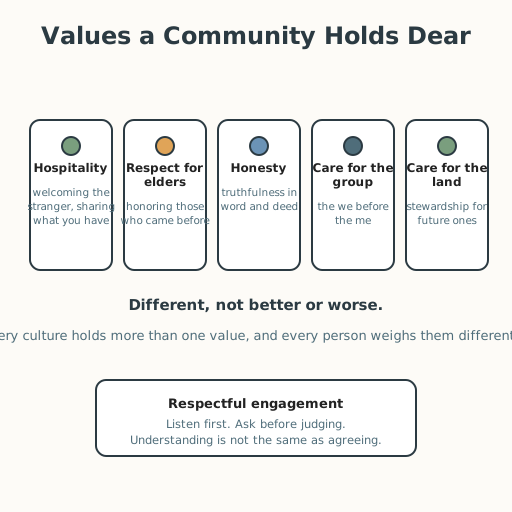
- Meet five values (10 min). Look at the value cards: hospitality, respect for elders, honesty, care for the group, care for the land. For each, say one real example of a community that holds it dear. Then notice: the same value shows up in many cultures, but which values a community puts first differs.
- Compare two communities (15 min). Read the two short descriptions. On your chart, note for each community: what it values most, why, and what it teaches children. Then write one place they agree and one place they differ.
- Practice respectful engagement (12 min). In pairs, role-play a visit between a person from each community. Rules of the exchange: listen first, ask before judging, and say back what you heard before you respond. Understanding is not agreeing — but it must come first.
- Argue for it (7 min). Write three sentences: why does respectful engagement with another culture’s values matter? Use one concrete example from your comparison.
- Close (3 min). Values differ; that is not a problem to solve but a fact of human life to meet with respect. Next: comparing ideas of justice.
Differentiation
- Support: Provide a sentence frame (“They value ___ because ___; we agree on ___, and differ on ___.”).
- Extension: Find a case where two values within one community pull in different directions (honesty vs. care for the group) and explain the tension.
Assessment
- Formative (peer): Does the learner’s comparison name a real value for each community, and does their argument for respectful engagement use a concrete example rather than a slogan?
- Artifact: The completed comparison chart and the three-sentence argument, kept in the portfolio.
Home connection
Ask someone at home about a custom from their family or community that a newcomer might misunderstand, and the value behind it. What would help a newcomer meet it with respect?
Resources
- On cultural diversity as a shared commitment: UNESCO Universal Declaration on Cultural Diversity, https://www.unesco.org/en/legal-affairs/unesco-universal-declaration-cultural-diversity (S-389).
- On a land-stewardship tradition and its living practice: Smithsonian National Museum of the American Indian, https://americanindian.si.edu/ (S-203); Britannica Kids, “Haudenosaunee (Iroquois),” https://kids.britannica.com/kids/article/Haudenosaunee/353303 (S-142).
- On distinguishing evidence from values and holding questions open: see
docs/philosophy.md§5 and §11.