Lesson 01 — Media, Technology & Our Earth Home: Where We've Been, Where We're Going
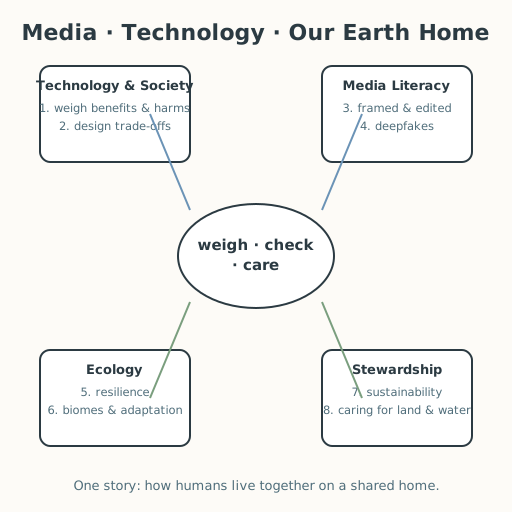
Learners recall three Grade-7 ideas — trustworthy sources, misinformation versus disinformation, and the basics of climate change — and preview this unit's four strands and eight goals. They meet the unit's organizing idea: we read **media** critically, weigh **technology** for who it helps and harms, and live as part of the **Earth** we call home.
Objectives
Objectives
- D10.S1.08.01 Analyze the benefits and harms of a technology for different groups of people, and weigh them.
- D10.S1.08.02 Explain how design decisions involve trade-offs among cost, safety, access, and the environment, using a real example.
Essential question
What do we already know about media, technology, and the Earth — and where are we going in this unit?
Key vocabulary
Materials
Standard materials
- Unit map sheet · 1 per learner A one-page map of the unit's four strands and eight goals, to mark and return to across the unit
- Recall cards · 1 set per group Cards recalling three Grade-7 ideas — trustworthy sources, misinformation vs. disinformation, and the basics of climate change
Low-tech / no-cost
- A shared board or large paper Draw the four strands and eight goals together; no printed map needed
- Voice and memory Recall the Grade-7 ideas aloud as a group instead of using cards
Enriched / lab & device
- A digital slideshow of the four strands · 1 One image or diagram per strand (technology, media, ecology, stewardship) to preview each
- A wonder box (physical or shared document) · 1 A place to collect every learner's questions about the unit to revisit at the close
Works in different contexts
- large-group Do the recall round as a whole group with ideas recorded on the board, then small groups sort the recall cards
- multi-age Younger learners match each recall idea to a picture; older learners state the idea in one sentence and connect it to the new unit
- self-directed A learner reads the unit map, writes three sentences recalling the Grade-7 ideas, and lists one question per strand
- level-grouped Learners ready to extend write a fourth Grade-7 idea not on the cards and explain why it matters here
- outdoor-only Point to a real technology, a real media message, and a real living thing outdoors, and say which strand each belongs to
Lesson 1 — Media, Technology & Our Earth Home: Where We’ve Been, Where We’re Going
Summary
Learners recall three Grade-7 ideas — trustworthy sources, misinformation versus disinformation, and the basics of climate change — and preview this unit’s four strands and eight goals. They meet the unit’s organizing idea: we read media critically, weigh technology for who it helps and harms, and live as part of the Earth we call home.
Objectives
- Begin to name the unit’s first goals: analyzing a technology’s benefits and harms for different people, and weighing design trade-offs among cost, safety, access, and the environment. (D10.S1.08.01, D10.S1.08.02)
Connection
Think of one thing you did today that used a tool, a screen, or a message — a message you read, a device you charged, water you drank, a picture you saw. Every one of those is a doorway into this unit. Media, technology, and the Earth are not three separate subjects; they are one story about how we humans live together on a shared home. Today we remember what we already know and see where the road is taking us.
Materials
- Unit map sheet
- Recall cards
Preparation
- Copy the unit map sheet and recall cards.
- Retrieval: from Grade 7, recall (a) what makes a source trustworthy, (b) the difference between misinformation and disinformation, and (c) the basic science of climate change. Today we link those to the new unit.
Facilitator note
This lesson is written to the learner (“you”). It is the unit’s opening and retrieval pass, so the goals are modest: (1) recall three Grade-7 ideas — a trustworthy source is one we can trace and check; misinformation is false by mistake, disinformation is false on purpose; and greenhouse gases trapping heat is the basic science of climate change; (2) preview the unit’s four strands — Technology & Society, Media & Information Literacy, Ecology & Environmental Systems, and Sustainability & Stewardship — and its eight goals; (3) plant the organizing idea: media is read critically, technology is weighed for who it helps and harms, and the Earth is our shared home to steward. Do not teach the eight goals today; just name and locate them. The four lenses run through every lesson: the ethics lens asks what is right and who is affected; the egalitarian lens asks who benefits and who is left out; the global lens asks how this looks in other places and times; and the technology & environment lens — this unit’s core — asks what tools and media do to humanity and the Earth (philosophy §4). Keep claims precise and cited; hold values open as values, not facts (philosophy §5, §11). Spacing note (S-039): this recall pass is what makes the unit’s ideas stick later.
Procedure
- Recall (10 min). In a small group, look at three recall cards: trustworthy sources, misinformation vs. disinformation, climate change basics. For each, say in one sentence what you remember from Grade 7.
- Connect the three (5 min). What do all three have in common? (Each is about checking — checking a source, checking a claim, checking how we treat the Earth.)
- Meet the map (10 min). Look at the unit map. Four strands: technology & society, media & information literacy, ecology & environmental systems, sustainability & stewardship. Eight goals — two per strand. Read each goal aloud once; don’t worry about understanding them yet.
- Plant the big idea (10 min). The unit’s idea in one breath: we read media with open eyes, we weigh technology for who it helps and who it harms, and we live as stewards of the Earth we share. Say it back in your own words.
- Wonder (10 min). Write one question about each strand in the wonder box. Which question do you most want answered by the end of the unit?
- Close (5 min). Today we remembered what we know and saw the road ahead. Next: we weigh a technology’s benefits and harms.
Differentiation
- Support: Give sentence starters for the recall round (“A trustworthy source is one I can…”).
- Extension: Add a fourth Grade-7 idea of your own and say why it will matter in this unit.
Assessment
- Formative (observation): Can the learner recall each Grade-7 idea in one sentence and name the unit’s four strands?
- Artifact: The completed unit map (or the learner’s written recall), kept in the portfolio.
Home connection
Ask someone at home: what is one thing you once believed about a picture or a product, then changed your mind about when you checked? Bring the story (no names needed) to the next lesson.
Resources
- On media and information literacy as a teachable skill set: UNESCO, “Media and Information Literacy,” https://www.unesco.org/en/media-information-literacy (S-217).
- On the basic science of climate change: Intergovernmental Panel on Climate Change, https://www.ipcc.ch/ (S-005).
- On the payoff of spaced retrieval: Dunlosky et al. (2013), https://doi.org/10.1177/1529100612453266 (S-039).
- On explicit instruction and worked examples: Kirschner, Sweller & Clark (2006), https://doi.org/10.1207/s15326985ep4102_1 (S-011).