Lesson 02 — Who Benefits, Who Is Harmed: Weighing a Technology
Learners **analyze the benefits and harms of a technology — a mobile phone — for different groups of people** and **weigh them**, seeing that the same tool helps some people and burdens others. This is the unit's first core skill: judging technology neither as pure good nor pure evil, but as a real trade.
Objectives
Objectives
- D10.S1.08.01 Analyze the benefits and harms of a technology for different groups of people, and weigh them.
Essential question
How do I weigh a technology's benefits and harms for different groups of people?
Key vocabulary
Materials
Standard materials
- Benefits-and-harms sheet · 1 per learner A two-column organizer (benefits / harms) with rows for different groups of people, to fill and weigh
- Technology case cards · 1 set per group Short profiles of one technology (a mobile phone) for several groups — a rural farmer, a city worker, an elder, a child, a miner, a person with a disability
Low-tech / no-cost
- A shared board or large paper Draw the two columns and the group rows together; no printed sheet needed
- Voice and a partner Discuss the benefits and harms aloud, one group of people at a time
Enriched / lab & device
- A short video or news clip on the life cycle of a phone · 1 Shows mining, assembly, use, and disposal to ground the benefits-and-harms analysis
- A shared digital table · 1 per group Build the benefits-and-harms table collaboratively and project it
Works in different contexts
- large-group Model the first row (one group of people) as a whole class, then small groups fill the rest and report
- multi-age Younger learners name one benefit and one harm; older learners weigh them and name who is most affected
- self-directed A learner fills the sheet alone, then writes one paragraph weighing the overall balance
- level-grouped Learners ready to extend choose a second technology and repeat the analysis to compare
- outdoor-only Choose a technology visible outdoors (a road, a power line, a water pump) and weigh its benefits and harms for the people nearby
Lesson 2 — Who Benefits, Who Is Harmed: Weighing a Technology
Summary
Learners analyze the benefits and harms of a technology — a mobile phone — for different groups of people and weigh them, seeing that the same tool helps some people and burdens others. This is the unit’s first core skill: judging technology neither as pure good nor pure evil, but as a real trade.
Objectives
- Analyze the benefits and harms of a technology for different groups of people, and weigh them. (D10.S1.08.01)
Connection
Almost everyone you know has a phone — but not everyone uses one the same way, and not everyone gets the same thing from it. For a farmer far from a bank, a phone can be a way to receive money safely; for a child, the same phone can be a distraction or a doorway to strangers. And before the phone is even made, someone else dug the minerals for it. One object, many people, very different outcomes. Today you learn to weigh a technology by asking: who benefits, and who is harmed?
Materials
- Benefits-and-harms sheet
- Technology case cards
Preparation
- Copy the sheet and case cards.
- Retrieval: from Lesson 1, recall the unit’s organizing idea — we weigh technology for who it helps and harms.
Facilitator note
This lesson is written to the learner (“you”). The idea to land: a technology is never neutral — the same tool helps some people and burdens others, and “good” or “bad” is too simple. Use the mobile phone as the worked example (S-211): benefits — a rural farmer receives and sends money by mobile phone (M-Pesa and similar services let people without a bank branch store and move money), a person with a disability uses voice and text to communicate, a migrant worker stays in touch with family. Harms — a child faces distraction and strangers; discarded phones become e-waste, toxic when dumped (S-397); and the minerals inside, such as cobalt, are sometimes mined in conditions that harm and exploit workers, including children (S-398). The egalitarian lens is central: the benefits and harms fall unevenly, and naming who carries each is the whole point. The ethics lens: once we see who is harmed, we can ask what is owed to them. The global lens: the phone is a global object — mined on one continent, built on another, sold and discarded across the world. The technology & environment lens: the same device that connects people also leaves a trail of e-waste and carbon. Keep the example factual and cite the sources; do not moralize — weigh honestly and let learners reach their own reasoned judgments (philosophy §11). The goal is mastery of the skill of weighing, not a single “correct” verdict (philosophy §8).
Procedure
- Recall (5 min). From Lesson 1: what does it mean to weigh a technology? (To ask who it helps and who it harms — not just whether you like it.)
- Meet the technology (5 min). Today’s example: the mobile phone. One object, used by billions — but in very different ways.
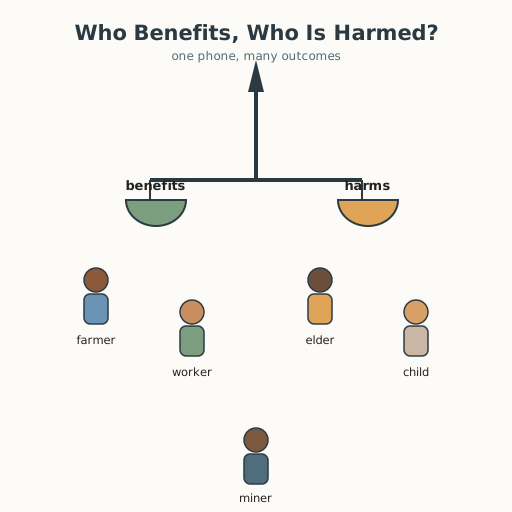
- Meet the groups (10 min). Read the case cards: a rural farmer, a city worker, an elder, a child, a miner, a person with a disability. For each, ask: what does the phone give them, and what does it take?
- Fill the sheet (15 min). Worked example first: the farmer — benefit: mobile money lets her receive payment without traveling to a bank; harm: none obvious to her directly, but the phone’s minerals were mined far away. Fill the rest of the rows in your group.
- Weigh it (10 min). Step back. Is the phone “good” or “bad”? Neither. Say it precisely: “The phone helps ___ and harms ___, and the harms fall hardest on ___.”
- Close (5 min). A fair judgment of a technology names everyone, not just the user in the mirror.
Differentiation
- Support: Provide the sheet pre-filled for one group and ask the learner to explain that one row in their own words.
- Extension: Choose a second technology (a plastic bottle, a bicycle, a fishing net) and weigh its benefits and harms for at least three groups.
Assessment
- Formative (observation): Can the learner name at least one benefit and one harm for two different groups, and state a balanced judgment?
- Portfolio artifact: The completed benefits-and-harms sheet, kept in the portfolio.
Home connection
Pick one object at home and ask: who made it, who uses it, and who is helped or harmed along the way? Note one idea to share.
Resources
- On mobile money expanding access to financial services: World Bank, “Financial Inclusion” (M-Pesa and digital financial services), https://www.worldbank.org/en/topic/financialinclusion (S-211); CGAP, https://www.cgap.org/ (S-210).
- On electronic waste: WHO, “Electronic waste (e-waste),” https://www.who.int/news-room/fact-sheets/detail/electronic-waste-%28e-waste%29 (S-397).
- On cobalt mining and human rights: Amnesty International (2016), “This Is What We Die For,” https://www.amnesty.org/en/latest/news/2016/01/child-labour-behind-smart-phone-and-electric-car-batteries/ (S-398).
- On explicit instruction and worked examples: Kirschner, Sweller & Clark (2006), https://doi.org/10.1207/s15326985ep4102_1 (S-011).