Lesson 07 — Biomes and Adaptation: Living Fit to a Place
Learners compare **two biomes or climate zones** — a desert and a rainforest — and explain how the living things in each are **adapted to their conditions**. They see that form follows climate: the cactus stores water because water is scarce, the rainforest leaf sheds rain because rain is endless.
Objectives
Objectives
- D10.S3.08.02 Compare two biomes or climate zones and explain how the living things there are adapted to their conditions.
Essential question
How are living things adapted to their biomes, and how do two biomes compare?
Key vocabulary
Materials
Standard materials
- Biome comparison sheet · 1 per learner A two-column organizer to compare two biomes — climate, plants, animals, and the adaptations each shows
- Biome cards · 1 set per group Cards for several biomes (desert, rainforest, tundra, savanna) with one climate fact and two adapted species each
Low-tech / no-cost
- A shared board or large paper Draw the two-biome comparison together; no printed sheet needed
- Voice and a partner Describe two biomes aloud — "it is hot and dry, so…" — and name an adaptation each
- A described or tactile biome pair Hold or feel examples — a spiny or waxy stem, a broad leaf, a smooth stone — and describe each biome aloud, so adaptation is learned by touch and listening, not only sight
Enriched / lab & device
- A short video or slideshow of two biomes · 1 Real footage of a desert and a rainforest (or two local climate zones) to ground the comparison
- A world map showing biome zones · 1 per group Locate deserts, rainforests, tundra, and savanna and discuss why each sits where it does
Works in different contexts
- large-group Model the desert column as a whole class, then small groups fill the rainforest (or second biome) column and report
- multi-age Younger learners match each species to its biome; older learners explain the adaptation in a "because" sentence
- self-directed A learner completes the comparison sheet alone and writes one paragraph contrasting two biomes
- level-grouped Learners ready to extend choose two biomes not on the cards and research their adaptations
- outdoor-only Identify your local climate zone and name two local species and one adaptation each shows for your conditions
Lesson 7 — Biomes and Adaptation: Living Fit to a Place
Summary
Learners compare two biomes or climate zones — a desert and a rainforest — and explain how the living things in each are adapted to their conditions. They see that form follows climate: the cactus stores water because water is scarce, the rainforest leaf sheds rain because rain is endless.
Objectives
- Compare two biomes or climate zones and explain how the living things there are adapted to their conditions. (D10.S3.08.02)
Connection
Why does a cactus look the way it does — thick, waxy, spined — while a rainforest leaf is broad and thin and ends in a point? Because each was shaped by its place. A cactus must hoard every drop of scarce water; a rainforest leaf must shed endless rain and reach for scarce light. Life is never “one size fits all” — it is fitted, over long time, to the place where it lives. Today you compare two biomes and read the adaptations written on their living things.
Materials
- Biome comparison sheet
- Biome cards
Preparation
- Copy the sheet and biome cards.
- Retrieval: from Grade 7, recall variation and natural selection — traits that help survival spread in a population. An adaptation is the result of that process, written in a species’ form.
Facilitator note
This lesson is written to the learner (“you”). The idea to land: a biome is a large region with a characteristic climate and community of life, and the living things there are adapted — their bodies and behaviors fit their conditions (S-396, S-106). The worked comparison is desert vs. rainforest: desert — hot, dry, water scarce; plants store water (thick stems), have shallow wide roots or deep taproots, small or spiny leaves to limit water loss; animals are often nocturnal, conserve water, and shed heat. Rainforest — hot, wet, light scarce at the ground; plants grow tall toward light, with broad leaves and “drip tips” to shed rain; animals live in layers (canopy, understory, floor) and many are adapted to climb or glide. The environment lens is this lesson’s core: adaptation is the living world’s answer to its conditions. The global lens: biomes repeat across continents — deserts on every landmass, rainforests near the equator — so the same problems draw the same kinds of answers everywhere (S-396). The egalitarian lens: human life is adapted too — people living in deserts, tundra, and rainforests have built knowledge and practices fitted to those places, and no place’s people are “behind” any other. The ethics lens: when we change a biome — clearing a forest or damming a river — we change the conditions the life there was fitted to, and must ask what that costs. The technology lens: maps, satellites, and climate data let us see and compare biomes across the whole Earth. Keep the biology precise and cited; adaptation is evidence-based, and origins remain open as models with evidence (philosophy §11).
Procedure
- Recall (5 min). From Grade 7: what is natural selection? (Traits that help survival spread.) An adaptation is that process written on a body.
- Meet the biome (5 min). A biome is a large region with a signature climate and community of life. Today: desert and rainforest.
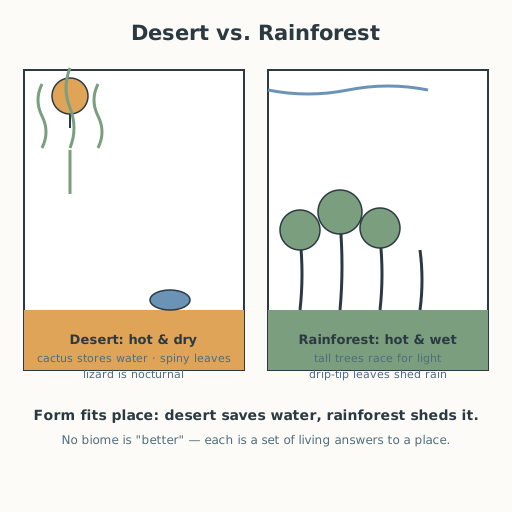
- Read the desert (12 min). Worked example: the desert is hot and dry, so water is scarce. The cactus stores water in a thick stem, trades leaves for spines to lose less water, and spreads shallow roots to catch rare rain. Animals are often nocturnal and hoard water. Fill the desert column.
- Read the rainforest (12 min). The rainforest is hot and wet, but light is scarce at the ground. Trees race upward for light; leaves are broad with drip tips to shed rain; animals live in layers — canopy, understory, floor. Fill the rainforest column.
- Compare (10 min). Put the two side by side. Say it in one breath: “In the desert, life is built to save water; in the rainforest, life is built to shed it.” Each form fits its place.
- Close (5 min). No biome is “better” — each is a set of living answers to a place’s questions.
Differentiation
- Support: Provide one column pre-filled and ask the learner to match three species to their biome.
- Extension: Choose two biomes not on the cards (tundra, savanna, temperate forest) and compare their adaptations.
- Access (non-visual): Describe each biome in words (“desert: hot, dry, water scarce”; “rainforest: hot, wet, light scarce”) and offer touch examples (a spiny or waxy stem, a broad leaf) so the “because” behind each adaptation is felt and heard; the sheet’s labels carry the same information as the picture.
Assessment
- Formative (observation): Can the learner name one adaptation for each of two biomes and explain the “because” behind it?
- Portfolio artifact: The completed biome comparison sheet, kept in the portfolio.
Home connection
Name your local climate zone and find two local plants or animals; say how each is fitted to your conditions.
Resources
- On biomes as large climate-and-life regions: National Geographic Education, “Biomes,” https://education.nationalgeographic.org/resource/biomes/ (S-396).
- On adaptation: BBC Bitesize, “What is adaptation?” (S-106).
- On the desert biome: National Geographic Education, “Desert,” https://education.nationalgeographic.org/resource/desert/ (S-057).
- On habitats and the life they support: WWF, “Habitats,” https://www.worldwildlife.org/habitats (S-218).
- On explicit instruction and worked examples: Kirschner, Sweller & Clark (2006), https://doi.org/10.1207/s15326985ep4102_1 (S-011).