Lesson 06 — Disturbance and Recovery: How Ecosystems Bounce Back
Learners explain how an **ecosystem responds to a disturbance, such as fire or flooding, and what helps it recover — resilience**. They trace a forest through disturbance, succession, and recovery, and name what makes recovery possible: surviving seeds and roots, returning species, and connection to nearby healthy land.
Objectives
Objectives
- D10.S3.08.01 Explain how an ecosystem responds to a disturbance, such as fire or flooding, and what helps it recover (resilience).
Essential question
How does an ecosystem respond to a disturbance like fire or flooding, and what helps it recover?
Key vocabulary
Materials
Standard materials
- Disturbance-and-recovery sheet · 1 per learner A timeline of a forest after fire — disturbance, early regrowth, returning life — with spaces to label what helps recovery
- Case cards · 1 set per group Two real disturbances — a forest fire and a flood — with facts about what returns and when, and what helps
Low-tech / no-cost
- A shared board or large paper Draw the disturbance-and-recovery timeline together; no printed sheet needed
- Voice and a partner Tell the story of a forest after fire aloud, step by step, from memory
- A tactile timeline Mark the three stages — disturbance, succession, recovery — with three piles of found objects (ash or stone, a sprout or stick, a leaf or seed) so the sequence can be felt and heard, not only seen
Enriched / lab & device
- A short documentary clip of a forest recovering after fire · 1 Shows real regrowth — seeds, sprouts, returning animals — over seasons
- A field guide or app for local plants and animals · 1 per group Identify early-returning species in a nearby recovering or green space
Works in different contexts
- large-group Build the recovery timeline once as a whole class on the board, then small groups label what helps and report
- multi-age Younger learners put the timeline pictures in order; older learners explain what makes recovery faster or slower
- self-directed A learner labels the sheet alone and writes one paragraph explaining resilience
- level-grouped Learners ready to extend explain how a keystone species can speed or slow recovery, with an example
- outdoor-only Find a real sign of recovery outdoors — a sprout in a crack, new growth after a cut — and say what helped it return
Lesson 6 — Disturbance and Recovery: How Ecosystems Bounce Back
Summary
Learners explain how an ecosystem responds to a disturbance, such as fire or flooding, and what helps it recover — resilience. They trace a forest through disturbance, succession, and recovery, and name what makes recovery possible: surviving seeds and roots, returning species, and connection to nearby healthy land.
Objectives
- Explain how an ecosystem responds to a disturbance, such as fire or flooding, and what helps it recover (resilience). (D10.S3.08.01)
Connection
Watch a patch of bare ground for a season and you will see a quiet drama: a sprout in a crack, then grass, then small animals. The living world has a stubborn habit of coming back. A forest burned by fire or a meadow flooded by a river does not end — it changes, and then it returns. Today you learn how ecosystems recover, and what helps them bounce back.
Materials
- Disturbance-and-recovery sheet
- Case cards
Preparation
- Copy the sheet and case cards.
- Retrieval: from Grade 7, recall how matter and energy move through an ecosystem and how one changed population can ripple through a food web. Today we look at how a whole ecosystem responds to a big disturbance.
Facilitator note
This lesson is written to the learner (“you”). The idea to land: a disturbance — fire, flood, drought — is not the end of an ecosystem but a change, and resilience is the ecosystem’s capacity to recover and regain its structure and function. The worked example is a forest after fire (S-152, S-107): the fire clears old growth; surviving seeds, roots, and soil life sprout first; then grasses, shrubs, and young trees return in a sequence called succession; animals follow the food; and over years a fuller forest returns. What helps recovery: surviving seeds and roots in the soil; seeds and animals arriving from nearby healthy land (so connection matters); and conditions like moisture and soil that the fire left behind. The environment lens is this lesson’s core: ecosystems are living systems we are part of, not backdrops. The global lens: some ecosystems are adapted to fire and depend on it — many grasslands and some forests need occasional fire to renew, and many Indigenous peoples have used fire to care for land for thousands of years (S-320, S-321) — which we will revisit in Lesson 9. The ethics lens: how humans respond to a disturbance — letting land recover, or building over it — is a choice about the living world. The technology lens: satellites and sensors now help people watch recovery happen and plan for it. Keep claims precise and cited; distinguish what evidence shows from what we value (philosophy §5). Resilience is not “indestructible” — a system pushed too far can change permanently, a caution for the next lessons.
Procedure
- Recall (5 min). From Grade 7: how does a change in one population ripple through a food web? Today we zoom out to a whole ecosystem hit by a big change.
- Meet the disturbance (10 min). A disturbance is a big change that disrupts an ecosystem — fire, flood, drought, a storm. The ecosystem responds not by ending, but by recovering.
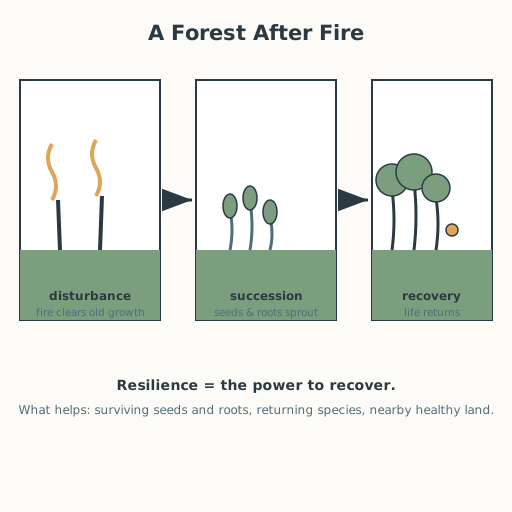
- Trace the recovery (15 min). Worked example: a forest after fire. First, what survives (seeds, roots, soil life). Then succession: grasses, shrubs, young trees, in order. Then animals return as food returns. Label the timeline on your sheet.
- Name what helps (10 min). Resilience — the power to recover — depends on: surviving seeds and roots; seeds and animals from nearby healthy land; and the conditions the land keeps. Which of these matters most for a fire? For a flood?
- Apply (7 min). Read the flood case card and trace its recovery the same way. Write one sentence: “This ecosystem recovered because ___.”
- Close (3 min). The living world comes back — and what helps it come back is worth protecting.
Differentiation
- Support: Provide the timeline pre-ordered and ask the learner to explain one stage in their own words.
- Extension: Explain how a keystone species can speed or slow recovery, using a real example (for instance, wolves returning to Yellowstone reduced elk browsing, which let willows and aspens regrow along streams — a well-known trophic cascade).
- Access (non-visual): Tell the fire-to-forest sequence aloud step by step, or lay it out as three tactile piles (ash or stone → sprout or stick → leaf or seed) so the order can be felt and heard; each stage is named in words on the sheet, so the diagram is not the only way in.
Assessment
- Formative (observation): Can the learner trace a disturbance through recovery and name one thing that helps?
- Portfolio artifact: The labeled disturbance-and-recovery sheet, kept in the portfolio.
Home connection
Find one place near home that has changed and is coming back — a garden, a field, a cracked pavement with a weed — and say what helped it recover.
Resources
- On ecosystems as communities of living and nonliving parts: National Geographic Education, “Ecosystem,” https://education.nationalgeographic.org/resource/ecosystem/ (S-152).
- On how ecosystems work and respond to change: BBC Bitesize, “How do ecosystems work?” (S-107).
- On Indigenous cultural burning as land care: CSIRO, “Indigenous cultural burning education resources” (S-320); Firesticks Alliance / Living Knowledge Network (S-321).
- On explicit instruction and worked examples: Kirschner, Sweller & Clark (2006), https://doi.org/10.1207/s15326985ep4102_1 (S-011).