Lesson 10 — Speaking Up, Standing With: Self-Advocacy and the Unit's Gathering
Learners practice **self-advocacy** — stating their own needs and boundaries directly and respectfully, using an **I-statement** frame and distinguishing it from passive and aggressive styles. Then they gather the unit's **six goals into one whole self**, revisiting the Lesson 1 map and their portfolio artifacts in a closing reflection.
Objectives
Objectives
- D01.S1.09.01 Use a broad emotional vocabulary to articulate subtle and secondary emotions in complex social situations.
- D01.S1.09.02 Analyze how emotions are shaped by social context, media, and group belonging.
- D01.S2.09.01 Construct a coherent personal narrative that connects their past, present, and hoped-for future.
- D01.S2.09.02 Analyze how a person's identity is shaped by their society and, in turn, shapes their choices.
- D01.S3.09.01 Set a longer-term goal with a realistic plan and milestones, and adjust it as needed.
- D01.S3.09.02 Advocate for their own needs and boundaries respectfully while considering others.
Essential question
How do I advocate for my own needs and boundaries respectfully while considering others — and how do the six goals of this unit gather into one whole self?
Key vocabulary
Materials
Standard materials
- Advocacy scenario cards · 1 set per group Short, realistic situations requiring a need or boundary to be stated (e.g., asking for help, declining a request, asking for quiet to work)
- I-statement frame sheet · 1 per learner The "I feel… when… because… what I need is…" pattern, with passive/aggressive/assertive examples to compare
- Unit map sheet (from Lesson 1) · 1 per learner Return to the Lesson 1 map to gather the six goals into one whole self
Low-tech / no-cost
- Paper and pencil Write the I-statement frame and your own examples freehand; no printed sheets needed
- Voice and role-play Act out the scenarios and practice saying the need aloud, no cards needed
Enriched / lab & device
- A video or audio recording tool · 1 per pair Record the role-play and listen back to refine tone and wording
- A digital portfolio folder · 1 per learner Gather all six portfolio artifacts from the unit into one place for the final reflection
Works in different contexts
- large-group Model one scenario whole-class, then pairs role-play the rest; gather the six goals on one shared board at the close
- multi-age Younger learners practice a single simple request; older learners practice a full boundary with reasons and consideration for the other
- self-directed A learner writes three I-statements for real situations, checks them against passive/aggressive/assertive, and completes the unit reflection alone
- level-grouped Learners ready to extend write an advocacy plan for a systemic need (not just a personal one) and identify whom to address
- outdoor-only Practice saying a need aloud in a real space — asking for help carrying something, requesting quiet, declining a task — then gather the six goals in a closing circle outdoors
Lesson 10 — Speaking Up, Standing With: Self-Advocacy and the Unit’s Gathering
Summary
Learners practice self-advocacy — stating their own needs and boundaries directly and respectfully, using an I-statement frame and distinguishing it from passive and aggressive styles. Then they gather the unit’s six goals into one whole self, revisiting the Lesson 1 map and their portfolio artifacts in a closing reflection.
Objectives
- Advocate for your own needs and boundaries respectfully while considering others. (D01.S3.09.02)
- Gather the unit’s six goals — naming subtle and secondary emotions, seeing context and media’s shaping, telling a coherent story, seeing society and self shaping each other, setting a goal with milestones, and advocating for yourself — into one whole self. (D01.S1.09.01, D01.S1.09.02, D01.S2.09.01, D01.S2.09.02, D01.S3.09.01, D01.S3.09.02)
Connection
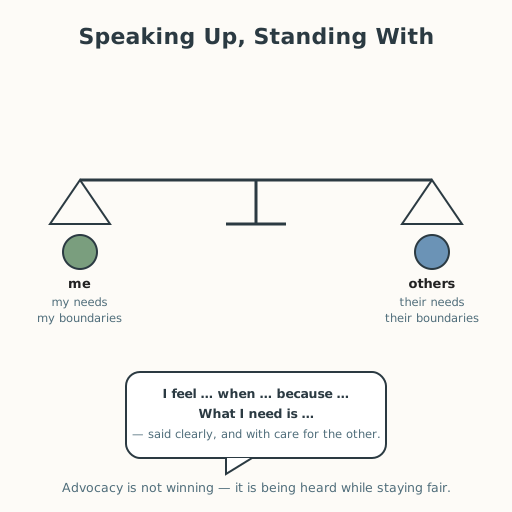
There is a difference between being quiet when you are hurting, shouting to win, and speaking up for yourself while still seeing the other person. The first two are easy and costly; the third is a skill. Saying “I feel worried when plans change at the last minute, because I prepare carefully — what I need is a heads-up sooner” names your need without attacking anyone. Self-advocacy is not winning; it is being heard while staying fair. And it is the last piece of this unit: together with naming your feelings, seeing what shapes them, telling your story, seeing how you and society make each other, and setting a goal, it is how you become the author of your own life.
Materials
- Advocacy scenario cards
- I-statement frame sheet
- Unit map sheet (from Lesson 1)
Preparation
- Copy the advocacy scenario cards and I-statement frame sheet; have learners’ Lesson 1 unit maps and their portfolio artifacts on hand.
- Retrieval: this whole lesson is a retrieval, synthesis, and application pass — the payoff of the unit (S-039).
Facilitator note
This lesson is written to the learner (“you”). It is the final skill lesson and the unit’s capstone. The skill — self-advocacy — is taught with a worked example and guided practice (S-011). The core frame is assertiveness: expressing one’s own needs and boundaries directly and respectfully, distinct from passive (suppressing one’s needs) and aggressive (trampling others’) styles (Alberti & Emmons, S-405). The I-statement pattern — “I feel… when… because… what I need is…” — carries it (related to Rosenberg’s nonviolent communication, S-148). The ethics lens: advocacy that honors the other person is a moral skill, not just a social one. The egalitarian lens: some people’s needs are heard more readily than others’ — because of status, gender, disability, or prejudice — so teaching every learner to advocate is itself an act of leveling; and advocacy can be collective, not only individual. The global lens: cultures differ in how directly a need is stated; the lesson offers the I-statement as one respectful form, not the only right one — a learner whose culture values indirectness should be honored, not “corrected.” Safety: role-plays are low-stakes and invented; no learner is made to disclose a real need. The closing gathering retrieves all six goals (S-039) and celebrates mastery as collective, never a ranking (S-007): a learner who has not yet got a goal simply revisits it — “not yet” is information. Close with warmth: the unit has been inward work, and it lands in care and agency, not pressure.
Procedure
- Recall (5 min). Name the unit’s six goals from memory. (Recalling is the learning.)
- Worked example (10 min). Watch as your facilitator models the three styles for one scenario — passive, aggressive, assertive — and lands on the I-statement: “I feel… when… because… what I need is…”. Notice how the assertive one honors both people.
- Guided practice (15 min). In pairs, take the advocacy scenario cards. For each, first say the need passively and aggressively (to feel the difference), then craft and say the assertive I-statement. Give each other one specific piece of feedback.
- Apply it to you (10 min). Write one I-statement for a real (or invented) need or boundary of your own. Say it aloud to your pair if you wish.
- Gather the six (15 min). Return to your Lesson 1 unit map and your portfolio artifacts. For each of the six goals, write one sentence of what you now know or can do. Connect them: how do feelings, identity, and purpose make one whole self?
- Close (5 min). You began this unit wondering who you are. You end it as the author — still in the making, and that is exactly right.
Differentiation
- Support: Practice a single simple request with the I-statement frame before moving to full boundaries.
- Extension: Write an advocacy plan for a need bigger than your own — a change your community needs — and name whom to address and how.
Assessment
- Summative (portfolio): The six-goal gathering on the unit map — one sentence per goal, linked into one whole self — kept in the portfolio alongside the unit’s artifacts.
- Self/peer: Learners self-check all six goals are present and give one specific “I noticed you honored both people when…” to a partner.
- Mastery, not ranking: A learner missing a goal revisits its artifact and completes it; the map is finished when it is finished.
Home connection
Show someone at home your completed unit map and teach them one goal end to end — including the I-statement. Teaching it is the surest sign it is yours.
Resources
- On assertiveness and equality in relationships: Alberti & Emmons, Your Perfect Right (S-405).
- On nonviolent communication and stating needs: Rosenberg, Nonviolent Communication (S-148).
- On retrieval practice and spacing: Dunlosky et al. (2013), https://doi.org/10.1177/1529100612453266 (S-039).
- On explicit instruction and worked examples: Kirschner, Sweller & Clark (2006), https://doi.org/10.1207/s15326985ep4102_1 (S-011).