Lesson 01 — The Body as the Ground of Feeling and Thought
Learners name the **somatic basis of emotion and thought**: feeling and thinking are not separate from the body but built *in and with* it. They trace a **two-way loop** between body state and mind, study a worked example, and run a short **body-notice** to feel the loop in themselves before recording their own example.
Objectives
Objectives
- D03.S1.09.01 Explain the somatic basis of emotion and thought, using an example of how body state shapes mood and thinking.
Essential question
How does my body state shape my mood and thinking — and how does my thinking shape my body in return?
Key vocabulary
Materials
Standard materials
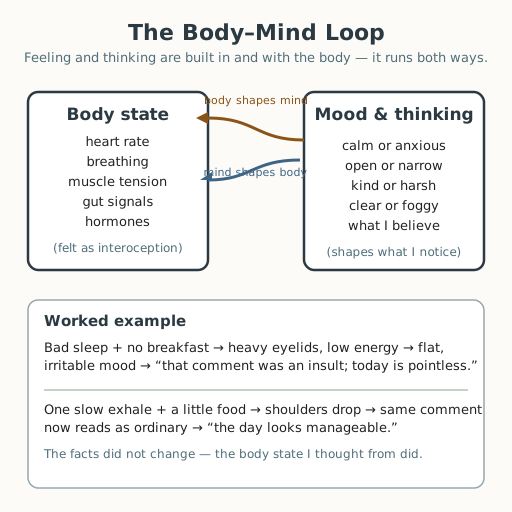
- Body–mind loop handout · 1 per learner A one-page diagram of the two-way body↔mind loop with a worked example and blank spaces for the learner's own example
- Notebook or journal · 1 per learner For the body-notice log and end-of-lesson reflection
Low-tech / no-cost
- Voice and the body itself Run the body-notice as a spoken, seated or standing exercise; no paper needed
- A shared board or large paper Draw the two-way loop together instead of printing handouts
Enriched / lab & device
- A simple heart-rate or breathing app (optional) · 1 per pair Observe heart rate rise with a quick movement and settle with a slow exhale
- A short video clip of a body-scan or box-breathing demo · 1 for the group Model the skill before learners try it themselves
Works in different contexts
- large-group Do the body-notice as one whole-group guided exercise, then pairs share one example each; keep the movement break short and calm
- multi-age Younger learners name one body signal (racing heart, tight jaw); older learners trace the full loop and add the "why" from the nervous system
- self-directed A learner reads the worked example, does the body-notice alone with a timer, and writes their own before/after loop in a journal
- level-grouped Learners ready to extend connect the loop to the sympathetic/parasympathetic nervous system and predict what happens when stress becomes chronic
- outdoor-only Run the body-notice outside; notice how fresh air, temperature, and wind change the body state learners can feel
Lesson 1 — The Body as the Ground of Feeling and Thought
Summary
Learners name the somatic basis of emotion and thought — the idea that feeling and thinking are not floating “in the mind” but built in and with the body. They trace a two-way loop between body state and mind, study a worked example, run a short body-notice, and record one example of their own.
Objectives
- Explain the somatic basis of emotion and thought, using an example of how body state shapes mood and thinking. (D03.S1.09.01)
Connection
Think of a moment your heart pounded before you spoke in front of people, or your stomach churned before a test, or you snapped at someone when you were tired or hungry and only realized why later. Those are not failures of self-control — they are your body and your mind doing what they always do: working as one loop. The “feeling” and the “thought” were shaped by the body’s state, just as your thoughts can set your heart racing. Today you learn to name and trace that loop, so you can read yourself more clearly instead of being pushed around by signals you do not understand.
Materials
- Body–mind loop handout
- Notebook or journal
Preparation
- Copy the body–mind loop handout (or draw the loop on the board).
- Retrieval: from Grade 8, recall the nervous system and the fight, flight, or rest response — the sympathetic (“fight or flight”) and parasympathetic (“rest and digest”) branches, and how stress shows up in the body (S-338, S-339).
Facilitator note
This lesson is written to the learner (“you”). The concept to land: emotion and thought have a somatic basis — a body basis. The brain and body form a two-way loop: body state (heart rate, breathing, muscle tension, gut signals, hormones) shapes mood and thinking, and thoughts shape body state in return. This builds directly on Grade 8’s nervous system and stress work, deepening it from “stress happens in the body” to “all feeling and thinking happen with the body” (S-338). Use a worked example first, then guided practice — naming a body signal and tracing the loop is a skill, and explicit modeling carries skills for novices (S-011). Keep the science honest and hedged: the somatic marker idea (Damasio) holds that bodily responses help guide feeling and decision-making (S-406), and the interoception account (Barrett) holds that the brain integrates internal body signals to construct emotional experience (S-401) — these are two respected scientific stories, offered as stories, not gospel. The ethics lens: reading our own signals honestly is a form of self-respect, and it helps us avoid blaming ourselves for a body that is just tired or hungry. The egalitarian lens: every body reads signals differently — some bodies feel signals strongly, some faintly, and some people use assistive tools — and no way is more legitimate than another. The global lens: cultures worldwide have long mapped feeling to body parts (a “heavy heart,” a “knotted stomach”), so this is not one region’s idea but a widely shared human understanding (S-401). The technology lens: the devices that now measure our heart rate and breathing are just tools that make an always-on loop visible; the loop itself predates every device. Be careful and non-shaming: never tell a learner their body is “wrong”; the point is noticing, not correcting. If a learner notices something distressing (a racing heart that will not settle, chronic pain), normalize it and quietly route them toward a trusted adult or the help-seeking paths named in later units.
Procedure
- Recall (5 min). From Grade 8: what are the two branches of the autonomic nervous system, and what does each do? (Fight-or-flight / rest-and-digest.) Today we go one step deeper: all feeling and thinking ride on the body — not just stress.
- Meet the loop (10 min). Look at the diagram. The brain and body are a two-way loop. Body state — heart rate, breath, muscle tension, gut signals, hormones — reaches the brain as interoception (your sense of what is happening inside you), and it colors how you feel and think. Then your thoughts and feelings send signals back out, changing your body state. It never runs one way.
- Study the worked example (10 min). Worked example: You slept badly and skipped breakfast. Body state: heavy eyelids, low energy, empty stomach. Mood: flat and irritable. Thinking: “Everything is pointless today; that comment from a friend must have been an insult.” Now trace the reverse: you notice the tight shoulders, take one slow, long exhale, eat something. Body state shifts → the same comment now reads as ordinary, and the day looks manageable. The facts did not change; the state you thought from did.
- Body-notice (8 min). Sit or stand comfortably. Close your eyes or soften your gaze. Scan slowly: your breath, your shoulders, your jaw, your hands, your stomach. Do not fix anything — just notice. What is your body doing right now? Name one signal and a word for the mood it leans toward.
- Make it yours (15 min). In your journal, draw the two-way loop with your own example: a body state → a mood → a thought, and then a small change in body state (a breath, a stretch, water, food, rest) → a different thought. Use the handout’s blank spaces.
- Peer-check (5 min). Share your example with a partner. Check together: is the loop two-way? Did you name a real body signal and a real thought? Fix anything missing.
- Close (2 min). One sentence each: “My body shapes my thinking when…” The body is not a container the mind rides in — it is the ground the mind stands on.
Differentiation
- Support: Provide the loop pre-labeled and ask learners to fill in only the body signal and the mood; give a sentence starter (“When my body feels ___, I think ___”).
- Extension: Add the third term — prediction. The brain guesses what the body will need next and that guess becomes part of the feeling (S-401). Write one sentence explaining how a prediction could make a neutral event feel dangerous.
Assessment
- Formative (observation): Can the learner name a body state, a mood, and a thought, and trace the loop in both directions?
- Portfolio artifact: The learner’s own two-way loop, kept in the portfolio.
Home connection
Before you sleep tonight, do a one-minute body-notice and write one line: what your body was doing and how your mood leaned. Bring that line to the next lesson.
Resources
- On the nervous system and stress in the body: American Psychological Association, “Stress effects on the body,” https://www.apa.org/topics/stress/body (S-338).
- On bodily responses guiding feeling and decision-making (the somatic marker idea): Damasio, Descartes’ Error (1994) (S-406).
- On interoception and how the brain constructs emotion from body signals: Barrett, How Emotions Are Made (2017) (S-401).
- On explicit instruction and worked examples: Kirschner, Sweller & Clark (2006), https://doi.org/10.1207/s15326985ep4102_1 (S-011).