Lesson 02 — Reading My Body's Signals
Learners practice **reading body signals accurately** — hunger, fatigue, stress — and tracing how each one silently steers mood and thinking. They build a shared signal list, study a worked example, run a guided **body scan**, and log their own signals with a simple, non-judgmental response for each.
Objectives
Objectives
- D03.S1.09.01 Explain the somatic basis of emotion and thought, using an example of how body state shapes mood and thinking.
Essential question
How do I read the signals my body sends — hunger, fatigue, stress — before they silently steer my mood and my thinking?
Key vocabulary
Materials
Standard materials
- Signal cards · 1 set per pair Cards naming common body signals (tight jaw, shallow breath, empty stomach, heavy eyes, warm face, clenched fists) and one mood/thought clue each
- Notebook or journal · 1 per learner For the signal log and reflection
Low-tech / no-cost
- Voice and the body Name signals aloud and act them out gently; no cards needed
- A shared board or large paper Build one class list of body signals together
Enriched / lab & device
- A timer or phone app · 1 per pair Time a 3-minute guided body scan
- A short guided body-scan audio · 1 for the group Optional; learners may also guide each other
Works in different contexts
- large-group Build the signal list as a whole class, then pairs match signals to moods; share a few examples aloud
- multi-age Younger learners match one signal to one mood; older learners add the "what it made me think" step and a small regulation action
- self-directed A learner does a timed body scan, logs three signals and the moods and thoughts that rode on them, then writes one regulation action for each
- level-grouped Learners ready to extend distinguish acute stress from fatigue and hunger, and predict how each steers thinking differently
- outdoor-only Do the body scan outside; add temperature, wind, and light as signals the body reads too
Lesson 2 — Reading My Body’s Signals
Summary
Learners practice reading body signals accurately — hunger, fatigue, stress — and tracing how each silently steers mood and thinking. They build a shared signal list, study a worked example, run a guided body scan, and log their own signals with a simple, non-judgmental response for each.
Objectives
- Explain the somatic basis of emotion and thought, using an example of how body state shapes mood and thinking. (D03.S1.09.01)
Connection
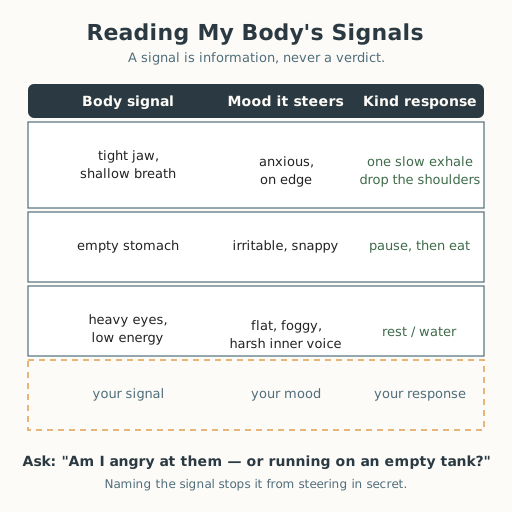
Have you ever argued with someone and only an hour later realized you were just hungry? Or reread a text message you thought was rude, then noticed you had slept four hours and suddenly it read fine? Your body was talking the whole time — you just had not been listening. Reading your own signals is like checking the weather before you trust a mood: “Am I angry at them, or am I running on an empty tank?” Naming the signal does not make it go away, but it stops it from steering you in secret. Today you practice that listening.
Materials
- Signal cards
- Notebook or journal
Preparation
- Copy or make the signal cards.
- Retrieval: from Lesson 1, recall the two-way body–mind loop and the word interoception (your sense of what is happening inside you).
Facilitator note
This lesson is written to the learner (“you”). The skill to land: noticing a body signal (hunger, fatigue, stress), naming it, and tracing how it steers mood and thinking — then choosing a small, non-judgmental response (water, food, a slow breath, rest). This is a skill, so use a worked example first, then guided practice (S-011). The critical-thinking lens: this is the same move as checking a source before trusting a claim — check the body state before trusting a thought. The ethics lens: reading your own signals is self-respect, not self-indulgence; it is the opposite of the old message that we should “push through” and ignore the body. The egalitarian lens: bodies signal differently — some people feel hunger as a sudden crash, others as a slow fade; some people use assistive devices and cannot feel certain signals, and that is not a deficit. The global lens: every culture has words for reading the body’s needs, and no one way of naming or responding is more legitimate. Hold the tone as noticing, never judging: a learner who notices they are stressed or tired is doing it right; the lesson never grades how “calm” anyone gets. Remind learners that a body scan can sometimes surface distress; if a learner becomes uncomfortable, they may pause or step out, and the facilitator or a trusted adult can follow up. Keep all examples free of weight, calories, or “should” language about food or rest — a small snack is fuel, not a moral act.
Procedure
- Recall (5 min). From Lesson 1: what is the body–mind loop, and what is interoception? Today we get better at the “listening” side of the loop.
- Build the signal list (10 min). With a partner, name body signals you have felt: tight jaw, shallow breath, empty stomach, heavy eyes, warm face, clenched fists, a flutter in the chest. Add one mood or thought each signal tends to steer toward. Share the best ones with the group and build one class list.
- Study the worked example (8 min). Worked example: Signal: my shoulders are up by my ears and my breath is shallow. Mood: anxious, on edge. Thought: “I’m going to mess this up.” Response (not a fix, just a shift): one slow, long exhale, drop the shoulders, a sip of water. Then: the same task looks a little more doable. The thought was not the truth — it was the state talking.
- Guided body scan (8 min). Sit or stand comfortably. Soften your gaze or close your eyes. Move your attention slowly from your jaw to your shoulders, your breath, your stomach, your hands, your legs. At each stop, ask only: what is happening here? Name one signal clearly in your mind.
- Log it (15 min). In your journal, make a three-column table for three signals: Signal → Mood/thought it steers → Small response. Use real ones from your body scan or your day. Keep responses kind and practical: water, food, a breath, rest, moving, talking to someone.
- Peer-check (5 min). Swap logs with a partner. Check: is the signal concrete? Does the response treat the body with care rather than blame? Fix anything harsh or vague.
- Close (4 min). One sentence each: “Next time I feel ___, I’ll first check if I’m ___, ___, or ___.” Listening to the body is a skill, and like any skill, it grows with practice.
Differentiation
- Support: Give three pre-written signals and ask learners to match each to a mood and a response; use a fill-in (“When my body feels ___, my mood leans ___, so I can ___”).
- Extension: Add a fourth column — was the thought accurate? — and write how checking the body state changed (or did not change) your answer.
Assessment
- Formative (observation): Can the learner name a concrete signal, trace it to a mood or thought, and propose a kind response?
- Portfolio artifact: The three-row signal log, kept in the portfolio.
Home connection
This week, catch one moment where a mood might actually be a body state (hunger, thirst, short sleep). Write one line about what you noticed and what you did. Bring it to the next lesson.
Resources
- On stress showing up in the body: American Psychological Association, “Stress effects on the body,” https://www.apa.org/topics/stress/body (S-338).
- On interoception and reading internal signals: Barrett, How Emotions Are Made (2017) (S-401).
- On explicit instruction and worked examples: Kirschner, Sweller & Clark (2006), https://doi.org/10.1207/s15326985ep4102_1 (S-011).