Lesson 08 — Hunger, Food Security, and Health Around the World
Learners **explain how hunger, food security, and unequal access to healthy food shape health outcomes around the world**. They learn the four pillars of food security — availability, access, utilization, stability — and the key distinction that *hunger is not usually a lack of food on Earth but a failure of access and fairness.* They write a short food-security reflection and gather the unit's threads.
Objectives
Objectives
- D03.S3.09.02 Explain how hunger, food security, and unequal access to healthy food affect health outcomes around the world.
Essential question
What is food security, why are hunger and unequal access to healthy food still widespread, and how do they shape health around the world?
Key vocabulary
Materials
Standard materials
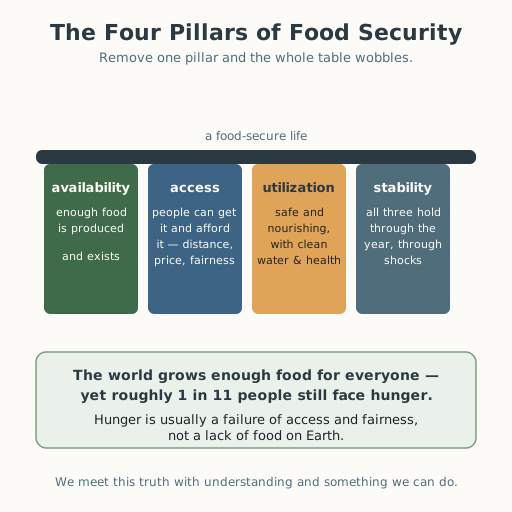
- Food-security diagram · 1 per learner A one-page diagram of the four pillars of food security (availability, access, utilization, stability) with a plain-language note for each
- Notebook or journal · 1 per learner For the reflection and the unit-gathering close
Low-tech / no-cost
- A shared board or large paper Draw the four pillars together; discussion carries the lesson
- Voice and memory Reflect on food in the learner's own community without any printed data
Enriched / lab & device
- A device or screen · 1 per pair Look up a country's hunger or food-insecurity trend and compare two places
- A short documentary or news feature on food access · 1 for the group Optional; ground the global picture in a real place
Works in different contexts
- large-group Teach the four pillars to the whole group, then pairs apply them to two contrasting places and share one finding each
- multi-age Younger learners name the four pillars in their own words; older learners explain how a failure in one pillar (e.g., access) can cause hunger even when food exists
- self-directed A learner studies the diagram, writes one paragraph explaining how unequal access shapes health, and completes the food-security reflection alone
- level-grouped Learners ready to extend analyze a food-justice question — how policy, cost, or location creates unequal access — and propose one change that widens access
- outdoor-only Discuss food access while walking or sitting outside; connect the global picture to what grows or is sold in the learner's own area
Lesson 8 — Hunger, Food Security, and Health Around the World
Summary
Learners explain how hunger, food security, and unequal access to healthy food shape health outcomes around the world. They learn the four pillars of food security — availability, access, utilization, stability — and the key distinction that hunger is not usually a lack of food on Earth but a failure of access and fairness. They write a short food-security reflection and gather the unit’s threads.
Objectives
- Explain how hunger, food security, and unequal access to healthy food affect health outcomes around the world. (D03.S3.09.02)
Connection
There is more than enough food grown on Earth to feed everyone — and yet hundreds of millions of people still go hungry, not because food does not exist, but because it does not reach them, or they cannot afford it, or a shock (a drought, a war, a lost job) took away what they had. That gap — between the food that exists and the food people can actually get — is the heart of food insecurity, and it lands hardest on health: hunger stunts growth, weakens immunity, and makes every illness harder to fight. Learning this does not make you powerless; it makes you someone who can see a system where others see only a shortage. Today you name the system and its pillars.
Materials
- Food-security diagram
- Notebook or journal
Preparation
- Copy the food-security diagram.
- Retrieval: from Lesson 7, recall the food-system stages and that the system’s benefits and harms fall unevenly.
Facilitator note
This lesson is written to the learner (“you”). The concept to land: food security rests on four pillars — availability (enough food exists), access (people can get and afford it), utilization (the food is safe and nourishing, and bodies can use it), and stability (all three hold over time) — and hunger is usually a failure of access and fairness, not a shortage of food on Earth. The evidence: the FAO estimates that roughly 1 in 11 people worldwide faced hunger, and that billions more faced moderate or severe food insecurity — figures to state accurately and with the caveat that they shift year to year (S-409, S-119). Hold the distinction firmly: evidence (the numbers, the four pillars) vs. values (that everyone deserves enough to eat — a widely shared commitment, stated as a commitment, not a fact). The egalitarian lens: unequal access is not natural or inevitable — it is made by prices, policies, distance, and power, and it can be unmade. The global lens: food insecurity looks different everywhere — a drought in one place, an unaffordable market in another, a disrupted supply chain in a third — but the pillars are the same worldwide. The environment lens: climate shocks (droughts, floods) are now a major driver of food insecurity, connecting this lesson to the year’s climate work (S-409). The community lens: mutual aid, school meals, food banks, and community gardens are real, human-scale answers people build together. The ethics lens: ending with agency, not despair is essential — learners should leave knowing something they could do (support a food drive, grow food, learn and speak about access), never with nihilism. Avoid any framing that shames poverty, blames individuals for their hunger, or moralizes about food.
Procedure
- Recall (5 min). From Lesson 7: what are the six stages of a food system, and who does the system treat unevenly? Today we look at the biggest unevenness of all: who gets fed, and who does not.
- Meet the four pillars (10 min). Study the diagram. Availability — enough food is produced. Access — people can get it and afford it. Utilization — it is safe and nourishing, and bodies can use it (which needs clean water and health too). Stability — all of this holds through the year and through shocks. Remove one pillar and the whole table wobbles.
- Study the key distinction (10 min). The world grows enough food for everyone — yet roughly 1 in 11 people still face hunger (S-409). So hunger is usually not a shortage of food on Earth; it is a failure of access and fairness — price, distance, conflict, climate, and inequality decide who gets fed. This is the difference between “there is not enough” and “it does not reach everyone.”
- Apply it (15 min). With a partner, take two contrasting situations — a drought-hit region, and a city where healthy food is sold but too expensive for many. For each, name which pillar fails and how that shapes health (hunger, weakened immunity, illness that is harder to fight). Write your reasoning.
- Write your reflection (10 min). In your journal, finish these three sentences: “Food security means…”, “Hunger is usually a failure of…, not a lack of…”, and “One thing I could do, even small, is…”. This reflection is your portfolio artifact.
- Close (5 min). Gather the unit: one sentence each connecting the threads — my body shapes my mind (Lessons 1–2), I hold my own view of my body (Lessons 3–4), movement is a lever I own (Lessons 5–6), and food is a system of fairness (Lessons 7–8). We do not meet the world’s hardest truths with despair — we meet them with understanding and a thing we can do.
Differentiation
- Support: Give the four pillars pre-defined and ask learners to match each to a plain-language example; provide the reflection sentences as fill-ins.
- Extension: Research one country’s hunger trend and write a short paragraph explaining which pillar is most at risk there, with a source.
Assessment
- Formative (observation): Can the learner name the four pillars and explain that hunger is usually a failure of access, not a global shortage?
- Portfolio artifact: The food-security reflection, kept in the portfolio.
Home connection
Ask a family member or neighbor where their food comes from and whether getting enough healthy food has ever been hard. Write one sentence about what you heard, and one thing your community already does (or could do) to widen access.
Resources
- On hunger and food security: FAO, “Hunger and food security,” https://www.fao.org/hunger/en/ (S-119).
- On hunger and food-insecurity figures and drivers: FAO, The State of Food Security and Nutrition in the World (S-409).
- On what a healthy diet is: WHO, “Healthy diet,” fact sheet (S-038).
- On explicit instruction and worked examples: Kirschner, Sweller & Clark (2006) (S-011).