Lesson 07 — From Farm to Table to Waste: Tracing a Food System
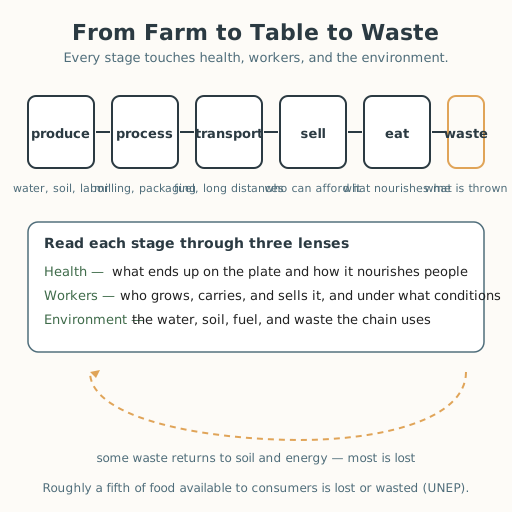
Learners **analyze a food system from farm to table to waste**, tracing one food through six stages — produce, process, transport, sell, eat, waste — and naming the effects of each stage on **health, workers, and the environment**. They distinguish food that is *lost or wasted* from food that is *eaten*, and connect the journey to their own plate.
Objectives
Objectives
- D03.S3.09.01 Analyze a local food system from farm to table to waste and its effects on health, workers, and the environment.
Essential question
How does my food travel from farm to table to waste, and what does that journey do to health, to the people who grow and carry it, and to the environment?
Key vocabulary
Materials
Standard materials
- Food-system flow sheet · 1 per learner A template with the six stages (produce, process, transport, sell, eat, waste) and a row for effects on health, workers, and environment at each stage
- One food item per learner · 1 per learner A wrapper, label, or remembered meal to trace (bread, rice, a fruit, a tin, a snack)
Low-tech / no-cost
- A shared board or large paper Trace one food's journey together as a class; no printed sheets needed
- Memory and voice Learners trace a remembered meal aloud from farm to table to waste
Enriched / lab & device
- A device or screen · 1 per pair Look up where a food's ingredients are grown and how far they travel (origin labels, simple maps)
- A visit to a market, garden, farm, or kitchen · optional Observe one stage of the food system in person and report back
Works in different contexts
- large-group Trace one common food as a whole class, then pairs trace a second food and share one effect each
- multi-age Younger learners name the six stages in order; older learners add the effects on health, workers, and environment at each stage
- self-directed A learner traces one food through all six stages and writes at least one effect on health, one on workers, and one on the environment
- level-grouped Learners ready to extend compare two foods (a local staple vs. a heavily processed snack) and contrast their effects stage by stage
- outdoor-only Trace a food that grows nearby; walk to a market, garden, or field if possible, and note what the environment gives and takes at each stage
Lesson 7 — From Farm to Table to Waste: Tracing a Food System
Summary
Learners analyze a food system from farm to table to waste, tracing one food through six stages — produce, process, transport, sell, eat, waste — and naming the effects of each stage on health, workers, and the environment. They distinguish food that is lost or wasted from food that is eaten, and connect the journey to their own plate.
Objectives
- Analyze a local food system from farm to table to waste and its effects on health, workers, and the environment. (D03.S3.09.01)
Connection
Before it reached your hand, the rice or bread or fruit you ate had a long life you never saw: someone grew it, someone harvested it, someone packed and moved it, someone sold it, and somewhere, some of it was thrown away. That whole journey — farm to table to waste — is a food system, and it touches your health (what ends up on your plate), workers (who is paid what to grow and carry it), and the environment (water, soil, fuel, and waste along the way). Tracing one food is how you stop seeing a meal as a single object and start seeing it as a chain of choices and consequences. Today you follow that chain.
Materials
- Food-system flow sheet
- One food item per learner
Preparation
- Copy the flow sheet.
- Retrieval: from earlier grades, recall that food comes from plants and animals raised by people (S-080), and that it moves through plant, grow, harvest, transport, sell, and cook before it reaches a table (S-081).
Facilitator note
This lesson is written to the learner (“you”). The concept to land: a food system is a chain of stages — produce, process, transport, sell, eat, waste — and each stage has effects on health (what people eat and its quality), workers (who does the labor, under what conditions, for what pay), and the environment (water, soil, energy, emissions, and waste). This is a systems analysis skill, so model the trace on one food, then guide learners through their own (S-011). The global lens: food moves farther and through more hands than it once did; the same plate now links a field on one continent to a kitchen on another (S-081). The environment lens: a large share of food is lost or wasted — roughly a fifth of the food available to consumers worldwide — which wastes the water, land, and energy used to produce it (S-410). The ethics and egalitarian lenses: the system does not treat everyone equally — farm and food workers often do hard, essential work for low pay and little protection, and the benefits and harms of the chain fall unevenly. The technology lens: processing, refrigeration, and long-distance transport changed what food is possible — and created the packaging and fuel costs the chain now carries. Hold the tone carefully: this is not a lesson in shaming anyone’s food or family. Every family eats what it can, within its means and culture; the point is to understand the system, not to grade a plate. Distinguish evidence (how food moves, how much is wasted) from values (that workers deserve fair pay, that waste matters) throughout.
Procedure
- Recall (5 min). Where does food come from, and what steps does it pass through before it reaches a table? Today we trace those steps and ask what each one does to people and the planet.
- Meet the six stages (10 min). Read them on the flow sheet: produce (grow and harvest), process (clean, mill, cook, package), transport (move it, often far), sell (market, shop, stall), eat (your table), and waste (what is thrown away or spoiled). Each stage has effects on health, workers, and the environment.
- Model the trace (12 min). Worked example — rice: Produce: grown in flooded fields, using water and labor. Process: milled and bagged. Transport: shipped long distances, burning fuel. Sell: sold at a market or shop. Eat: a staple that feeds billions. Waste: spoiled or thrown-away rice wastes the water and work that made it. At each stage, name one effect on health, workers, or the environment.
- Trace your own food (15 min). Choose your food item. Fill the flow sheet through all six stages, and write at least one effect on health, one on workers, and one on the environment somewhere in the chain.
- Peer-check (5 min). Swap sheets with a partner. Check: are all six stages present and in order? Is there at least one effect for each of the three categories? Fix what is missing.
- Close (8 min). One sentence each: “Tracing my food changed how I see it because…” Then add one small, honest thing a person could do — not a rule, just a possibility (buy local when possible, waste less, learn where a staple is grown).
Differentiation
- Support: Provide the six stages pre-labeled and ask learners to fill in only the effects; give a fill-in (“At the ___ stage, ___ affects ___”).
- Extension: Compare two foods — a local staple and a heavily processed snack — and write one paragraph contrasting their effects on health, workers, and the environment.
Assessment
- Formative (observation): Can the learner order the six stages and name at least one effect on health, one on workers, and one on the environment?
- Portfolio artifact: The completed flow sheet, kept in the portfolio.
Home connection
At your next meal, ask where one ingredient came from and how far it likely traveled. Write one sentence about what you found. Bring it to the capstone lesson.
Resources
- On food value chains (the path from production to consumer): FAO, Sustainable Food Value Chains, https://www.fao.org/sustainable-food-value-chains/en/ (S-081).
- On food originating from plants and animals raised by people: FAO, The State of Food and Agriculture (S-080).
- On food loss and waste: UNEP, Food Waste Index Report (S-410).
- On explicit instruction and worked examples: Kirschner, Sweller & Clark (2006) (S-011).