Lesson 01 — Communicating Across Difference
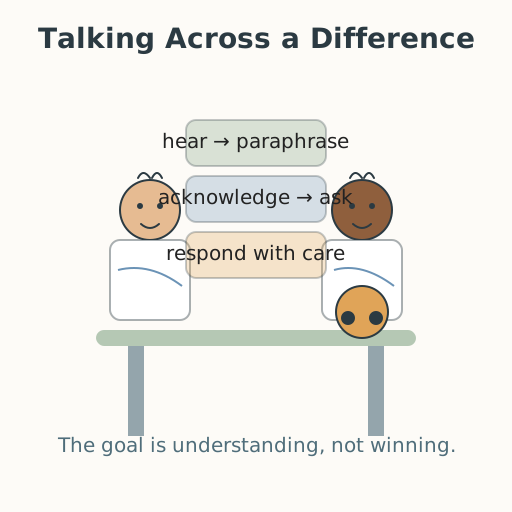
Learners practice **communicating across real difference** — opinion, culture, or background — using a three-move skill (paraphrase, acknowledge, ask) modeled first, then practiced on real disagreements. The goal is understanding, not winning.
Objectives
Objectives
- D02.S1.09.01 Communicate respectfully across differences of opinion, culture, or background.
Essential question
How do I communicate respectfully with someone whose opinion, culture, or background differs from my own — without winning or giving up?
Key vocabulary
Materials
Standard materials
- Across-difference conversation card · 1 per pair A two-column prompt — "What I heard you say…" and "What I wonder about…" — with a worked example printed on the back
- Disagreement scenarios · 1 set per group Four short, real disagreements (a group decision, a family rule, a school policy, a community question) to practice on
Low-tech / no-cost
- A shared board or large paper Model the worked example together; learners copy the two columns by hand
- Voice and a partner The whole activity can run with speaking and listening alone, no paper needed
Enriched / lab & device
- A shared document or chat tool · 1 per pair Practice the same skill in writing, where tone and body language are absent
Works in different contexts
- large-group Model one worked example to the whole group, then pairs practice one scenario each and report a single takeaway
- multi-age Younger learners paraphrase and ask one question; older learners also reflect on power and tone in the exchange
- self-directed A learner studies the worked example, then practices the two columns in writing on a real disagreement they have noticed
- level-grouped Learners ready to extend add a third move — naming where their own view might be incomplete
- outdoor-only Run the pairs conversation while walking or seated outside; the skill needs no equipment
Lesson 1 — Communicating Across Difference
Summary
Learners practice communicating across real difference — of opinion, culture, or background — using a three-move skill (paraphrase, acknowledge, ask) that is modeled first, then practiced on real disagreements. The goal is understanding, not winning.
Objectives
- Communicate respectfully across differences of opinion, culture, or background. (D02.S1.09.01)
Connection
Think of a time you disagreed with someone you otherwise care about — a friend who loves a song you can’t stand, a family member with a rule you think is unfair, a classmate whose view on a hot topic is the opposite of yours. Maybe you argued until someone won and someone lost, or maybe you both went quiet and dropped it. There is a third way, used in meeting halls and markets and around fires all over the world: talk across the difference so that both people leave feeling heard, even when neither changes their mind. Today you learn that way.
Materials
- Across-difference conversation card
- Disagreement scenarios
Preparation
- Copy the conversation card and scenario set.
- Retrieval: from Grade 8, recall how tone, body language, and digital messages can change meaning (D02.S1.08.01); from Grade 7, recall setting and respecting a boundary during disagreement.
Facilitator note
This lesson is written to the learner (“you”). The skill to land: communicating across difference has three moves — (1) paraphrase: say back what you heard, in your own words, to check you understood; (2) acknowledge: name what is reasonable or real in their view before you respond; (3) ask: ask a genuine question from curiosity, not as a trap. This is a skill, so use a worked example first, then guided practice (explicit instruction carries skills for novices — S-011). The ethics lens: we owe people dignity even when we disagree — understanding someone is not agreeing with them. The egalitarian lens: in any conversation, some voices are louder and some are quieter; across difference, notice who has more power and make room. The global lens: norms of disagreement differ across cultures — in some places, direct disagreement is rude and indirect hints are respectful; there is no single “right” way, only the shared goal of being heard. The technology lens: online, tone and body language vanish, so the same three moves matter even more in text. Model the worked example fully before pairs practice. Emphasize that the goal is understanding, not winning or giving up.
Procedure
- Recall (5 min). From Grade 8: how can tone, body language, and digital messages change the meaning of what we say? Today we add a skill for talking across a difference.
- Meet the three moves (8 min). When you talk with someone you disagree with, three moves keep the conversation human: paraphrase (say back what you heard), acknowledge (name what is reasonable in their view), ask (ask a real question from curiosity).
- Study the worked example (10 min). Scenario: two neighbors disagree about whether a shared field should become a market or a garden. One says: “A market would bring money and jobs; a garden is a waste.” The other responds with all three moves: “You’re saying the market would help people earn and the garden wouldn’t (paraphrase). The money-and-jobs point is a real one (acknowledge). What worries you about a garden, or what would make a garden feel worthwhile to you (ask)?” Trace each move and say why it works.
- Practice in pairs (18 min). Pick a scenario from the set (a group decision, a family rule, a school policy, a community question). Person A states their view. Person B responds using all three moves — and does not argue back yet. Then switch roles.
- Peer-check (5 min). Ask your partner: did I say your view back accurately? Did I name something real in it? Was my question a genuine one? Fix what was missing.
- Close (4 min). Share one move you will keep. Understanding is not the same as agreeing — and that is exactly what makes it possible.
Differentiation
- Support: Provide sentence stems — “What I hear you saying is…”, “One thing I see in your view is…”, “I wonder…”.
- Extension: Add a fourth move: name where your own view might be incomplete (“I might be missing something because…”).
- Non-speaking / AAC: The three moves are ways of understanding, not of voice — a learner can paraphrase, acknowledge, and ask by writing, pointing to the stems, signing, or using a device; the partner responds to whatever the learner produced.
- Deaf / hard of hearing: Run the three moves in sign, writing, or text, not only speech; a paraphrase signed or written back is a real paraphrase, and the “ask” move works just as well on paper.
Assessment
- Formative (observation): Can the learner paraphrase, acknowledge, and ask in a real exchange?
- Peer check: Partner confirms the three moves were present and genuine.
- Portfolio artifact: The completed conversation card, kept in the portfolio.
Home connection
Notice one difference of opinion at home or in your neighborhood this week. Before responding, try one move: say back what you heard, or ask one genuine question. Bring what happened to the next lesson.
Resources
- On relationship skills and social awareness as SEL competencies: CASEL, “Fundamentals of Social and Emotional Learning,” https://casel.org/fundamentals-of-sel/ (S-001).
- On needs-based, respectful communication: Marshall B. Rosenberg, Nonviolent Communication (2003) (S-148).
- On explicit instruction and worked examples for skills: Kirschner, Sweller & Clark (2006), https://doi.org/10.1207/s15326985ep4102_1 (S-011).