Lesson 02 — Consent: Yes, No, and Changing Your Mind
Learners practice **consent** — asking for it, giving it, and hearing "no" — using the "FRIES" memory aid (freely given, reversible, informed, enthusiastic, specific) and everyday ask-and-answer scenarios.
Objectives
Objectives
- D02.S1.09.02 Practice healthy relationship skills, including consent, trust, and honest talk about feelings.
Essential question
How do I ask for, give, and respect consent — including hearing "no" and changing my mind?
Key vocabulary
Materials
Standard materials
- Consent choices card · 1 per learner A simple card showing that consent is freely given, reversible, informed, enthusiastic, and specific (the "FRIES" memory aid), with example sentences
- Ask-and-answer scenario set · 1 set per group Short everyday situations — borrowing, a hug, a shared plan, sharing a photo — to practice asking and hearing a "no" or a "maybe"
Low-tech / no-cost
- Voice and a partner Practice the ask-and-answer scripts aloud; no paper needed
- A shared board or large paper Write the memory aid together as a class
Enriched / lab & device
- A short video or article on consent · 1 A reputable health-education resource on consent to view and discuss
Works in different contexts
- large-group Teach the memory aid once to the whole group, then pairs practice one scenario each
- multi-age Younger learners focus on everyday borrowing and touch; older learners also discuss consent online (photos, posts, accounts)
- self-directed A learner studies the memory aid and writes three example sentences for giving and three for hearing "no"
- level-grouped Learners ready to extend discuss how power (age, status, popularity) can make a "yes" not really free
- outdoor-only Run the scenario practice while walking or seated outside; the skill needs no equipment
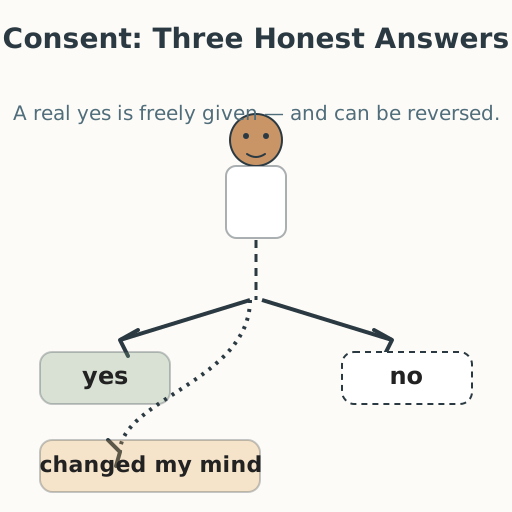
Lesson 2 — Consent: Yes, No, and Changing Your Mind
Summary
Learners practice consent — asking for it, giving it, and hearing “no” — using the “FRIES” memory aid (freely given, reversible, informed, enthusiastic, specific) and everyday ask-and-answer scenarios.
Objectives
- Practice healthy relationship skills, including consent, trust, and honest talk about feelings. (D02.S1.09.02)
Connection
Consent is not only about one kind of relationship; it runs through ordinary life. Borrowing a phone, hugging a friend hello, adding someone to a group, sharing a photo, making a plan — every one of these is a small ask and a small answer. A “yes” that is pressured, half-hearted, or not really free isn’t a real yes; and a “yes” that can’t be changed into a “no” isn’t a real yes either. Today you learn to ask clearly, answer honestly, and hear “no” without making it hurt.
Materials
- Consent choices card
- Ask-and-answer scenario set
Preparation
- Copy the consent choices card and scenario set.
- Retrieval: from Grade 7, recall setting and respecting personal boundaries (D02.S1.07.01); from Grade 5, recall body autonomy and “my body is my home.”
Facilitator note
This lesson is written to the learner (“you”). The ideas to land: consent is (1) freely given — not pressured, not assumed, not owed; (2) reversible — anyone can change their mind at any point, and a later “no” overrides an earlier “yes”; (3) informed — everyone knows what they are agreeing to; (4) enthusiastic — a genuine yes, not a reluctant shrug; and (5) specific — yes to one thing is not yes to everything. Use the “FRIES” memory aid (freely given, reversible, informed, enthusiastic, specific). This is a skill, so model an ask-and-answer pair fully before learners practice (S-011). The ethics lens: respect for another’s autonomy is the ground of care. The egalitarian lens: everyone’s body, belongings, and choices deserve the same respect, no matter their age, status, or gender — and power differences (popularity, age, authority) can make a “yes” not truly free, so watch for them. The global lens: the principle — that a person must freely agree — is shared across cultures, even though customs about how to ask and show agreement differ. The technology lens: consent applies online too — asking before sharing a photo, tagging, or posting about someone. Keep it ordinary and non-frightening; this is about everyday autonomy, not only about sex.
Procedure
- Recall (5 min). From Grade 7: what is a boundary, and how do you know when someone has set one? Today we name the yes-and-no behind every boundary.
- Meet the idea (8 min). Consent is a free, informed, changeable “yes.” Meet the five parts: freely given, reversible, informed, enthusiastic, specific — the “FRIES” aid.
- Study the worked example (10 min). Asking: “Can I borrow your phone to check the time?” Giving a real yes: “Sure, for a minute.” A reversible no: “Not right now — maybe later.” Trace each part: the ask is specific, the yes is free and reversible, and a “no” is answered with “okay, thanks” — not pressure, not guilt.
- Practice in pairs (15 min). Work through the scenario set — borrowing, a hug, a shared plan, sharing a photo. Person A asks. Person B answers — sometimes yes, sometimes no, sometimes “I changed my mind.” Person A practices hearing the answer with grace, then switch roles.
- Peer-check (5 min). Ask your partner: was my ask clear and specific? Did I hear “no” without pushing? Fix what was missing.
- Close (4 min). Share one sentence you now know how to say — to ask, to say yes, or to say no kindly.
Differentiation
- Support: Provide sentence stems — “Is it okay if I…?”, “I’m comfortable with… but not…”, “Thanks for asking, but no.”
- Extension: Discuss a power-imbalanced scenario (an older or more popular person asking) and name why a “yes” there might not be free.
- Non-speaking / AAC / Deaf / hard of hearing: A “yes,” “no,” or “changed my mind” can be given by sign, gesture, a point to the card, writing, or a device — never only by voice. Every learner must be able to give and withdraw consent in their own mode, and “hearing no” means accepting the answer however it is expressed.
Assessment
- Formative (observation): Can the learner ask clearly, answer honestly, and hear “no” without pressure?
- Peer check: Partner confirms the ask was specific and the “no” was respected.
- Portfolio artifact: The completed consent choices card, kept in the portfolio.
Home connection
Practice one clear ask and one kind “no thanks” at home this week — something small, like borrowing or joining a plan — and notice how it feels to be asked and answered clearly.
Resources
- On comprehensive sexuality education, consent, and healthy relationships: UNESCO, “International Technical Guidance on Sexuality Education” (S-412).
- On a child’s right to be heard and protected: UN Convention on the Rights of the Child (UNICEF, child-friendly summary), https://www.unicef.org/child-rights-convention (S-060).
- On explicit instruction and worked examples for skills: Kirschner, Sweller & Clark (2006), https://doi.org/10.1207/s15326985ep4102_1 (S-011).