Lesson 08 — How Systems Shape Cooperation, Competition, and Inequality
Learners evaluate how **economic and social systems** — their rules and incentives — shape whether people **cooperate or compete** and how **equally rewards are shared**, using two versions of one simple game and real examples from commons, markets, and mutual aid.
Objectives
Objectives
- D02.S4.09.01 Evaluate how economic and social systems shape cooperation, competition, and inequality.
Essential question
How do economic and social systems — their rules and incentives — shape whether people cooperate or compete, and how equally the rewards are shared?
Key vocabulary
Materials
Standard materials
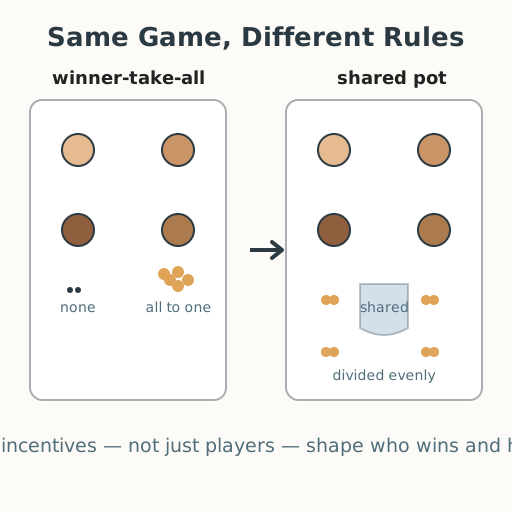
- Rules-of-the-game diagram · 1 per learner Two versions of the same simple game — one with rules that reward cooperation, one that rewards competition — to compare outcomes on
- System example cards · 1 set per group Short, real examples — a shared commons, a market, a mutual-aid network, a rule that excluded a group — to sort and analyze
Low-tech / no-cost
- A shared board or large paper Draw the two game versions together and tally the outcomes
- Voice and discussion The analysis can run entirely as talk
Enriched / lab & device
- A spreadsheet or data page on inequality · 1 per group Real data on how income or wealth is distributed in different countries, to read and discuss
Works in different contexts
- large-group Play one quick demonstration of the two rule-sets together, then small groups analyze the example cards
- multi-age Younger learners sort examples into "cooperates," "competes," and "both"; older learners connect each to inequality
- self-directed A learner studies the two game versions, analyzes the example cards, and writes how one real system shapes outcomes
- level-grouped Learners ready to extend read real inequality data and connect a rule or incentive to an observed gap
- outdoor-only Run the demonstration with found objects (stones, sticks) as tokens; the concept needs no equipment
Lesson 8 — How Systems Shape Cooperation, Competition, and Inequality
Summary
Learners evaluate how economic and social systems — their rules and incentives — shape whether people cooperate or compete and how equally rewards are shared, using two versions of one simple game and real examples from commons, markets, and mutual aid.
Objectives
- Evaluate how economic and social systems shape cooperation, competition, and inequality. (D02.S4.09.01)
Connection
Imagine two groups playing the same simple game — rolling dice for tokens — but with different rules. In one, every point earned goes to whoever rolled it; in the other, points go into a shared pot divided evenly. The players are identical; the outcomes are not. This is the quiet truth about systems: the rules, not just the players, decide who cooperates, who competes, and how much each person ends up with. Today you learn to see the rules behind the world you live in.
Materials
- Rules-of-the-game diagram
- System example cards
Preparation
- Copy the diagram and example cards.
- Retrieval: from Grade 6, recall why some people have more than they need while others lack (D02.S4.06.02); from Grade 8, recall how systems of care operate and what makes them fair or unfair.
Facilitator note
This lesson is written to the learner (“you”). The ideas to land: (1) a system is a set of rules and incentives; (2) the rules of a system shape behavior — cooperative rules (shared rewards, shared stakes) tend to produce cooperation, while winner-take-all rules tend to produce competition (social interdependence theory, S-233); (3) the rules also shape outcomes — the same players can end up very unequal under one rule-set and roughly equal under another; (4) real systems — a shared commons with rules for the common good (S-416), a market, a mutual-aid network — are all rule-sets, and their rules can be changed; (5) inequality is not a fact of nature but is partly produced by rules and incentives, which is why different countries with similar wealth can have very different levels of inequality (S-006). This is a concept; use the demonstration and inquiry, not drill (philosophy §13). The egalitarian lens is the heart: inequality is structured, not just individual. The ethics lens: because rules are human-made, we can ask whether they are fair — and change them. The global lens: different societies have built different systems — commons, markets, cooperatives, mutual aid — and each produces different patterns of cooperation and inequality. The technology/environment lens: technology changes the rules (automation shifts who earns; extractive economies shift costs onto the environment and onto the people least able to bear them). Keep the demonstration concrete and let learners draw the lesson themselves before you name it.
Procedure
- Recall (5 min). From Grade 6: why do some people have more than they need while others lack? Today we look at the rules behind that question.
- Play the two versions (12 min). Study the diagram: the same simple game with two rule-sets. Version A: each roll’s points go to the roller. Version B: all points go to a shared pot, divided evenly. Predict the outcome of each — who cooperates, who competes, who ends up with more.
- Name the lesson (8 min). The players are the same; the rules and incentives changed the behavior and the outcome. That is what a system is — rules and incentives that shape what people do and what they get.
- Analyze real systems (18 min). Sort the example cards — a shared commons with rules for fair use (S-416), a market with a winner-take-all incentive, a mutual-aid network that shares by need. For each: what behavior does it reward, and how equally are the rewards shared? Which rules could be changed, and by whom?
- Connect to inequality (8 min). Inequality is not only about individuals working hard or not; it is partly produced by rules. Countries with similar wealth can be far more or far less equal because their rules differ (S-006). Write one rule in your own community that shapes who has more and who has less.
- Close (4 min). Rules are human-made — which means they can be remade. That is where fairness lives.
Differentiation
- Support: Sort the example cards into “rewards cooperation” and “rewards competition” using the diagram.
- Extension: Read real inequality data (S-006) and connect one observed gap to a specific rule or incentive you can name.
Assessment
- Formative (observation): Can the learner explain how rules and incentives shape cooperation, competition, and inequality, and identify a rule that could be changed?
- Portfolio artifact: The annotated diagram and the learner’s one-rule analysis, kept in the portfolio.
Home connection
Look at one system you are inside this week — a class, a household, a workplace, a game. Name one rule in it, and ask: what behavior does this rule reward, and who ends up with more or less because of it?
Resources
- On cooperative versus competitive goal structures: Johnson & Johnson (1981) (S-233).
- On communities governing shared resources by their own rules: Elinor Ostrom (1990), Governing the Commons (S-416).
- On global inequality data: Our World in Data, https://ourworldindata.org/ (S-006).
- On mutual aid and cooperation as widespread human practice: Peter Kropotkin (1902), Mutual Aid (S-163).