Lesson 07 — Nationalism, Exclusion, and In-Group Loyalty
Learners analyze how **in-group loyalty and nationalism** can both **build** community (belonging, shared purpose, liberation) and **limit** it (exclusion, dehumanization, conflict), and practice asking where the line between pride and exclusion lies.
Objectives
Objectives
- D02.S3.09.02 Analyze how nationalism, exclusion, and in-group loyalty can both build and limit community.
Essential question
How can in-group loyalty and nationalism both build community and limit it — and where is the line between pride and exclusion?
Key vocabulary
Materials
Standard materials
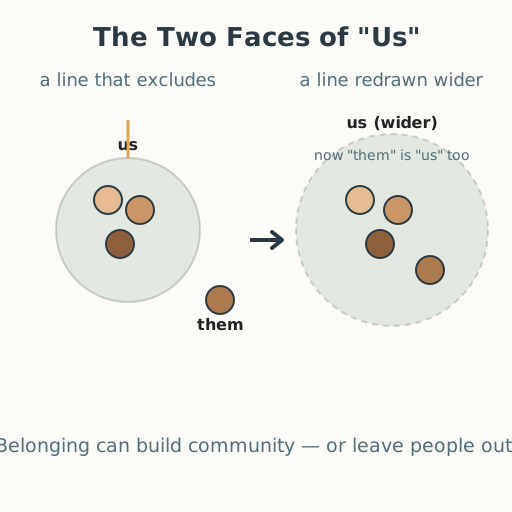
- In-group/out-group diagram · 1 per learner A circle with "us" inside and "them" outside, with a second, larger circle showing the boundary redrawn to include more people
- Case-study cards · 1 set per group Short, real examples of group loyalty and nationalism that built community, limited it, or both — to sort and analyze
Low-tech / no-cost
- A shared board or large paper Draw the circles together and add the learners' own examples
- Voice and discussion The analysis can run entirely as talk
Enriched / lab & device
- A short video or article on a historical independence movement · 1 A real example of nationalism that both united people and created new exclusions, to discuss
Works in different contexts
- large-group Teach the diagram once together, then small groups each take one case study and report the "builds" and "limits" they found
- multi-age Younger learners sort examples into "builds belonging" and "excludes people"; older learners analyze the same case for both at once
- self-directed A learner studies the diagram, analyzes the case cards, and writes where pride tips into exclusion in one example
- level-grouped Learners ready to extend compare two historical nationalisms — one liberating, one oppressive — and name what differs
- outdoor-only Discuss while walking; use visible or remembered groups (teams, neighborhoods, nations) as examples
Lesson 7 — Nationalism, Exclusion, and In-Group Loyalty
Summary
Learners analyze how in-group loyalty and nationalism can both build community (belonging, shared purpose, liberation) and limit it (exclusion, dehumanization, conflict), and practice asking where the line between pride and exclusion lies.
Objectives
- Analyze how nationalism, exclusion, and in-group loyalty can both build and limit community. (D02.S3.09.02)
Connection
You know the warmth of “us.” It might be your team, your neighborhood, your language community, or your country — the feeling of being on the inside with people who share something with you. That warmth is real and good; it is how people have fed one another through famines and won their freedom. But “us” always has an edge: somewhere, a line is drawn, and someone is left on the other side of it. The same loyalty that builds can also exclude, dehumanize, and burn. Today you look honestly at both faces of “us.”
Materials
- In-group/out-group diagram
- Case-study cards
Preparation
- Copy the diagram and case-study cards.
- Retrieval: from Grade 6, recall how belonging can include some and exclude others (D02.S3.06.01); from Grade 8, recall how power and resources are shared in a community.
Facilitator note
This lesson is written to the learner (“you”). The ideas to land: (1) in-group loyalty is a deep human tendency — even arbitrary group labels produce favoritism toward “us” (the minimal-group experiments, S-232); (2) this loyalty builds community: belonging, trust, shared purpose, and the solidarity that wins liberation; (3) it also limits community: an out-group is excluded, stereotyped, and sometimes dehumanized; (4) nationalism is a modern form of in-group loyalty built around an “imagined community” — a nation whose members will never meet but imagine themselves as one (S-415); (5) the same nationalism can liberate a colonized people and become a new exclusion — so the honest question is not “is loyalty good or bad?” but “who does this ‘us’ include, who does it leave out, and at what cost?” This is a concept with real moral weight, so use inquiry and careful discussion, not drill (philosophy §13). The global/anthropological lens: nationalism is historically recent and culturally specific — for most of human history people belonged by kinship, place, faith, or empire, not nation-state. The ethics lens: loyalty to one’s own is good, but it does not license harm to outsiders. The egalitarian lens: every person outside the line is as fully human as everyone inside it. The technology lens: online platforms can harden “us versus them” by showing us only our side and feeding outrage against the out-group. Hold this topic with care — learners may hold deep national or ethnic loyalties; honor them while inviting honest reflection, and keep the posture of questions, not verdicts.
Procedure
- Recall (5 min). From Grade 6: how can belonging include some people and exclude others? Today we examine the biggest “us” of all — the nation.
- Meet the warmth (10 min). Draw the circle: “us” inside, “them” outside. In-group loyalty is real and early — even people given a meaningless label (blue team vs red team) begin to favor their own side (S-232). Name what “us” gives people: belonging, trust, shared purpose.
- Meet the edge (10 min). The same line that holds “us” together leaves “them” out. An out-group can be stereotyped, mistrusted, and — at its worst — dehumanized. A nation is an “imagined community”: its members will never meet, yet they imagine themselves as one (S-415).
- Analyze the double face (15 min). Work the case-study cards: a liberation movement that united a people; a national pride that became a campaign against a minority; a sports loyalty that turned violent. For each, answer: what did this “us” build, and what did it limit or destroy?
- Ask the honest question (10 min). The question is not “is loyalty good or bad?” but “who does this ‘us’ include, who does it leave out, and at what cost?” Write your answer for one case — and redraw the circle wider where you think it should be.
- Close (5 min). Loyalty can be love; exclusion is where love stops. The skill is holding the first without slipping into the second.
Differentiation
- Support: Sort the case-study cards into “mostly builds,” “mostly limits,” and “both” using the diagram.
- Extension: Compare a liberating nationalism (a people winning independence) with an oppressive one (a nation dominating others), and name two things that distinguish them.
Assessment
- Formative (observation): Can the learner explain how in-group loyalty both builds and limits community, and apply the “who is left out?” question?
- Portfolio artifact: The annotated diagram with one case analysis and the redrawn circle, kept in the portfolio.
Home connection
Notice one “us” you belong to this week — a team, a group chat, a nation, a faith. Ask yourself honestly: who does this “us” include, and who does it leave out?
Resources
- On minimal-group favoritism and social identity: Henri Tajfel (1970) (S-232).
- On nationalism as an “imagined community”: Benedict Anderson (1983), Imagined Communities (S-415).
- On hidden bias and how groups shape perception: Banaji & Greenwald (2013), Blindspot (S-344).