Lesson 03 — Leading a Discussion That Welcomes Every Voice
Learners practice **leading a discussion** using four moves — invite, echo, take turns, and disagree kindly — modeled first, then practiced in small circles with a rotating facilitator. The goal is a discussion where every voice is welcomed and disagreement is managed with fairness, not won.
Objectives
Objectives
- D04.S1.09.02 Lead or facilitate a discussion, inviting participation and managing disagreement with fairness.
Essential question
How do I lead a discussion that invites participation and manages disagreement with fairness?
Key vocabulary
Materials
Standard materials
- Facilitation toolkit card · 1 per learner Four moves — invite, echo, take turns, disagree kindly — each with a worked phrase, printed on one card
- Discussion scenarios · 1 set per group Four short, real questions worth discussing (a shared-space decision, a school rule, a community project, a current local issue)
Low-tech / no-cost
- A talking object · 1 A stone, stick, or shell passed to mark whose turn it is — a turn-taking custom found across many cultures
- Voice and a circle The whole activity runs with people, a circle, and a shared question — no paper needed
Enriched / lab & device
- A recording device · 1 Record a short discussion so the group can review how well every voice was included
- A shared online space · 1 Practice the same moves in a text discussion, where tone and turn-taking need more care
Works in different contexts
- large-group Model one facilitation to the whole group, then small circles of four to six each run a short discussion with a rotating facilitator
- multi-age Younger learners practice invite and take turns; older learners add echo and disagree kindly, and rotate as facilitator
- self-directed A learner studies the toolkit, then runs a short discussion with family or peers and reflects in writing on who spoke least and why
- level-grouped Learners ready to extend also notice power — who is loudest, who is silent — and name one move that rebalances the room
- outdoor-only Hold the discussion in a circle outside; the talking object and the four moves need no walls or equipment
Lesson 3 — Leading a Discussion That Welcomes Every Voice
Summary
Learners practice leading a discussion using four moves — invite, echo, take turns, and disagree kindly — modeled first, then practiced in small circles with a rotating facilitator. The goal is a discussion where every voice is welcomed and disagreement is managed with fairness, not won.
Objectives
- Lead or facilitate a discussion, inviting participation and managing disagreement with fairness. (D04.S1.09.02)
Connection
A good discussion does not happen by accident. Think of the last time a group you were in had to decide something — where to eat, what the team should do, whether to change a rule. Usually the loudest person wins, the quietest person never speaks, and someone leaves annoyed. In councils, classrooms, and community circles all over the world, people solve this by giving one person a special job: not to talk the most, but to make sure everyone else talks enough and that when people disagree, they push on ideas, not on each other. Today you learn that job.
Materials
- Facilitation toolkit card
- Discussion scenarios
Preparation
- Copy the toolkit card and scenario set; have a talking object ready.
- Retrieval: from Grade 8, recall disagreeing respectfully — building on others’ ideas and pushing back on the idea, not the person. Today we add the facilitator’s job of protecting that for the whole group.
Facilitator note
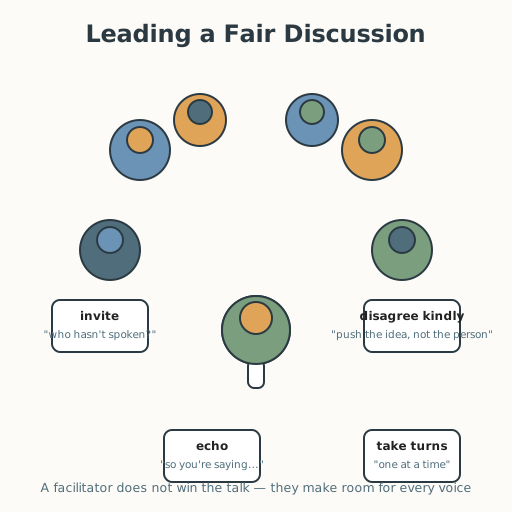
This lesson is written to the learner (“you”). The skill to land: facilitation has four moves — (1) invite: draw in the person who has not spoken (“Who hasn’t had a turn?”); (2) echo: restate what someone said so they feel heard and the group stays on track (“So you’re saying…”); (3) take turns: hold the space so one voice at a time is heard; (4) disagree kindly: redirect an attack from the person to the idea (“Let’s push on the idea, not on each other.”). This is a skill, so use a worked example, then guided practice (S-011). Model a short discussion once, playing the facilitator and narrating each move as you make it. The ethics lens: a facilitator does not win — they serve the fairness of the group, and they owe dignity to every speaker, including the one they disagree with. The egalitarian lens: in every room, power is uneven — some voices are louder, some are silent; facilitation is the deliberate act of rebalancing, and a good facilitator notices who is not speaking and asks why. The global lens: turn-taking customs — the talking stick, the speaking circle, the council where elders listen first — appear in Indigenous, African, Asian, and other traditions, and all share the same aim: every voice matters. The critical-thinking lens: managing disagreement fairly means separating the strength of a claim from the volume of the person making it. The technology & environment lens: a discussion held online or in text changes turn-taking — who can dominate, who gets queued, who is silenced — and a recording lets a group review how well it actually included every voice. Keep the practice questions real but not explosive; the point is the skill, not the outcome.
Procedure
- Recall (5 min). From Grade 8: what does it mean to disagree with an idea without attacking a person? Today we protect that for a whole group.
- Meet the four moves (8 min). A facilitator has four tools: invite (draw in the quiet), echo (restate to check understanding), take turns (one at a time), disagree kindly (push the idea, not the person). Say each in your own words.
- Study the worked example (10 min). Watch (or read) a short discussion where the facilitator makes all four moves. After each move, pause and name which tool was used and why it helped.
- Practice in a circle (20 min). In groups of four to six, choose a scenario and a question. One person facilitates for five minutes using the four moves; the rest discuss. Rotate so at least two people try facilitating.
- Peer-check (7 min). Ask the group: did the facilitator invite someone quiet? Did they echo fairly? Did they keep turns? Did they redirect a disagreement to the idea? Name one move done well and one to try next time.
- Close (5 min). Share one move you will keep. A leader of discussion is not the loudest voice — they are the one who makes room for every voice.
Differentiation
- Support: Provide the exact phrases on the toolkit card and let a learner facilitate with a partner (co-facilitator) the first time.
- Extension: Also name the power in the room — who is loudest, who is silent — and add a fifth move: invite the silent voice specifically by name or by written note.
- Non-speaking / AAC: Facilitation can be done by gesture, by pointing to move cards, by writing, or on a device; “echo” means showing back what was said, in any mode.
- Deaf / hard of hearing: Run the discussion in sign or text; turn-taking works visually (hands, a raised card, a queued chat), and the facilitator’s four moves are the same.
Assessment
- Formative (performance/observation): Can the learner make all four moves while facilitating a short real discussion?
- Peer check: The group names one move done well and one to try next.
- Portfolio artifact: The toolkit card marked with the learner’s own phrases, kept in the portfolio.
Home connection
At your next family or group decision, try one move: invite someone who has not spoken, or restate what someone said before you answer. Notice what changes.
Resources
- On relationship skills and social awareness as SEL competencies (the basis of fair turn-taking and disagreement): CASEL, “Fundamentals of Social and Emotional Learning,” https://casel.org/fundamentals-of-sel/ (S-001).
- On restoring and repairing rather than only punishing when disagreement harms a group: International Institute for Restorative Practices, https://www.iirp.edu/ (S-022).
- On explicit instruction and worked examples for skills: Kirschner, Sweller & Clark (2006), https://doi.org/10.1207/s15326985ep4102_1 (S-011).