Lesson 04 — Structure, Style & Argument: One Text Working Together
Learners analyze how **structure, style, and argument** work together in one text — Chimamanda Ngozi Adichie's "The Danger of a Single Story" — tracing how her ordering of personal stories (structure), her direct, repetitive voice (style), and her claim that single stories flatten people (argument) combine to create meaning and effect.
Objectives
Objectives
- D04.S2.09.01 Analyze how a text's structure, style, and argument work together to create meaning and effect.
Essential question
How do a text's structure, style, and argument work together to create meaning and effect?
Key vocabulary
Materials
Standard materials
- Structure-style-argument sheet · 1 per learner A three-column organizer — structure (how parts are ordered), style (word choice, voice, rhythm), argument (the claim and reasons) — with a worked example on the back
- Adichie, "The Danger of a Single Story" passage · 1 per learner A short, faithful excerpt of Chimamanda Ngozi Adichie's 2009 TED talk, chosen to show anecdote, thesis, and repetition
Low-tech / no-cost
- A shared board or large paper Build the three columns together; the facilitator reads the passage aloud twice
- Voice and memory Recall the passage by ear and mark its structure by listening, not reading
Enriched / lab & device
- A short clip of the talk · 1 Watch two to three minutes of Adichie's delivery to hear how style lives in the voice
- A transcript with the paragraphs numbered · 1 per learner Number the paragraphs to make the structure visible and discussable
Works in different contexts
- large-group Read the passage once together, then pairs each take one column (structure, style, or argument) and report back to assemble the full picture
- multi-age Younger learners identify the main claim and one repeated phrase; older learners trace how the ordering of stories builds the argument
- self-directed A learner reads the passage, fills the three columns, and writes one paragraph on how the three work together
- level-grouped Learners ready to extend compare two of Adichie's anecdotes and say why she placed one before the other
- outdoor-only Read the passage aloud outside; then find a nearby short text — a notice, a sign, a song — and run the same three columns on it
Lesson 4 — Structure, Style & Argument: One Text Working Together
Summary
Learners analyze how structure, style, and argument work together in one text — Chimamanda Ngozi Adichie’s “The Danger of a Single Story” — tracing how her ordering of personal stories (structure), her direct, repetitive voice (style), and her claim that single stories flatten people (argument) combine to create meaning and effect.
Objectives
- Analyze how a text’s structure, style, and argument work together to create meaning and effect. (D04.S2.09.01)
Connection
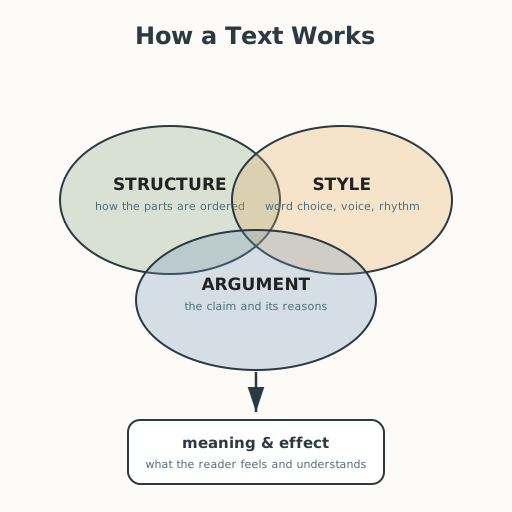
You have felt the difference between a story told well and the same story told badly — even when the facts are identical. What changed was not the information; it was how the teller ordered it, the words they chose, and the point they were building toward. A text is a machine with three working parts: structure (how the parts are arranged), style (the voice and word choice), and argument (the claim it is making). When they pull together, the reader feels something; when they fight each other, the text falls flat. Today you take one powerful text apart to see the three parts turning together.
Materials
- Structure-style-argument sheet
- “The Danger of a Single Story” passage
Preparation
- Copy the sheet and the passage.
- Retrieval: from Grade 8, recall how point of view, tone, and figurative language shape a reader’s understanding. Today we add how structure and argument join them.
Facilitator note
This lesson is written to the learner (“you”). The idea to land: a text’s structure (how it orders its parts), style (its word choice, voice, and rhythm), and argument (its claim and reasons) are not three separate things — they work together, and the effect on a reader comes from their combination. Worked example: Chimamanda Ngozi Adichie’s 2009 TED talk “The Danger of a Single Story” (S-417). Its argument: when we know only a single story about a person or place, we risk flattening them — so we must seek many stories. Its structure: a series of personal anecdotes (growing up in Nigeria reading British books; her American roommate’s assumptions; her own single story of a poor family) ordered to move from being the one flattened to the one flattening others, which makes the thesis land as earned, not preached. Its style: first person, plain and direct, with the phrase “single story” repeated like a refrain — a spoken, confessional rhythm built for a live audience. Show that the effect — the reader’s felt conviction that single stories are dangerous — comes from all three at once. The critical-thinking lens: naming structure, style, and argument is the beginning of reading with a tool, not the end; ask what the text does not say. The global lens: Adichie writes from and about Nigeria, Britain, the United States, and the way Western readers see Africa — a global argument about who gets to tell whose story. The ethics lens: the “single story” is an ethical problem — it treats a person as a category, and the cure is to seek the many stories that honor their full humanity. The egalitarian lens: whose stories get told, and whose get flattened into a single image, is a question of power. The technology & environment lens: “The Danger of a Single Story” is a spoken text preserved and spread by video and streaming — digital media changes how a single story can travel, for harm and for good — and a transcript turns a voice into a page a reader can study. Keep the passage short and faithful; do not over-quote (fair use, S-417). Emphasize that these three categories are lenses, not boxes — real texts blur them.
Procedure
- Recall (5 min). From Grade 8: how do tone, point of view, and figurative language shape how a text makes you feel? Today we add two more moving parts — structure and argument.
- Meet the three parts (8 min). Structure = how the parts are ordered. Style = word choice, voice, rhythm. Argument = the claim and its reasons. Together they produce meaning and effect.
- Read the passage (12 min). Read (or hear) the excerpt from Adichie’s “The Danger of a Single Story.” On first reading, just notice: what is she arguing? Where does she begin, and where does she end?
- Fill the three columns (15 min). With a partner, fill the sheet: structure (list the anecdotes in order — what does each one do?), style (find the repeated phrase and the first-person voice), and argument (state her thesis in one sentence).
- Name the effect (10 min). Put it together: how does the order of her stories make her thesis hit harder? How does the repetition drive it home? Write one sentence: “The effect comes from all three because…”
- Close (5 min). Share your sentence. You have just done what a mature reader does — you saw the machine behind the meaning.
Differentiation
- Support: Provide the three columns pre-filled with prompts (“one anecdote is…”, “the repeated phrase is…”, “her claim is…”) and ask learners to complete them.
- Extension: Compare the first anecdote and the last one, and explain why Adichie placed them where she did.
- Non-speaking / AAC: Analysis can be written, pointed to, or composed on a device; the three-column sheet is a visual tool that needs no speech.
- Deaf / hard of hearing: Work from the written transcript; “style” then includes Adichie’s sentence rhythm and repetition on the page, not only her voice.
Assessment
- Formative (observation): Can the learner name the argument, list the structural moves, and find one stylistic choice — and say how the three combine into an effect?
- Portfolio artifact: The completed three-column sheet, kept in the portfolio.
Home connection
Choose any text you meet this week — a song, a news post, a speech — and ask: what is its claim, how is it ordered, and what words does it repeat? Bring one finding to the next lesson.
Resources
- On the talk itself: Chimamanda Ngozi Adichie, “The Danger of a Single Story,” TED, July 2009 (S-417).
- On explicit instruction and worked examples for skills: Kirschner, Sweller & Clark (2006), https://doi.org/10.1207/s15326985ep4102_1 (S-011).
- On spaced retrieval: Dunlosky et al. (2013), https://doi.org/10.1177/1529100612453266 (S-039).