Lesson 05 — World Literature Gallery: Structure, Style & Argument Across Cultures
Learners run the Lesson 4 analysis on a **chosen text from world literature** — Du Fu, Rumi, Neruda, Tagore, Joy Harjo, or the Sundiata epic — finding each writer's structure, style, and argument in their own form. The gallery makes visible that the same three tools of text are wielded differently in every language and tradition.
Objectives
Objectives
- D04.S2.09.01 Analyze how a text's structure, style, and argument work together to create meaning and effect.
Essential question
How do writers from many cultures use structure, style, and argument — each in their own way?
Key vocabulary
Materials
Standard materials
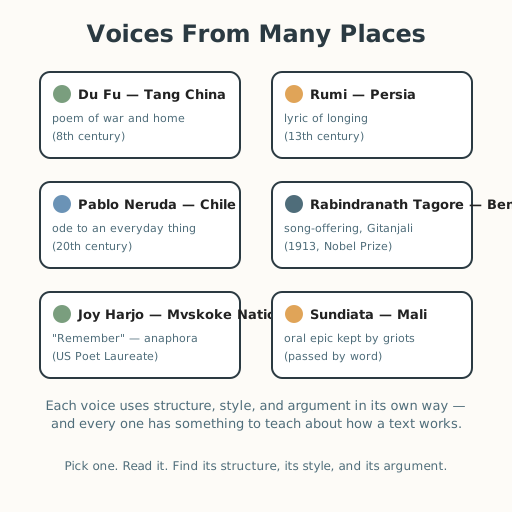
- World-literature gallery cards · 1 set per group Six short texts with brief notes — Du Fu (Tang China, poem), Rumi (Persia, lyric), Neruda (Chile, ode), Tagore (Bengal, Gitanjali lyric), Joy Harjo (Mvskoke Nation, "Remember"), and a Sundiata passage (Mali, oral epic) — each with a faithful translation
- Structure-style-argument sheet · 1 per learner The same three-column tool from Lesson 4, now applied to a chosen text
Low-tech / no-cost
- A shared board or large paper Copy the six short texts by hand and read them aloud; no printed cards needed
- Voice and memory The facilitator reads each text aloud twice; learners choose by ear and analyze from memory with help
Enriched / lab & device
- Audio recordings of the poems · 1 per text Where available, hear the poem in its original language and in translation to feel the style
- A digital anthology · 1 Link to full texts and translations so learners who finish early can read on
Works in different contexts
- large-group Read all six texts once as a gallery walk, then each learner chooses one to analyze and shares one line of insight with the class
- multi-age Younger learners find the main feeling and one repeated phrase; older learners run the full three-column analysis
- self-directed A learner chooses two texts, fills the three columns for each, and writes one paragraph comparing how their styles differ
- level-grouped Learners ready to extend compare a translated poem with another and name what translation may have gained or lost
- outdoor-only Read the texts aloud in a circle outdoors; choose the one whose rhythm suits the open air and say why
Lesson 5 — World Literature Gallery: Structure, Style & Argument Across Cultures
Summary
Learners run the Lesson 4 analysis on a chosen text from world literature — Du Fu, Rumi, Neruda, Tagore, Joy Harjo, or the Sundiata epic — finding each writer’s structure, style, and argument in their own form. The gallery makes visible that the same three tools of text are wielded differently in every language and tradition.
Objectives
- Analyze how a text’s structure, style, and argument work together to create meaning and effect, using a text from a world literature beyond the Western canon. (D04.S2.09.01)
Connection
No single place invented the art of saying something well. For as long as people have gathered, they have made poems and epics and songs — a Tang dynasty poet counting the petals of a spring he may never see again, a Persian mystic longing for the beloved, a Chilean poet celebrating an onion, a Bengali writer offering songs to the world, a Mvskoke poet telling a young person to remember, a West African griot keeping a king’s history alive by word of mouth. Each one orders words, chooses a voice, and makes a claim — each in their own way. Today you walk through this gallery and choose one voice to study closely.
Materials
- World-literature gallery cards
- Structure-style-argument sheet
Preparation
- Copy the gallery cards and the three-column sheet.
- Retrieval: from Lesson 4, recall the three parts — structure, style, argument — and how they combine into meaning and effect. Today we apply the same tool to six texts from six traditions.
Facilitator note
This lesson is written to the learner (“you”). The idea to land: the same three tools — structure, style, argument — are wielded differently in every language and tradition, and reading across cultures is how a mature reader learns that no one way of writing is the “normal” one. The six texts (with faithful, brief translations) are: Du Fu (杜甫, Tang China, 8th c.) — a poem of war and home, whose structure moves from what the eye sees to what the heart fears (S-418); Rumi (Jalāl al-Dīn Rūmī, Persia, 13th c.) — a short lyric of longing whose style is ecstatic address and whose argument is that the heart’s longing points beyond itself (S-419); Pablo Neruda (Chile, 20th c.) — an “ode to an everyday thing,” whose structure elevates a humble object and whose argument is that the small and ordinary are worthy of praise (S-420); Rabindranath Tagore (Bengal, 20th c.) — a lyric from Gitanjali (“song-offerings”), whose style is prayer-like and whose argument is that the divine and the everyday touch (S-421); Joy Harjo (Mvskoke [Creek] Nation, contemporary) — “Remember,” whose structure is a litany of anaphora (“Remember…”) and whose argument is that memory links a person to sky, earth, ancestors, and language (S-422); and a Sundiata passage (Mali, oral epic kept by griots) whose structure is episodic praise and whose argument is that a people’s history lives by being spoken and remembered (S-269). Keep each text short and faithful; treat translation honestly — a translated poem is a re-creation, and something is always gained and lost (note this; do not rank the original above the translation). The global lens is the heart of the lesson: these are living traditions, honored with respectful questions, never specimens (philosophy §4, D04 rationale). The critical-thinking lens: the three-column tool works on all six precisely because structure, style, and argument are near-universal — but their forms are not. The ethics lens: honoring a text from another culture means not flattening it into a “single story” (Lesson 4). The egalitarian lens: a world-literature gallery that includes only one continent is not a gallery — it is a mirror; this set deliberately spans five continents and both oral and written traditions. The technology & environment lens: writing, print, and recording are how these traditions reach us today, while the Sundiata epic reminds us that story lived in memory and voice long before writing — and several of these poems carry their own land, seasons, and weather in their lines.
Procedure
- Recall (5 min). From Lesson 4: what are the three parts of a text, and what do they produce together?
- Walk the gallery (15 min). Read (or hear) all six cards — Du Fu, Rumi, Neruda, Tagore, Joy Harjo, Sundiata. For each, note in one phrase: what is it about, and what form is it (poem, lyric, ode, epic)?
- Choose one (5 min). Pick the text that pulled at you. You will study it closely.
- Run the three columns (20 min). Fill the sheet for your chosen text: structure (how is it ordered — a list? a scene? a litany of “remember”?), style (what words or rhythms repeat? who is speaking?), argument (what claim does it make about the world?).
- Share one line of insight (7 min). In a small group, each person reads one line from their text and names one thing its structure, style, or argument is doing. Listen for how different the voices sound.
- Close (3 min). Six traditions, one tool, six different musics. Next: we put several texts together to form a position of our own.
Differentiation
- Support: Provide a guided version of the sheet with one prompt filled per text (“Harjo’s repeated word is…”).
- Extension: Take two texts and write one paragraph on how their styles differ — and what each style makes you feel that the other does not.
- Non-speaking / AAC: Choose, read, and annotate the text in writing or on a device; share a line by displaying it.
- Deaf / hard of hearing: Work from the written cards; “rhythm” and “voice” are visible on the page in repetition and line breaks, and a signed recitation is a real performance of a text.
Assessment
- Formative (observation): Can the learner locate structure, style, and argument in a text from a tradition they did not already know?
- Peer: Each learner shares one accurate, specific line of insight about their text.
- Portfolio artifact: The completed three-column sheet for the chosen text, kept in the portfolio.
Home connection
Ask someone at home about a song, poem, or saying from your own or another tradition — what does it claim, and how is it said? Bring one example to the next lesson.
Resources
- On the Sundiata epic and the griot tradition: Djibril Tamsir Niane, Sundiata: An Epic of Old Mali (1965) (S-269).
- On the six texts: Du Fu (S-418), Rumi (S-419), Neruda (S-420), Tagore (S-421), Joy Harjo (S-422).
- On explicit instruction and worked examples for skills: Kirschner, Sweller & Clark (2006), https://doi.org/10.1207/s15326985ep4102_1 (S-011).