Lesson 06 — Synthesizing Across Texts: Many Views, One Position
Learners **synthesize four texts on one topic — "home"** — by a Chilean, Palestinian, Mvskoke, and Bengali writer, finding what they share, naming where they differ, and writing one supported position of their own that cites the texts. This moves them from analyzing one text to *speaking for themselves* across several.
Objectives
Objectives
- D04.S2.09.02 Synthesize ideas and evidence from multiple texts on the same topic to form a supported position.
Essential question
How do I bring several texts on one topic into a single, supported position of my own?
Key vocabulary
Materials
Standard materials
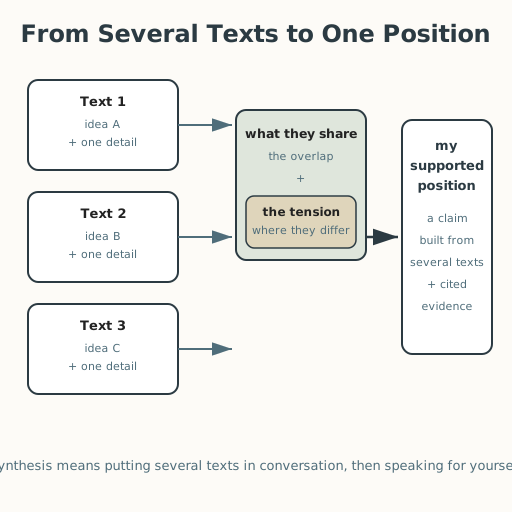
- Multi-text synthesis sheet · 1 per learner An organizer with a column per text, then a "shared ideas" box, a "tension" box, and a line for the learner's own supported position
- Four short texts on "home" · 1 set per group Four short texts on the same topic — a Neruda ode (home in small things), a Mahmoud Darwish poem (home in exile), a Joy Harjo poem (home in ancestors and land), and a Tagore lyric (home as a road) — each with a faithful translation
Low-tech / no-cost
- A shared board or large paper Build the shared-ideas and tension boxes together; learners write their position beneath
- Voice and memory Read the four texts aloud twice; learners hold each in memory and synthesize by discussion
Enriched / lab & device
- A shared writing document · 1 per group Draft and merge the group's synthesized positions into one polished paragraph
- One or two additional texts on "home" · 2 more texts For learners ready for a fifth or sixth source (e.g., a prose memoir passage or another culture's poem)
Works in different contexts
- large-group Analyze the four texts in small groups, then assemble a whole-class shared-ideas list on the board before each learner writes a position
- multi-age Younger learners find the shared idea across two texts; older learners name the tension and write the full synthesis with citations
- self-directed A learner reads all four texts, fills the organizer, and writes a position paragraph that cites at least two of them
- level-grouped Learners ready to extend add a fifth text of their own choosing and fold it into the synthesis
- outdoor-only Read the four texts aloud outside; then gather four real voices nearby (or from memory of home) on "what makes a place home" and synthesize those too
Lesson 6 — Synthesizing Across Texts: Many Views, One Position
Summary
Learners synthesize four texts on one topic — “home” — by a Chilean, Palestinian, Mvskoke, and Bengali writer, finding what they share, naming where they differ, and writing one supported position of their own that cites the texts. This moves them from analyzing one text to speaking for themselves across several.
Objectives
- Synthesize ideas and evidence from multiple texts on the same topic to form a supported position. (D04.S2.09.02)
Connection
No single text tells the whole truth about anything that matters. Ask four people what “home” means and you will get four answers: for one it is the smell of a kitchen, for another the ache of a place they had to leave, for another the land their ancestors walked, for another a road that never quite ends. Each answer is true and each is partial. To form a position of your own — one you can defend — you do not pick your favorite and ignore the rest; you put them in conversation, keep the parts that pull against each other, and then say something that is yours, supported by theirs. Today you do that with four poets.
Materials
- Multi-text synthesis sheet
- Four short texts on “home”
Preparation
- Copy the synthesis sheet and the four texts.
- Retrieval: from Lessons 2 and 4, recall synthesis (many voices → one account) and the three-column reading tool. Today we combine them: many texts → one supported position.
Facilitator note
This lesson is written to the learner (“you”). The idea to land: synthesizing across texts means (1) noting each text’s idea and evidence, (2) naming what they share, (3) holding the tension where they differ — and only then (4) stating a position of your own that cites them. The four texts on “home”: Neruda (Chile) — an ode locating home in humble, loved things; Mahmoud Darwish (Palestine) — a poem locating home in exile and the refusal to be erased from it (S-423); Joy Harjo (Mvskoke) — “Remember” locating home in sky, earth, ancestors, and language (S-422); Tagore (Bengal) — a Gitanjali lyric locating home in the road and the small, everyday meeting (S-421). The shared idea: home is not only a building — it is carried in memory, people, and place. The tension: is home something you have (Neruda’s loved things) or something you can be cut off from (Darwish’s exile)? A mature synthesis holds both: home is precious precisely because it can be lost. This is a skill, so use a worked example of a two-text synthesis first, then let learners add the other two texts (S-011). The critical-thinking lens: a position that ignores the tension is weaker, not stronger — name it. The ethics lens: honor each writer’s meaning; do not bend a poem to fit your position — if a text resists, say so. The egalitarian lens: a Palestinian, a Mvskoke, a Chilean, and a Bengali writer each speak of home; a synthesis that treats any one as “exotic” or any one as “universal default” fails them all. The global lens: “home” is one of the oldest and most widespread themes in human literature — and its meaning changes with each life. The technology & environment lens: a shared document lets a synthesis be written together across distance, and in these four poems “home” is often land and place as much as people — so what is lost with exile or displacement is also a piece of the living world. Keep the texts short and faithful; note that translation is a re-creation (as in Lesson 5). Cite by naming author and title, so a reader can find the poem.
Procedure
- Recall (5 min). From Lesson 2: what is synthesis? From Lesson 4: what are the three parts of a text? Today we synthesize across several texts on one topic.
- Meet the topic (3 min). The topic is home. Before reading, write your own one-line answer: what does home mean to you?
- Read the four texts (15 min). Read (or hear) Neruda, Darwish, Joy Harjo, and Tagore on home. For each, note its idea (what it says home is) and one piece of evidence (a line or image that carries it).
- Find shared ideas and tension (12 min). Fill the two boxes: what they share (the idea all four gesture toward) and the tension (where they pull apart — e.g., home as held vs. home as lost).
- Write your position (15 min). Write one paragraph that begins with your own position, then supports it by citing at least two of the texts by author and title — and names the tension honestly. Keep the line between their words and your judgment clear.
- Peer-check (5 min). Ask a partner: is my position really mine, or just a summary? Did I cite the texts fairly? Did I hold the tension or smooth it over? Fix what is weak.
Differentiation
- Support: Provide a two-text starter — synthesize Neruda and Darwish with a frame before adding the others — and a sentence stem for the position (“Taken together, these poets suggest that home is ___, because ___.”).
- Extension: Add a fifth text on home of your own choosing and fold it into the synthesis, naming what it adds.
- Non-speaking / AAC: The position can be composed in writing or on a device; the synthesis lives in the merging, not in the voice.
- Deaf / hard of hearing: Work from the written texts; cite author and title in writing, and treat a signed rendering of a poem as a legitimate way of meeting the text.
Assessment
- Formative (observation): Can the learner name a shared idea, a real tension, and write one position that cites at least two texts and separates their judgment from the texts’?
- Peer check: Partner confirms the citations are fair and the tension is not smoothed over.
- Portfolio artifact: The completed synthesis sheet with the position paragraph, kept in the portfolio.
Home connection
Bring one short text — a song lyric, a poem, a post — about “home” from a tradition you know or are curious about, and add its one idea to your synthesis.
Resources
- On the four texts: Neruda (S-420), Tagore (S-421), Joy Harjo (S-422), Mahmoud Darwish (S-423).
- On explicit instruction and worked examples for skills: Kirschner, Sweller & Clark (2006), https://doi.org/10.1207/s15326985ep4102_1 (S-011).
- On spaced retrieval: Dunlosky et al. (2013), https://doi.org/10.1177/1529100612453266 (S-039).