Lesson 07 — Writing a Research-Supported Argument: Claim, Evidence, Citation
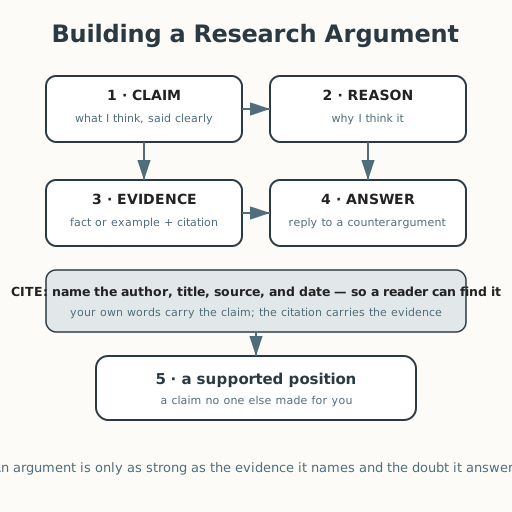
Learners write the first draft of a **research-supported argument**, using a five-part frame — claim, reason, evidence with citation, answer to a counterargument, and a supported position — modeled first, then drafted on a chosen topic with at least two cited sources. They learn to cite so a reader can find the source, in their own words, not a single national style.
Objectives
Objectives
- D04.S3.09.01 Write a research-supported argument that integrates and cites sources and evaluates conflicting evidence.
Essential question
How do I write an argument that integrates and cites sources, not just asserts an opinion?
Key vocabulary
Materials
Standard materials
- Argument-builder sheet · 1 per learner A five-part frame — claim, reason, evidence (with citation), answer to a counterargument, and a supported position — with a worked example on the back
- Topic menu · 1 per learner A short menu of global, grade-appropriate topics (local food waste, school phone rules, water access, public green space, one language's place in a school) each with two to three starter sources
Low-tech / no-cost
- A shared board or large paper Build the worked example together; learners draft by hand on any paper
- A class library or printed articles Two or three printed sources per topic, so research needs no device
Enriched / lab & device
- A device with library or web access · 1 per learner or pair Find and check one additional source for the chosen topic
- A citation tool · 1 A simple reference manager or citation formatter to practice naming sources consistently
Works in different contexts
- large-group Model the worked example to the whole group, then learners draft their own claim and one cited piece of evidence, and pairs swap to check the citation
- multi-age Younger learners write a claim with one cited reason; older learners add the counterargument and the full supported position
- self-directed A learner chooses a topic, gathers two sources, drafts the full five-part argument, and self-checks each source is cited
- level-grouped Learners ready to extend integrate a *third* source that partly disagrees and explain how it qualifies their claim
- outdoor-only Choose an outdoor topic (a local green space, water, shade, waste) and gather evidence by observing and by asking two people, then write the argument by hand
Lesson 7 — Writing a Research-Supported Argument: Claim, Evidence, Citation
Summary
Learners write the first draft of a research-supported argument, using a five-part frame — claim, reason, evidence with citation, answer to a counterargument, and a supported position — modeled first, then drafted on a chosen topic with at least two cited sources. They learn to cite so a reader can find the source, in their own words, not a single national style.
Objectives
- Write a research-supported argument that integrates and cites sources and evaluates conflicting evidence. (D04.S3.09.01)
Connection
An opinion is cheap; an argument is earned. Saying “I think the market should move” costs nothing. Saying “the market should move because the vendors’ own survey shows most customers cannot reach it, and the town’s own report shows the current site floods each rainy season” — that is an argument, because it rests on evidence someone else can check, and it names where that evidence came from. The difference between the two is exactly the difference between a voice people can dismiss and a voice people have to answer. Today you build the second kind.
Materials
- Argument-builder sheet
- Topic menu
Preparation
- Copy the argument-builder sheet and topic menu; assemble the starter sources.
- Retrieval: from Grade 8, recall writing an argument with a claim, reasons, evidence, and a response to a counterargument, and citing sources accurately. Today we add research — finding and integrating real sources — and evaluating conflicting evidence.
Facilitator note
This lesson is written to the learner (“you”). The skill to land: a research-supported argument has five parts — (1) claim (what I think, said clearly); (2) reason (why I think it); (3) evidence (fact or example from a source) with a citation; (4) an answer to a counterargument; and (5) a supported position that is recognizably yours. This is a skill, so use a worked example, then guided practice (S-011). Teach citation generically and globally: a citation names author, title, source, and date so a reader can find the evidence — this is the shared purpose behind every citation style, and we teach the purpose, not one nation’s format (a learner may use the style their region uses). Model the worked example fully — a claim about a real, local, low-heat topic (e.g., “our school should compost its food waste”) with a reason, a cited piece of evidence, and an honest answer to a counterargument. The critical-thinking lens: evidence supports a claim; it does not prove it — teach learners to write “suggests” or “shows,” not “proves” (philosophy §5, §7). The ethics lens: citing is an act of honesty — it separates your words from others’ and gives credit; failing to cite is taking someone else’s work (S-040 on separating one’s words from others’). The egalitarian lens: whose knowledge counts as a citable “source” matters — a local elder’s testimony and a government report are both sources, and a learner’s home-language source is a real source, not a lesser one. The global lens: the topic menu spans many places and stakes, and learners may choose any topic they can research. The technology lens: where a device is available, a source is found and checked online; where not, printed articles and people’s testimony serve the same purpose. Keep the topics real but not explosive; the point is the skill.
Procedure
- Recall (5 min). From Grade 8: what are the parts of an argument, and what does it mean to cite a source accurately?
- Meet the five parts (8 min). Claim → reason → evidence + citation → answer a counterargument → supported position. A citation names author, title, source, date so a reader can find it.
- Study the worked example (10 min). Read the model argument about a real local topic. Trace each of the five parts, and find the citation. Notice the claim uses “suggests,” not “proves.”
- Choose a topic and gather two sources (12 min). Pick from the menu (or propose your own). From the starter sources, note one piece of evidence for your claim and, if you can, one against it.
- Draft your argument (15 min). Write the five parts: your claim, one reason, one cited piece of evidence, one honest answer to a counterargument, and your supported position. Keep your words and your sources’ words visibly separate.
- Peer-check (5 min). Swap with a partner. Can they find your claim, your citation, and your answer to a counterargument? Is each source named well enough to find? Fix what is missing.
Differentiation
- Support: Provide the worked example with the five parts labeled, and a fill-in frame for the draft (“My claim is ___. One reason is ___. A source that supports this is ___ [citation], which shows ___.”).
- Extension: Integrate a source that partly disagrees, and add one sentence explaining how it qualifies (narrows) your claim.
- Non-speaking / AAC: The argument is written; a learner drafts on paper or a device, and citation is done in writing, not speech.
- Deaf / hard of hearing: All drafting is written or typed; pair work can run in sign or text, and the five-part frame is visual.
Assessment
- Formative (observation): Can the learner write a claim, a reason, a cited piece of evidence, and an answer to a counterargument — with their own words clearly separate from the source’s?
- Peer check: Partner confirms the five parts are present and the citation is findable.
- Portfolio artifact: The draft argument, kept in the portfolio (revised in Lesson 8 and reshaped in Lesson 9).
Home connection
Read one news article or post this week and ask: what is the claim, what is the evidence, and does it name where the evidence came from? Bring one observation to the next lesson.
Resources
- On separating one’s own words from others’ and writing with evidence: National Reading Panel (2000), https://www.nichd.nih.gov/research/supported/nrp (S-040).
- On evaluating where information comes from: Common Sense Education, “News & Media Literacy,” https://www.commonsense.org/education/digital-citizenship/topic/news-and-media-literacy (S-063).
- On explicit instruction and worked examples for skills: Kirschner, Sweller & Clark (2006), https://doi.org/10.1207/s15326985ep4102_1 (S-011).