Lesson 08 — Weighing Conflicting Evidence
Learners practice **weighing conflicting evidence**, using four criteria — author, purpose, evidence, and currency — to judge two sources that disagree, then writing a verdict that either leans toward one source or honestly holds the question unsettled. This completes the "evaluates conflicting evidence" half of writing a research-supported argument.
Objectives
Objectives
- D04.S3.09.01 Write a research-supported argument that integrates and cites sources and evaluates conflicting evidence.
Essential question
When sources disagree, how do I weigh them and reach a justified conclusion — or hold uncertainty honestly?
Key vocabulary
Materials
Standard materials
- Evidence-weighing sheet · 1 per learner A four-criterion table — author, purpose, evidence, currency — for judging each of two conflicting sources, with a line for the learner's verdict
- Two-source conflict sets · 1 set per pair Two real-style sources that disagree on the same question (e.g., a study vs. a company claim; an old report vs. a recent one; a news story vs. a social-media post), ready to weigh
Low-tech / no-cost
- A shared board or large paper Build the four-criterion table together; compare the two sources side by side by hand
- Printed articles Two printed sources per conflict, so weighing needs no device
Enriched / lab & device
- A device with web access · 1 per pair Look up each source's author and date, and cross-check a claim against a third independent source
- A fact-checking checklist · 1 per pair A printed or digital checklist (author? purpose? evidence? date? independent confirmation?) to apply systematically
Works in different contexts
- large-group Weigh one conflict set as a whole class on the board, then pairs each weigh a second set and report their verdict
- multi-age Younger learners name the two sources' claims and which is newer; older learners apply all four criteria and write the verdict with justification
- self-directed A learner weighs both sources with the table, writes a verdict paragraph, and states where the evidence remains unsettled
- level-grouped Learners ready to extend cross-check a claim against a third independent source and say whether it confirms or complicates
- outdoor-only Weigh two conflicting claims about a real nearby question (e.g., is the stream safe, is the tree healthy) by observing directly and asking two people
Lesson 8 — Weighing Conflicting Evidence
Summary
Learners practice weighing conflicting evidence, using four criteria — author, purpose, evidence, and currency — to judge two sources that disagree, then writing a verdict that either leans toward one source or honestly holds the question unsettled. This completes the “evaluates conflicting evidence” half of writing a research-supported argument.
Objectives
- Evaluate conflicting evidence when writing a research-supported argument. (D04.S3.09.01)
Connection
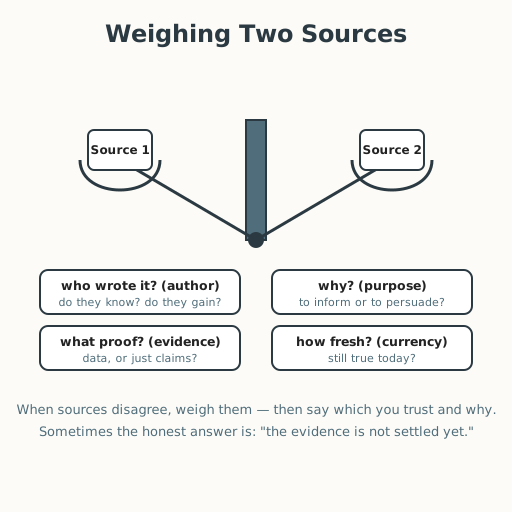
Have you ever read two things that flatly disagree — one says a food is healthy, another says it is not; one says a plan will save money, another says it will waste it? Your first instinct might be to believe the one you already agreed with. That is not weighing; that is choosing. Weighing means asking the same questions of both sides: Who wrote this, and do they have something to gain? Why was it written? What evidence does it actually show? Is it still true today? Sometimes the answers tip the scale; sometimes they leave it balanced, and the honest thing is to say “we do not know yet.” Today you learn to weigh, not just to choose.
Materials
- Evidence-weighing sheet
- Two-source conflict sets
Preparation
- Copy the weighing sheet and conflict sets.
- Retrieval: from Grade 8, recall evaluating a source’s credibility by checking author, purpose, and evidence. Today we apply that to two sources that disagree, and we add the discipline of holding uncertainty when the scale stays balanced.
Facilitator note
This lesson is written to the learner (“you”). The skill to land: when sources disagree, weigh them on four criteria — (1) author (do they know this? do they gain from a certain answer?), (2) purpose (to inform or to persuade?), (3) evidence (data and named facts, or only assertions?), and (4) currency (still true today?) — then state a verdict: lean toward one source with reasons, or hold the question unsettled. This is a skill, so use a worked example, then guided practice (S-011). Model it on one conflict set, showing that weighing is not “the fancier source always wins” — a company’s polished report can lose to a researcher’s plain study on the evidence criterion, and a decades-old figure can lose to a recent one on currency. The critical-thinking lens is the spine of the lesson: a mature mind can hold two contradictory claims at once and judge between them on criteria, not on feeling (philosophy §7). The ethics lens: honest weighing means naming when your own preference is pulling you — and resisting the temptation to let it. The egalitarian lens: power shapes which sources look credible — a well-funded campaign can out-shout a local community’s testimony; weighing fairly means asking whose evidence is being dismissed and why. The global lens: whose knowledge counts as credible has differed across times and places — oral testimony, an elder’s word, a written record — and weighing evidence fairly means not assuming one culture’s standard of proof is the only one. The technology lens: online, speed and polish masquerade as credibility; the same four questions are the antidote, and cross-checking against an independent source is the strongest single move (S-063). Keep the conflict sets real but low-heat, and model the honest third outcome — “the evidence is not settled yet” — as a strength, never a failure (philosophy §11, §5). This lesson feeds Lesson 7’s draft: learners will return to their own argument and weigh its conflicting sources.
Procedure
- Recall (5 min). From Grade 8: how do you check whether a source is credible? Today we use that on two sources that disagree.
- Meet the four criteria (8 min). Author (who, and do they gain?), purpose (inform or persuade?), evidence (data or assertion?), currency (still true?). These are the weights on the scale.
- Study the worked example (10 min). Watch (or read) one conflict set weighed: the same four questions asked of both sources, then a verdict that leans one way for stated reasons — or holds the question open.
- Weigh a conflict set (15 min). With a partner, take a two-source conflict. Fill the table for each source. Then write your verdict in one sentence: which source do you trust more, and on which criterion — or is the question unsettled?
- Cross-check (10 min). If you can, check one disputed claim against a third, independent source. Does it confirm or complicate your verdict? Add one sentence.
- Peer-check (5 min). Ask another pair: did we ask all four questions of both sources, or only the one we liked? Did we state our reasons, or just our preference? Fix what is weak.
Differentiation
- Support: Provide a sentence stem for the verdict (“I trust Source ___ more because on the criterion of ___ it ___.”), and let learners weigh with one criterion at a time.
- Extension: Find a real conflict on the learner’s own Lesson 7 topic and weigh it, then revise their draft to reflect the verdict.
- Non-speaking / AAC: The verdict and table are written; a learner weighs on paper or a device, and pair discussion can run in writing or sign.
- Deaf / hard of hearing: Run pair work in sign or text; the table is visual, and the four criteria can be pointed to as labels.
Assessment
- Formative (observation): Can the learner apply all four criteria to both sources and state a verdict with reasons — including, where warranted, holding the question unsettled?
- Peer check: Another pair confirms both sources were judged on the same criteria and the reasons are stated.
- Portfolio artifact: The completed weighing sheet, kept in the portfolio.
Home connection
Find two things that disagree this week — two reviews, two weather apps, two people’s accounts of the same event — and ask the four questions of each. What tips the scale?
Resources
- On evaluating where information comes from and cross-checking claims: Common Sense Education, “News & Media Literacy,” https://www.commonsense.org/education/digital-citizenship/topic/news-and-media-literacy (S-063).
- On explicit instruction and worked examples for skills: Kirschner, Sweller & Clark (2006), https://doi.org/10.1207/s15326985ep4102_1 (S-011).
- On spaced retrieval: Dunlosky et al. (2013), https://doi.org/10.1177/1529100612453266 (S-039).