Lesson 12 — Capstone: Synthesis & Authorship — Putting It Together
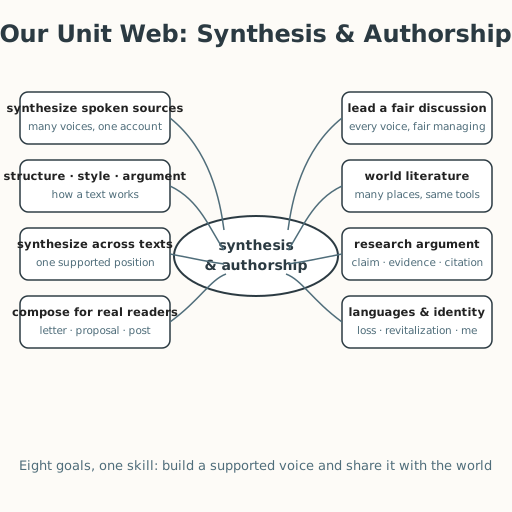
Learners synthesize the unit's **eight goals** into one web around **synthesis and authorship**, recalling each goal, writing one sentence for each, and choosing one to explain fully. This spaced-retrieval pass closes the unit and gathers the portfolio into a single picture of a mature voice.
Objectives
Objectives
- D04.S1.09.01 Synthesize information from multiple spoken sources and present a coherent account or argument.
- D04.S1.09.02 Lead or facilitate a discussion, inviting participation and managing disagreement with fairness.
- D04.S2.09.01 Analyze how a text's structure, style, and argument work together to create meaning and effect.
- D04.S2.09.02 Synthesize ideas and evidence from multiple texts on the same topic to form a supported position.
- D04.S3.09.01 Write a research-supported argument that integrates and cites sources and evaluates conflicting evidence.
- D04.S3.09.02 Compose for real audiences and purposes, such as letters, proposals, or published digital pieces.
- D04.S4.09.01 Explain how a person's languages are part of their identity, and reflect on their own multilingual or monolingual experience.
- D04.S4.09.02 Describe language loss and revitalization, and why protecting languages matters for humanity and the environment.
Essential question
How do all eight goals of this unit fit together as one skill — synthesis and authorship?
Key vocabulary
Materials
Standard materials
- Capstone map sheet · 1 per learner A one-page map of the eight goals with a space to write one sentence for each, centered on "synthesis & authorship"
- Eight goal cards · 1 set per group One card per goal, to sort and connect into a single web
Low-tech / no-cost
- A shared board or large paper Build the eight-goal web together on one big sheet
- Voice and memory Recall each goal aloud from memory before writing, with no cards needed
Enriched / lab & device
- A digital slide or poster tool · 1 per group Build the web digitally and present it
- The full portfolio assembled · 1 per learner Gather the unit's artifacts — synthesis sheet, three-column analyses, argument drafts, real-audience piece, language maps — into one place for a final reflection
Works in different contexts
- large-group Build the web once as a whole class on the board, then each learner completes their own map and shares one goal
- multi-age Younger learners match each goal to one of their artifacts; older learners write the connecting sentence for each and explain the whole web
- self-directed A learner completes the map from memory, self-checks each goal is covered, and writes a one-paragraph summary of the whole unit
- level-grouped Learners ready to extend choose one goal and explain how it connects to at least two others in the web
- outdoor-only Build the web outdoors, and for each goal find or point to something real nearby — a conversation, a sign, a story — that it explains
Lesson 12 — Capstone: Synthesis & Authorship — Putting It Together
Summary
Learners synthesize the unit’s eight goals into one web around synthesis and authorship, recalling each goal, writing one sentence for each, and choosing one to explain fully. This spaced-retrieval pass closes the unit and gathers the portfolio into a single picture of a mature voice.
Objectives
- Recall and connect all eight goals: synthesizing spoken sources, leading a discussion, analyzing structure, style, and argument, reading world literature, synthesizing across texts, writing a research argument, composing for real audiences, and holding languages as identity and as a living inheritance. (D04.S1.09.01, D04.S1.09.02, D04.S2.09.01, D04.S2.09.02, D04.S3.09.01, D04.S3.09.02, D04.S4.09.01, D04.S4.09.02)
Connection
You began this unit remembering what you already knew how to do — analyze one voice, argue one position, give credit for words. You end it able to do something larger: bring many voices into one account, lead a room so every voice is heard, read a text from any tradition with a reader’s tools, weigh evidence that fights, write an argument no one else could write for you, and aim it at a real reader — all while knowing that the languages you carry are part of who you are. Today you stand back and see the whole thing, one web, in your own hands.
Materials
- Capstone map sheet
- Eight goal cards
Preparation
- Copy the capstone map sheet and goal cards; gather each learner’s portfolio artifacts.
- Retrieval: this whole lesson is a retrieval and synthesis pass — the “science of learning” payoff of the unit (S-039). Have the learner’s earlier artifacts on hand.
Facilitator note
This lesson is written to the learner (“you”). It is the closing capstone and synthesis. The goal: each learner recalls all eight goals and connects them into one web around synthesis and authorship. The eight goals are: (1) synthesize multiple spoken sources into one account; (2) lead a discussion that welcomes every voice and manages disagreement fairly; (3) analyze how structure, style, and argument work together; (4) read and analyze texts from world literatures across cultures; (5) synthesize across multiple texts into a supported position; (6) write a research-supported argument that integrates and cites sources and weighs conflicting evidence; (7) compose for real audiences and purposes; (8) explain how languages are part of identity and describe language loss and revitalization, and why protecting languages matters for humanity and the environment. This is a retrieval and spacing moment — having learners recall rather than re-read is what makes the learning durable (S-039). Keep assessment mastery, not ranking: a learner who cannot yet recall a goal revisits that lesson’s artifact and tries again — “not yet” is information, never a verdict (philosophy §8). The four lenses, together: the critical-thinking lens asks what evidence supports each position; the ethics lens asks what is right and who is affected; the egalitarian lens asks who benefits and who is left out — in a discussion, in a source, in a language; the global lens asks how this looks in other places, times, and languages; the environment lens asks what language loss costs the living Earth. Celebrate the collective: each learner’s web is a thread in one class tapestry of voices. This lesson also gathers the portfolio — the unit’s artifacts are the evidence of the learner’s authorship (facilitation.md).
Procedure
- Recall, don’t peek (8 min). Without looking at notes, list the unit’s eight goals from memory. What can you remember? (That is the point — recalling is the learning.)
- Check and fill (5 min). Compare with the eight goal cards. For any goal you missed, open that lesson’s artifact and add it. “Not yet” is not a failure; it is a map of what to revisit.
- Build your web (15 min). On the capstone map, write one sentence for each of the eight goals, and connect each to the center: synthesis & authorship.
- Choose a deep dive (15 min). Pick the one goal that most changed you — or the artifact you are proudest of — and explain it fully to a partner: what it means, what you made, and one way it will matter beyond this unit. Then listen to your partner’s.
- Weave the class web (7 min). As a group, add everyone’s maps to one shared web. Notice how the goals touch: listening feeds reading, reading feeds writing, and every one of them lives in language — the thing that makes us human together.
- Close (5 min). Look at your web and your portfolio. You did not memorize eight facts — you built a voice and learned to share it. Carry it with you.
Differentiation
- Support: Work from the goal cards with their one-line reminders; choose one goal to explain instead of eight.
- Extension: Choose one goal and explain how it connects to at least two others (for example: weighing conflicting evidence strengthens both the research argument and the fairness of a discussion you lead).
- Non-speaking / AAC: The web and the deep-dive can be written, pointed to, or presented on a device; the explanation is in the content, not the voice.
- Deaf / hard of hearing: Present the deep dive in sign, writing, or a visual web; the unit’s goals are the same in a signed as in a spoken language.
Assessment
- Summative (portfolio): The completed capstone map — all eight goals, each with a sentence and a link to the center — kept alongside the unit’s artifacts in the portfolio.
- Self/peer: Learners self-check each goal is present and give one specific “I understood this when you said…” to a partner.
- Mastery, not ranking: A learner missing a goal revisits its artifact and completes it; the web is finished when it is finished, not before.
Home connection
Show someone at home your capstone web and explain one goal end to end — or better, show them your real-audience piece and tell them who it was for. Teaching it is the surest sign you have learned it.
Resources
- On retrieval practice and spacing: Dunlosky et al. (2013), https://doi.org/10.1177/1529100612453266 (S-039).
- On explicit instruction and worked examples for skills: Kirschner, Sweller & Clark (2006), https://doi.org/10.1207/s15326985ep4102_1 (S-011).