Lesson 01 — Mathematics & Reasoning: Where We've Been, Where We're Going
Learners recall four Grade-8 mathematics ideas — rational versus irrational numbers, functions, transformations, and scatter plots — and preview this unit's four strands and eight goals. They meet the unit's organizing idea: mathematics **models** the world, **proves** with reasons, and **reasons honestly** about data, drawn from many traditions and open to everyone.
Objectives
Objectives
- D05.S1.09.01 Work with real numbers, roots, and radicals in expressions and equations, explaining which properties justify each step.
- D05.S2.09.01 Model real situations with linear and exponential functions and interpret slope and intercept in context.
- D05.S3.09.01 Use rigid motions and coordinates to prove and reason about geometric relationships such as congruence.
- D05.S4.09.02 Use two-way tables and conditional relative frequencies to explore relationships between categories, including questions of fairness.
Essential question
What is mathematics as a way of making sense of the world — and where are we going in this unit?
Key vocabulary
Materials
Standard materials
- Unit map sheet · 1 per learner A one-page map of the unit's four strands and eight goals, to mark and return to across the unit
- Recall cards · 1 set per group Cards recalling four Grade-8 ideas — rational vs. irrational, functions, transformations, scatter plots
Low-tech / no-cost
- A shared board or large paper Draw the four strands and eight goals together; no printed map needed
- Voice and memory Recall the Grade-8 ideas aloud as a group instead of using cards
Enriched / lab & device
- A digital slideshow of the four strands · 1 One image or diagram per strand (number, patterns, geometry, data) to preview each
- A wonder box (physical or shared document) · 1 A place to collect every learner's questions about the unit to revisit at the close
Works in different contexts
- large-group Do the recall round as a whole group with hands raised and ideas recorded on the board, then small groups sort the recall cards
- multi-age Younger learners match each recall idea to a picture; older learners state the idea in one sentence and connect it to the new unit
- self-directed A learner reads the unit map, writes four sentences recalling the Grade-8 ideas, and lists one question per strand
- level-grouped Learners ready to extend write a fifth Grade-8 idea not on the cards and explain why it matters here
- outdoor-only Point to a real shape, slope, or pattern outdoors (a roof angle, a tiled floor, a line of trees) and ask what math could describe it
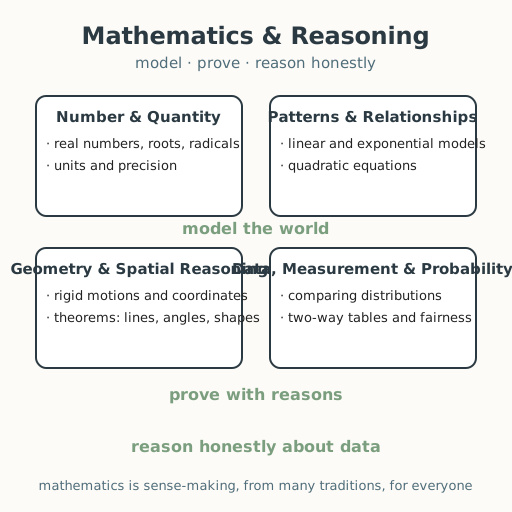
Lesson 1 — Mathematics & Reasoning: Where We’ve Been, Where We’re Going
Summary
Learners recall four Grade-8 mathematics ideas — rational versus irrational numbers, functions, transformations, and scatter plots — and preview this unit’s four strands and eight goals. They meet the unit’s organizing idea: mathematics models the world with functions, proves with reasons, and reasons honestly about data — drawn from many traditions, open to everyone.
Objectives
- Begin to name what real numbers and radicals are, and the idea that every step of a calculation must be justified by a property. (D05.S1.09.01)
- Begin to name what it means to model a real situation with a function. (D05.S2.09.01)
- Begin to name the idea of proof through motion and coordinates. (D05.S3.09.01)
- Begin to name how two-way tables can reveal questions of fairness. (D05.S4.09.02)
Connection
Think of something you have counted, measured, or noticed a pattern in this week — money shared fairly, the time a trip takes, a shape you see every day, a difference you noticed between two groups of people. Every one of those is a doorway into mathematics. Mathematics is not a wall to climb or a gate that sorts people into “good at math” and “bad at math.” It is sense-making: a way of seeing structure in real things. Today we remember what we already know how to do and see where it is taking us.
Materials
- Unit map sheet
- Recall cards
Preparation
- Copy the unit map sheet and recall cards.
- Retrieval: from Grade 8, recall (a) rational versus irrational numbers, (b) functions and function notation, (c) transformations — translations, rotations, reflections, dilations, and (d) scatter plots and informal line-fitting. Today we link those to the new unit.
Facilitator note
This lesson is written to the learner (“you”). It is the unit’s opening and retrieval pass, so the goals are modest: (1) recall four Grade-8 ideas — rational numbers end or repeat while irrational numbers never do, a function is a rule that gives one output for each input, rigid motions move shapes without changing their size and shape, and a scatter plot shows a possible relationship between two quantities; (2) preview the unit’s four strands — number & quantity, patterns & relationships, geometry & spatial reasoning, and data, measurement & probability — and its eight goals; (3) plant the organizing idea: mathematics models with functions, proves with reasons, and reasons honestly about data. Do not try to teach the eight goals today; just name and locate them. The critical-thinking lens: a pattern is not a proof, and association is not causation — that habit carries into the whole unit. The global lens: these same tools were built in Babylon, India, China, Egypt, the Islamic world, and Africa, not one place (S-023, S-024, S-429). The egalitarian lens: mathematics is sense-making open to all — “not yet” is information, never a verdict (philosophy §8, S-009). The ethics lens: mathematics that “reasons honestly” about data is an ethical commitment — a number can be made to lie, and part of this unit is learning not to let it, about others or ourselves (philosophy §5). The technology & environment lens: calculators and computers do arithmetic and store data, but they do not decide what is honest, meaningful, or fair — the human does; and the same tools we will build (models, tables, proofs) are how people measure and care for real things like water, land, energy, and climate. Keep everything held as sense-making, not creed. Spacing note (S-039): this recall pass is what makes the unit’s ideas stick later.
Procedure
- Recall (10 min). In a small group, look at four recall cards: rational vs. irrational, functions, transformations, scatter plots. For each, say in one sentence what you remember from Grade 8.
- Connect the four (5 min). What do all four have in common? (Each is about seeing structure in real things — numbers, change, shape, and data.)
- Meet the map (10 min). Look at the unit map. Four strands: number & quantity, patterns & relationships, geometry & spatial reasoning, data, measurement & probability. Eight goals — two per strand. Read each goal aloud once; don’t worry about understanding them yet.
- Plant the big idea (10 min). The unit’s idea in one breath: mathematics models the world with functions, proves with reasons, and reasons honestly about data. Say it back in your own words.
- Wonder (10 min). Write one question about each strand in the wonder box. Which question do you most want answered by the end of the unit?
- Close (5 min). Today we remembered what we know and saw the road ahead. Next: real numbers, roots, and radicals.
Differentiation
- Support: Give sentence starters for the recall round (“A rational number is one that…”).
- Extension: Add a fifth Grade-8 idea of your own (scientific notation? the Pythagorean theorem?) and say why it will matter in this unit.
Assessment
- Formative (observation): Can the learner recall each Grade-8 idea in one sentence and name the unit’s four strands?
- Artifact: The completed unit map (or the learner’s written recall), kept in the portfolio.
Home connection
Ask someone at home: what is one thing you use math for without thinking about it — cooking, budgeting, measuring, timing? Bring the example (no names needed) to the next lesson.
Resources
- On the history of numerals and mathematics across cultures: Ifrah (2000), The Universal History of Numbers (S-023); Zaslavsky (1999), Africa Counts (S-024); Boyer & Merzbach, A History of Mathematics (S-429).
- On the payoff of spaced retrieval: Dunlosky et al. (2013), https://doi.org/10.1177/1529100612453266 (S-039).
- On explicit instruction and worked examples: Kirschner, Sweller & Clark (2006), https://doi.org/10.1207/s15326985ep4102_1 (S-011).
- On grouping learners by level, not age: Pratham, Teaching at the Right Level (S-009).