Lesson 02 — Real Numbers, Roots & Radicals
Learners build the **real numbers** as rational and irrational together, meet **roots and radicals**, and **simplify** radicals using the product property and perfect squares, justifying each step. They locate √2 and π on a number line and meet the Babylonian tablet that approximated √2 nearly four thousand years ago.
Objectives
Objectives
- D05.S1.09.01 Work with real numbers, roots, and radicals in expressions and equations, explaining which properties justify each step.
Essential question
How do real numbers, roots, and radicals behave, and which properties justify what I do with them?
Key vocabulary
Materials
Standard materials
- Number-line sheet · 1 per learner A blank number line from 0 to 4 with room to mark √2, √3, π, and a few fractions and integers
- Worked-example card · 1 per learner Simplifying √50 = 5√2, fully justified with the product and perfect-square properties
Low-tech / no-cost
- A shared board or large paper Draw the number line and model the simplification; learners copy by hand
- A ruler and a square of paper Fold or draw a 1-by-1 square to feel where √2 lives as a diagonal
Enriched / lab & device
- A calculator or number-line app · 1 per learner Check decimal approximations of √2 and π and see they never settle into a repeating block
- A short image of the Babylonian tablet YBC 7289 · 1 A photograph or reproduction of the clay tablet showing a sexagesimal approximation of √2 from around 1800 BCE
Works in different contexts
- large-group Model the simplification once to the whole group, then pairs place numbers on the number line and justify their placement
- multi-age Younger learners identify the integers and simple roots (√4, √9); older learners simplify radicals and approximate irrationals on the line
- self-directed A learner studies the worked example, simplifies a set of radicals, and self-checks by squaring the answer back
- level-grouped Learners ready to extend prove that √2 is irrational by the classic contradiction argument, or rationalize a denominator
- outdoor-only Use a stick of length 1 and a square drawn in sand to see √2 as the diagonal; measure to feel why it is not a whole number
Lesson 2 — Real Numbers, Roots & Radicals
Summary
Learners build the real numbers as rational and irrational together, meet roots and radicals, and simplify radicals such as √50 = 5√2 using the product property and perfect squares, justifying each step. They locate √2 and π on a number line and meet the Babylonian tablet that approximated √2 nearly four thousand years ago.
Objectives
- Work with real numbers, roots, and radicals in expressions, explaining which properties justify each step. (D05.S1.09.01)
Connection
You already know two families of numbers: rational numbers — fractions like ½ and decimals like 0.75 that end or repeat — and irrational numbers — like √2 and π, whose decimals go on forever without ever settling into a repeating pattern. Put the two families together and you have the real numbers: every number that names a place on a single number line. Today you learn to work with roots and radicals and to say why each step is legal — not by memory, but by a property you can name.
Materials
- Number-line sheet
- Worked-example card
Preparation
- Copy the number-line sheet and worked-example card.
- Retrieval: from Grade 8, recall rational vs. irrational numbers and how to approximate a square root by locating it between two integers.
Facilitator note
This lesson is written to the learner (“you”). The skill to land: a radical √a is the non-negative number whose square is a; real numbers are rational and irrational together; and radicals simplify by two properties — the product property √(ab) = √a·√b (for non-negative a, b) and the fact that √(a²) = a for non-negative a. This is a skill, so use a worked example first, then guided practice (explicit instruction carries skills for novices — S-011). Model √50 = √(25·2) = √25·√2 = 5√2 fully, naming each property, then have learners simplify their own before independent work. The critical-thinking lens: justifying each step with a named property is the seed of proof. The global lens: irrationals were discovered, not invented — Babylonian scribes approximated √2 on the clay tablet YBC 7289 (~1800 BCE) to about six decimal places, and the idea that √2 cannot be written as a ratio of whole numbers shook Greek mathematics (S-429, S-430). The ethics/egalitarian lens: the name “irrational” once meant “unsayable,” and people were uncomfortable — but an irrational number is not broken or wrong; it is a real number like any other. Mathematics is sense-making open to all; naming a property is not a gate, it is a tool everyone can pick up. The technology lens: a calculator shows √2 and π to many digits but never the whole non-repeating decimal — the machine’s display is finite while the number is not, so the human must know what the display actually means. Keep the “is it rational?” question a matter of evidence (does the decimal repeat?), not authority.
Procedure
- Recall (5 min). From Grade 8: what is the difference between a rational and an irrational number? Name one of each.
- Meet roots and radicals (8 min). √a is the non-negative number whose square is a. So √9 = 3 because 3² = 9. The number under the sign is the radicand; the whole sign is a radical. A perfect square (1, 4, 9, 16, 25, …) has a whole-number square root. √2 is not a perfect square, so √2 is irrational.
- Study the worked example (12 min). Simplify √50. Step 1: write 50 as a product with the largest perfect square you can find — 50 = 25 · 2. Step 2: apply the product property — √(25·2) = √25 · √2. Step 3: replace √25 with 5 — √25 · √2 = 5√2. Check by squaring back: (5√2)² = 25 · 2 = 50. ✓
- Guided practice (15 min). With a partner, simplify √8, √18, √32, and √75. For each, name the property you used and check by squaring back.
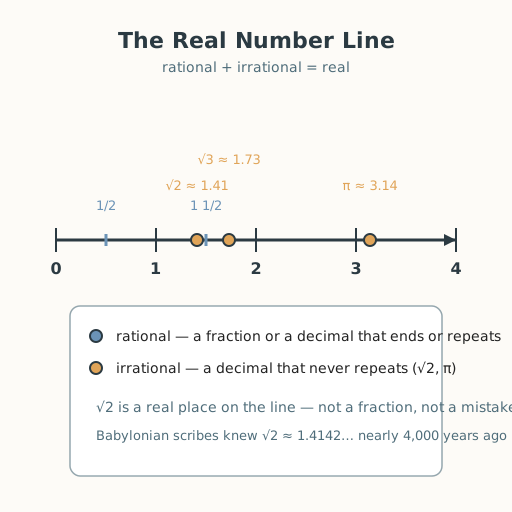
- Locate on the line (10 min). On the number-line sheet, place 0, 1, 2, 3, 4, ½, and 1½. Then place √2 (about 1.41), √3 (about 1.73), and π (about 3.14). Say which are rational and which are irrational.
- Close (5 min). One new idea to carry: an irrational number is not a mistake — it is a real place on the line that no fraction can land on exactly.
Differentiation
- Support: Give a list of perfect squares (1–144) to use while simplifying; start with √12 = √(4·3).
- Extension: Prove √2 is irrational by contradiction (assume √2 = p/q in lowest terms, square both sides, and reach a contradiction about even numbers).
Assessment
- Formative (observation): Can the learner simplify √50 to 5√2 and name the product property?
- Portfolio artifact: The completed number line with √2, √3, and π placed and labeled, kept in the portfolio.
Home connection
Find one square at home (a tile, a window, a phone screen). Measure its side; use the side length to predict its diagonal as a radical, then measure the diagonal and compare.
Resources
- On the Babylonian approximation of √2 (tablet YBC 7289): Wikipedia, “YBC 7289,” https://en.wikipedia.org/wiki/YBC_7289 (S-430).
- On the history of irrational numbers across traditions: Boyer & Merzbach, A History of Mathematics (S-429).
- On explicit instruction and worked examples: Kirschner, Sweller & Clark (2006), https://doi.org/10.1207/s15326985ep4102_1 (S-011).