Lesson 03 — Radical Equations: Justifying Every Step
Learners **solve radical equations** such as √(x+1) = 3 and √(2x−3) = x−3 by isolating the radical, squaring both sides, and **justifying each step with a property**. They discover that squaring can introduce an **extraneous solution**, and that the final check is not optional — it is part of honest mathematics.
Objectives
Objectives
- D05.S1.09.01 Work with real numbers, roots, and radicals in expressions and equations, explaining which properties justify each step.
Essential question
How do I solve equations with radicals, and how do I check that a "solution" is real?
Key vocabulary
Materials
Standard materials
- Justification-column sheet · 1 per learner A two-column template — "step" and "property that justifies it" — for solving radical equations
- Worked-example card · 1 per learner Solving √(x+1) = 3 and √(2x−3) = x−3 with each step justified and the second checked for extraneous solutions
Low-tech / no-cost
- A shared board or large paper Model the two-column solution; learners copy the template by hand
- Voice and a partner Talk through each step aloud, naming the property, before writing
Enriched / lab & device
- A graphing tool or calculator · 1 per learner Graph y = √(2x−3) and y = x−3 to see why one algebraic "solution" does not appear on the graph
- A short image of al-Khwarizmi's geometric "completing the square" · 1 A reproduction showing how early algebra was argued with shapes, not just symbols
Works in different contexts
- large-group Model the two-column solution once to the whole group, then pairs solve their own and read their justification aloud
- multi-age Younger learners solve √x = 4 and √x = 9; older learners handle two radicals and extraneous solutions
- self-directed A learner works the two-column sheet, then self-checks every answer by substituting it back into the original equation
- level-grouped Learners ready to extend solve √(x+3) + 2 = x and explain precisely where the extraneous solution sneaks in
- outdoor-only Frame the skill with a real question — a square garden plot of area 25 m² has side √25; ask what equation a side of 6 m would solve
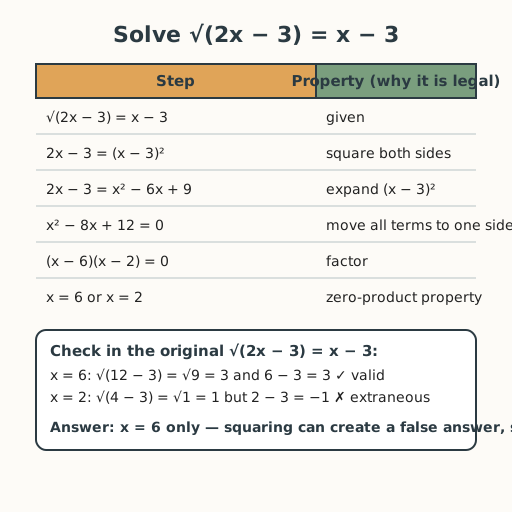
Lesson 3 — Radical Equations: Justifying Every Step
Summary
Learners solve radical equations such as √(x+1) = 3 and √(2x−3) = x−3 by isolating the radical, squaring both sides, and justifying each step with a property. They discover that squaring can introduce an extraneous solution, and that the final check is not optional — it is part of honest mathematics.
Objectives
- Work with real numbers, roots, and radicals in equations, explaining which properties justify each step. (D05.S1.09.01)
Connection
If someone told you a square garden plot has an area of 25 square meters and asked how long its side is, you would think “a number whose square is 25” — that is √25 = 5 meters. That tiny move — turning “the square is 25” into “the side is 5” — is exactly what solving a radical equation does, but in reverse: it undoes a square root. Today you learn to undo roots honestly, checking your answer instead of trusting it, because sometimes the algebra hands you a number that does not actually fit.
Materials
- Justification-column sheet
- Worked-example card
Preparation
- Copy the justification-column sheet and worked-example card.
- Retrieval: from Grade 8, recall how to solve linear equations and how squaring and taking the square root undo each other.
Facilitator note
This lesson is written to the learner (“you”). The skill to land: to solve a radical equation, (1) isolate the radical on one side; (2) square both sides (or raise to the power that matches the root) to undo it; (3) solve the resulting equation; (4) substitute every candidate answer back into the original equation, because squaring can create an extraneous solution — a number that solves the squared equation but not the original. This is a skill, so use a worked example first, then guided practice (S-011). Model √(x+1) = 3 first (clean), then √(2x−3) = x−3, which produces two candidates, x = 6 and x = 2, of which only x = 6 checks. The critical-thinking lens: the check is what separates “I did algebra” from “I know it is true.” The ethics lens: honesty about extraneous solutions is honesty about evidence — do not keep an answer just because the algebra produced it (philosophy §5). The global lens: solving by “undoing” and justifying steps with properties descends from the algebraic tradition named by al-Khwarizmi, whose title gave us the word algebra (from al-jabr, “the reuniting”); early arguments were carried by pictures as much as symbols (S-429, S-431). The egalitarian lens: checking every answer is a habit open to everyone — no “math gift” is required, only care; “not yet” — a step that needs fixing — is information, never a verdict (philosophy §8). The technology lens: a graphing tool can show why an extraneous solution does not appear on the graph, but it confirms the check — it does not replace the honest habit of substituting the answer back into the original equation.
Procedure
- Recall (5 min). From Grade 8: how do you undo addition? (subtract) Multiplication? (divide) A square? (take the square root). What undoes a square root? (squaring).
- Study the worked example (12 min). Solve √(x+1) = 3. Step 1: the radical is already isolated. Step 2: square both sides — x + 1 = 9. Step 3: subtract 1 — x = 8. Check: √(8+1) = √9 = 3. ✓
- Meet the trap (15 min). Solve √(2x−3) = x−3. Square both sides: 2x − 3 = (x−3)² = x² − 6x + 9. Rearrange to zero: x² − 8x + 12 = 0. Factor: (x−6)(x−2) = 0. Candidates: x = 6 or x = 2. Check each in the original. x = 6: √(12−3) = √9 = 3 and 6−3 = 3. ✓. x = 2: √(4−3) = √1 = 1, but 2−3 = −1. ✗. So x = 2 is extraneous — it appeared when we squared, but it does not solve the original. The answer is x = 6 only.
- Guided practice (15 min). With a partner, solve √(x+2) = 4 and √(x−1) = x−3 using the two-column sheet. Name the property at each step and check every answer.
- Peer-check (5 min). Swap sheets. Did each step have a property? Was every candidate checked in the original equation?
- Close (3 min). Squaring can open a door to false answers. Checking is not a formality — it is how you know.
Differentiation
- Support: Begin with √x = 4 and √x = 9 (no rearrangement needed), then add one step at a time.
- Extension: Solve √(x+3) + 2 = x and explain, in words, exactly where the extraneous solution appears.
Assessment
- Formative (observation): Can the learner justify each step with a property and correctly reject the extraneous solution in √(2x−3) = x−3?
- Portfolio artifact: One fully checked two-column solution, kept in the portfolio.
Home connection
Make up a radical equation for someone at home (start simple: √x = 5), have them solve it, then show them the check — and explain why checking matters.
Resources
- On al-Khwarizmi and the origin of the word algebra: Wikipedia, “Muhammad ibn Musa al-Khwarizmi,” https://en.wikipedia.org/wiki/Muhammad_ibn_Musa_al-Khwarizmi (S-431).
- On the history of algebraic methods: Boyer & Merzbach, A History of Mathematics (S-429).
- On explicit instruction and worked examples: Kirschner, Sweller & Clark (2006), https://doi.org/10.1207/s15326985ep4102_1 (S-011).