Lesson 04 — Units & Precision: Making Numbers Honest
Learners **choose units and a level of precision** for a real measurement, distinguishing **precision** (how fine the markings are) from **accuracy** (how close to the true value), and interpret what each level of precision is honest for. They meet the global reach of the metric system and the many unit systems people have used, and learn that over-precision is a kind of dishonesty.
Objectives
Objectives
- D05.S1.09.02 Choose appropriate units and levels of precision when measuring and calculating, and interpret the results in context.
Essential question
How do I choose units and a level of precision that make a measurement or calculation honest in context?
Key vocabulary
Materials
Standard materials
- Measuring sheet · 1 per learner A sheet for recording a length measured with three different rulers (e.g., a meter stick, a 30 cm ruler, and a hand span) and the precision of each
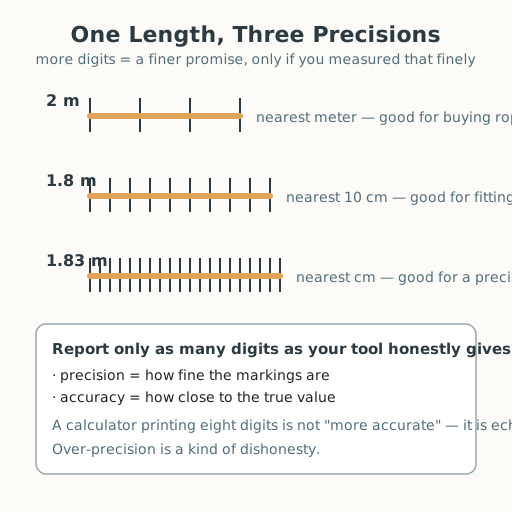
- Worked-example card · 1 per learner The same distance reported at three precisions — 2 m, 1.8 m, 1.83 m — with a note on what each is good for
Low-tech / no-cost
- Found measuring tools A hand span, a pace, a stick — any repeatable unit; measure the same distance three ways
- A shared board or large paper Record each measurement and its precision side by side
Enriched / lab & device
- Rulers of different graduations and a calculator · 1 set per group Measure the same length with a coarse and a fine ruler; compare the last trustworthy digit
- A map or satellite-image tool · 1 Estimate a real distance (a road, a field) and discuss how precise the estimate can honestly be
Works in different contexts
- large-group Measure one classroom object as a whole group, recording each tool's precision on the board, then pairs measure their own
- multi-age Younger learners measure with a hand span or pace; older learners add significant figures and interpret the last digit
- self-directed A learner measures one distance three ways, records the precision of each, and writes which precision the task really needs
- level-grouped Learners ready to extend compute with measurements and round the answer to the correct number of significant figures
- outdoor-only Measure a real outdoor distance — a path, a shadow, the span of a tree's shade — with a pace, a stick, and (if available) a tape, comparing precision
Lesson 4 — Units & Precision: Making Numbers Honest
Summary
Learners choose units and a level of precision for a real measurement, distinguishing precision (how fine the markings are) from accuracy (how close to the true value), and interpret what each level of precision is honest for. They meet the global reach of the metric system and the many unit systems people have used, and learn that over-precision is a kind of dishonesty.
Objectives
- Choose appropriate units and levels of precision when measuring and calculating, and interpret the results in context. (D05.S1.09.02)
Connection
Say a friend asks how far you walked to school. “Two kilometers” is honest. “Two point zero zero zero kilometers” is not — unless you actually measured to the nearest meter. Every number you report carries a hidden promise about how carefully you measured. A number with too many digits promises more than you know, and a number with too few throws away information you had. Today you learn to choose units and precision so your numbers tell the truth about what you actually know.
Materials
- Measuring sheet
- Worked-example card
Preparation
- Copy the measuring sheet and worked-example card.
- Retrieval: from Grades 5–8, recall converting among units (metric and others) and rounding.
Facilitator note
This lesson is written to the learner (“you”). The skill to land: precision is how fine your measuring tool’s markings are; accuracy is how close your result is to the true value; the last digit you report is the one you are sure about, and you choose units and precision to match what the situation needs. Use a worked example first (S-011): the same distance reported as “2 m” (one significant figure, fine for ordering a rope), “1.8 m” (two, fine for fitting a desk), and “1.83 m” (three, fine for a precise cut). The critical-thinking lens: a number’s digits are a claim about measurement, and we should read them that way. The ethics lens: over-precision is dishonesty in disguise — a calculator that prints eight digits is not “more accurate,” it is just echoing noise; choosing honest precision is an act of truthfulness (philosophy §5). The global lens: the metric system, built on shared base units, is used nearly everywhere because its conversions are powers of ten, while people have long used many other honest systems — the cubit, the pace, the li, the mile — each matched to its tasks (S-429). The egalitarian lens: honest measurement belongs to everyone and needs no special equipment; a hand span or a pace is a real unit. For a learner who cannot see the ruler markings, use a tactile measure instead — a rope with knots, a notched or Braille ruler, or a partner who reads the markings aloud — and let pace-counting or hand spans carry the same lesson; the idea (match your digits to what you actually know) is fully non-visual. The technology lens: digital tools over-report digits, so the human’s job is to decide what is meaningful, not to copy the screen.
Procedure
- Recall (5 min). From Grades 5–8: what is the difference between meters and kilometers? What does it mean to round 1.827 to two decimal places?
- Meet precision vs. accuracy (8 min). Precision = how fine the markings are. Accuracy = how close to the true value. A coarse ruler can be accurate; a fine ruler can be precise. They are different things.
- Study the worked example (10 min). The same length reported three ways: 2 m (nearest meter — fine for buying rope), 1.8 m (nearest 10 cm — fine for fitting a desk), 1.83 m (nearest cm — fine for cutting a shelf). Each extra digit promises a finer measurement. Report only as many digits as your tool honestly gives you.
- Measure three ways (15 min). Choose one real distance (a desk, a doorway, a wall). Measure it with three tools — a meter stick, a 30 cm ruler, and a hand span or pace. On the measuring sheet, record each result with the right number of digits for that tool, and note what each precision is good for.
- Interpret in context (10 min). For each measurement, ask: would this precision matter if I were (a) estimating paint for a wall, (b) cutting a shelf to fit, (c) telling a friend roughly how big the room is? Write which precision you would choose and why.
- Close (5 min). A number is a promise. Choose your digits so the promise matches what you actually know.
Differentiation
- Support: Provide a fill-in table (tool → smallest marking → example result with correct digits).
- Extension: Do a small calculation with measured numbers (e.g., area of a rectangle) and round the answer to the number of significant figures the measurements justify.
Assessment
- Formative (observation): Can the learner state a result with a number of digits that matches the tool, and explain which precision a real task needs?
- Portfolio artifact: The completed measuring sheet, kept in the portfolio.
Home connection
Measure the same thing at home two ways (a ruler and a step or hand span) and write both results with honest precision. Which precision would you use to order something that must fit?
Resources
- On the history of measurement and unit systems: Boyer & Merzbach, A History of Mathematics (S-429).
- On explicit instruction and worked examples: Kirschner, Sweller & Clark (2006), https://doi.org/10.1207/s15326985ep4102_1 (S-011).