Lesson 06 — Slope & Intercept in Context
Learners **read slope and intercept in context**, interpreting the slope of a linear model as a **rate of change** (so much per unit) and the intercept as a **starting value**, and use those meanings to compare real choices — which offer is cheaper, which job pays better. They connect slope-as-rate to questions of fairness.
Objectives
Objectives
- D05.S2.09.01 Model real situations with linear and exponential functions and interpret slope and intercept in context.
Essential question
What do the slope and the intercept of a linear model mean in a real situation, and what do they tell me to decide?
Key vocabulary
Materials
Standard materials
- Context-reading sheet · 1 per learner A sheet with three linear situations (a fare, a temperature, a wage) to read slope and intercept from, in words and numbers
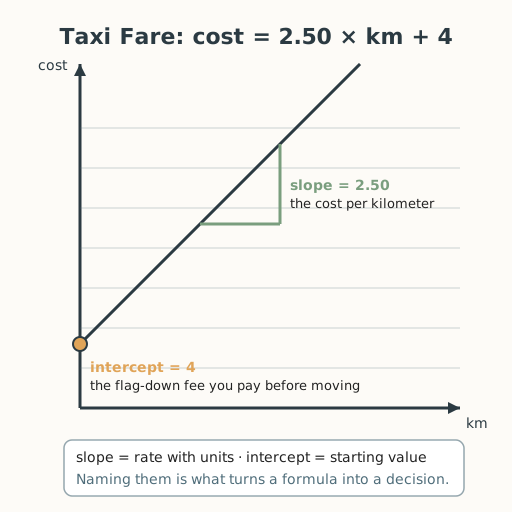
- Worked-example card · 1 per learner A taxi fare modeled as y = 2.50x + 4, with slope (cost per kilometer) and intercept (flag-down fee) named in context
Low-tech / no-cost
- A shared board or large paper Model reading the slope and intercept of one situation; learners do the rest by hand
- Voice and a partner Say aloud, in everyday words, what the slope means in each situation before writing
Enriched / lab & device
- A graphing tool · 1 per learner Graph each situation and slide the slope and intercept to see the line change meaning
- A small table of a real public fare or pay rate · 1 Read a real advertised price (a bus fare, a data plan) and model its fixed and per-unit parts
Works in different contexts
- large-group Read one situation aloud together, then pairs read the rest and share one slope and one intercept each
- multi-age Younger learners find the starting value; older learners compute the slope as a rate and interpret it
- self-directed A learner reads each situation, writes the meaning of slope and intercept in a full sentence, and self-checks against the worked example
- level-grouped Learners ready to extend compare two competing offers (two lines) and explain, using slopes and intercepts, when one is cheaper
- outdoor-only Model something visible outdoors — a slope of a hill, a shadow lengthening — and name its rate of change and starting value
Lesson 6 — Slope & Intercept in Context
Summary
Learners read slope and intercept in context, interpreting the slope of a linear model as a rate of change (so much per unit) and the intercept as a starting value, and use those meanings to compare real choices — which offer is cheaper, which job pays better. They connect slope-as-rate to questions of fairness.
Objectives
- Model real situations with linear and exponential functions and interpret slope and intercept in context. (D05.S2.09.01)
Connection
Most things you pay for have two parts: a fixed part you pay no matter what, and a part that grows with how much you use. A phone plan might charge a base fee plus so much per minute; a taxi charges a flag-down fee plus so much per kilometer. The fixed part is the intercept; the per-unit part is the slope. Once you can name those two numbers in a real situation, you can compare offers and see who benefits — which is the beginning of spotting fairness.
Materials
- Context-reading sheet
- Worked-example card
Preparation
- Copy the context-reading sheet and worked-example card.
- Retrieval: from Grade 8, recall the form y = mx + b and how to compute a rate of change from a table or graph.
Facilitator note
This lesson is written to the learner (“you”). The skill to land: in a linear model y = mx + b, the slope m is the rate of change — the amount the output changes per one unit of the input — and the intercept b is the starting value — the output when the input is zero. Use a worked example first (S-011): a taxi fare y = 2.50x + 4, where the slope 2.50 is “cost per kilometer” and the intercept 4 is “the flag-down fee you pay before moving.” The critical-thinking lens: units on the slope (“money per kilometer,” “degrees per hour”) are what give the number meaning — a slope without units is a number without a story. The egalitarian lens: two workers doing the same job at different hourly rates (different slopes) earn more and more apart over time, and a job with no base pay (intercept 0) leaves a worker with nothing when work stops — slope and intercept are where fairness shows up in a line. The global lens: reading a rate (“per liter,” “per kilometer,” “per hour”) is the same act in every market and every country. The ethics lens: naming a slope and intercept honestly — not hiding a fee in the fine print or inflating a rate — is an act of truthfulness, the same honesty we met with precision (philosophy §5). The technology & environment lens: a rate like “liters per kilometer” or “energy per hour” is where a line meets the environment — the same slope that models a fare also models fuel use and emissions, so reading the rate is reading our effect on the Earth. Have learners say the meaning aloud in everyday words, not just compute the numbers.
Procedure
- Recall (5 min). From Grade 8: in y = mx + b, which letter is the rate of change, and which is where the line starts?
- Study the worked example (10 min). A taxi charges a flag-down fee of 4 and then 2.50 per kilometer. Model: cost = 2.50 × (kilometers) + 4, or y = 2.50x + 4. The slope 2.50 is the cost per kilometer (the rate). The intercept 4 is the flag-down fee (what you pay even at zero kilometers).
- Read three situations (15 min). On the context-reading sheet: (a) a wage of 15 per hour with a 40 bonus — slope 15 = pay per hour, intercept 40 = the bonus; (b) temperature starting at 5°C and rising 2°C per hour — slope 2 = degrees per hour, intercept 5 = starting temperature; (c) a water tank holding 300 L and draining 20 L per minute — slope −20 = liters lost per minute, intercept 300 = starting volume. For each, write the model and the meaning of slope and intercept in a full sentence.
- Compare two offers (15 min). Two data plans: Plan A charges 20 plus 1.50 per gigabyte; Plan B charges 10 plus 2.00 per gigabyte. Write both models. Which has the lower slope? Which the lower intercept? Explain, in words, who each plan is cheaper for (someone who uses little data vs. a lot).
- Peer-check (5 min). Swap sheets. Did each slope carry its units? Did each intercept name a real starting value?
- Close (5 min). A slope is a rate with a story; an intercept is a starting point. Naming them in context is what turns a formula into a decision.
Differentiation
- Support: Provide sentence frames (“The slope means ___ per ___; the intercept means ___ when ___ is zero.”).
- Extension: Graph both data plans and find, using slopes and intercepts, the exact amount of data at which the two plans cost the same.
Assessment
- Formative (observation): Can the learner state the slope as a rate with units and the intercept as a starting value for a new situation?
- Portfolio artifact: The completed context-reading sheet, kept in the portfolio.
Home connection
Find a real price at home or nearby with a fixed and a per-unit part (an electricity bill, a ride, a phone plan) and write its model, naming the slope and intercept.
Resources
- On explicit instruction and worked examples: Kirschner, Sweller & Clark (2006), https://doi.org/10.1207/s15326985ep4102_1 (S-011).
- On rates and fairness in real data: Our World in Data, https://ourworldindata.org/ (S-006).