Lesson 04 — Biodiversity: Why Variety Keeps Ecosystems Strong
Learners describe **biodiversity** — the variety of living things — and explain why it matters: a **diverse ecosystem is resilient** because many species can do each job, so losing one does not collapse the whole, while a **monoculture** concentrates risk. They connect variety to **human well-being** — food, water, medicine, and climate.
Objectives
Objectives
- D06.S2.09.02 Describe biodiversity and explain why it matters for resilient ecosystems and human well-being.
Essential question
What is biodiversity, and why does it matter for resilient ecosystems and human well-being?
Key vocabulary
Materials
Standard materials
- Resilience comparison sheet · 1 per learner Two side-by-side ecosystems — a diverse one and a monoculture — to annotate with what happens when one kind is removed
- Biodiversity case cards · 1 set per group Short cases (a coral reef, a rice field, a forest, a grassland) naming the species and the human benefit each provides
Low-tech / no-cost
- A shared board or large paper Draw the diverse-versus-monoculture contrast together and list the benefits each ecosystem gives people
- Voice and a partner Tell the story of one ecosystem's variety and what it gives the people who depend on it
Enriched / lab & device
- A biodiversity database or species map (e.g., a national or global biodiversity site) · 1 per group Look up the species richness of two real places and compare
- A short film on a real ecosystem under pressure and its restoration · 1 Trace how variety — or its loss — shaped the outcome
Works in different contexts
- large-group Model the diverse-versus-monoculture contrast once, then groups read one case and report the human benefit of variety
- multi-age Younger learners count and list the different living things in a picture; older learners explain why losing one kind matters more in a monoculture
- self-directed A learner annotates both panels, then writes one paragraph on why variety matters for people
- level-grouped Learners ready to extend analyze the trade-offs of a monoculture (high yield now, fragile later) against a diverse system
- outdoor-only In one small patch, count how many different kinds of living things you can find, and ask what each contributes
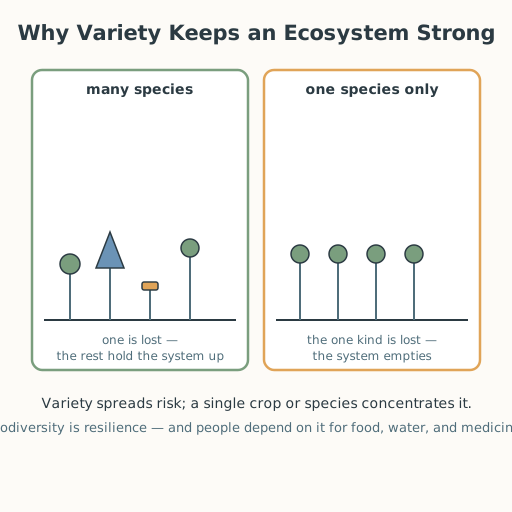
Lesson 4 — Biodiversity: Why Variety Keeps Ecosystems Strong
Summary
Learners describe biodiversity — the variety of living things — and explain why it matters: a diverse ecosystem is resilient because many species can do each job, so losing one does not collapse the whole, while a monoculture concentrates risk. They connect variety to human well-being — food, water, medicine, and climate.
Objectives
- Describe biodiversity and explain why it matters for resilient ecosystems and human well-being. (D06.S2.09.02)
Connection
Picture a market with a hundred different stalls. If one stall closes, you still have bread, fish, and fruit. Now picture a market with only one stall selling one thing; if it closes, the market is empty. An ecosystem works the same way. Biodiversity — the variety of living things — is like a many-stalled market. It spreads risk, so the system can bend without breaking. And people are not outside this market: our food, water, medicine, and air all come from it.
Materials
- Resilience comparison sheet
- Biodiversity case cards
Preparation
- Copy the resilience comparison sheet and case cards.
- Retrieval: from Grade 7, recall species relationships (predation, competition, symbiosis); from Grade 8, recall how one changed population ripples through an ecosystem.
Facilitator note
This lesson is written to the learner (“you”). The idea to land: biodiversity is the variety of living things — within a species, between species, and across ecosystems; it matters because (1) a diverse ecosystem is resilient — many species perform similar roles, so if one is lost, others hold the system up; and (2) human well-being depends on it directly — food, clean water, medicine, pollination, and a stable climate all come from living variety. Use a worked example first (S-011): the diverse-versus-monoculture contrast — in a field of one crop, a single disease can wipe out everything, while a mixed system keeps producing. The environment lens: biodiversity loss is a shared, documented concern — the authoritative international assessment (IPBES) reports that many species are declining and that this is driven by land and sea use change, overexploitation, climate change, pollution, and invasive species (S-437). The egalitarian lens: the people who depend most directly on wild biodiversity — small farmers, fishers, and Indigenous communities — are often the least responsible for its loss and the first to suffer it, so protecting biodiversity is inseparable from fairness (S-437; also FAO on biodiversity for food and agriculture, S-178). The ethics lens: variety is not only useful — there is a case, held by many peoples, that other species deserve care for their own sake, not only for what they give us; hold this as a value, distinct from the ecological facts. The global lens: biodiversity is distributed unevenly across the Earth — tropical forests and coral reefs hold outsized shares — so its stewardship is a worldwide, not a local, task (S-220, S-218). Cite IPBES (S-437), CBD (S-279), FAO (S-220), and WWF (S-218); keep numbers hedged.
Procedure
- Recall (5 min). From Grade 7 and 8: name three kinds of relationships between species. What happens when one population changes?
- Meet biodiversity (8 min). Biodiversity is the variety of living things — among individuals, between species, and across whole ecosystems.
- Model resilience (12 min). Worked example: compare a diverse ecosystem (many species doing each job) with a monoculture (one crop). Remove one kind from each. In the diverse system, others fill the gap; in the monoculture, the system empties. Annotate the sheet.
- Read the case cards (12 min). Each card names an ecosystem and the benefits its variety gives people — a coral reef (food, coastal protection), a forest (medicine, carbon storage), a grassland (grazing, soil), a rice field (food, water). List the human benefit of variety in each.
- Connect variety to well-being (10 min). Write one sentence per case: “If ___ loses its variety, people lose ___.”
- Close (8 min). Variety is not decoration; it is the load-bearing frame of the living world — and of the human world built on it.
Differentiation
- Support: Provide a picture of one diverse ecosystem; the learner lists the different living things and one benefit people get from each.
- Extension: Write a short argument weighing the high short-term yield of a monoculture against its fragility, and propose how to hedge the risk.
Assessment
- Formative (observation): Can the learner define biodiversity and give one ecological reason and one human reason it matters?
- Portfolio artifact: The annotated resilience comparison sheet, kept in the portfolio.
Home connection
Look at a meal or a garden. How many different living things are in it? Ask: if one of them disappeared, what would the rest — and the people who eat it — lose?
Resources
- On biodiversity loss and its drivers and consequences: IPBES, Global Assessment Report on Biodiversity and Ecosystem Services, https://www.ipbes.net/ (S-437).
- On biodiversity as the foundation of life and the global framework to halt its loss: Convention on Biological Diversity, https://www.cbd.int/ (S-279).
- On forests as home to much of the world’s land species and biodiversity for food and agriculture: FAO Forestry, https://www.fao.org/forestry/en/ (S-220); FAO CGRFA, https://www.fao.org/cgrfa/en/ (S-178).
- On biodiversity across habitats: WWF, https://www.worldwildlife.org/ (S-218).
- On explicit instruction and worked examples: Kirschner, Sweller & Clark (2006), https://doi.org/10.1207/s15326985ep4102_1 (S-011).